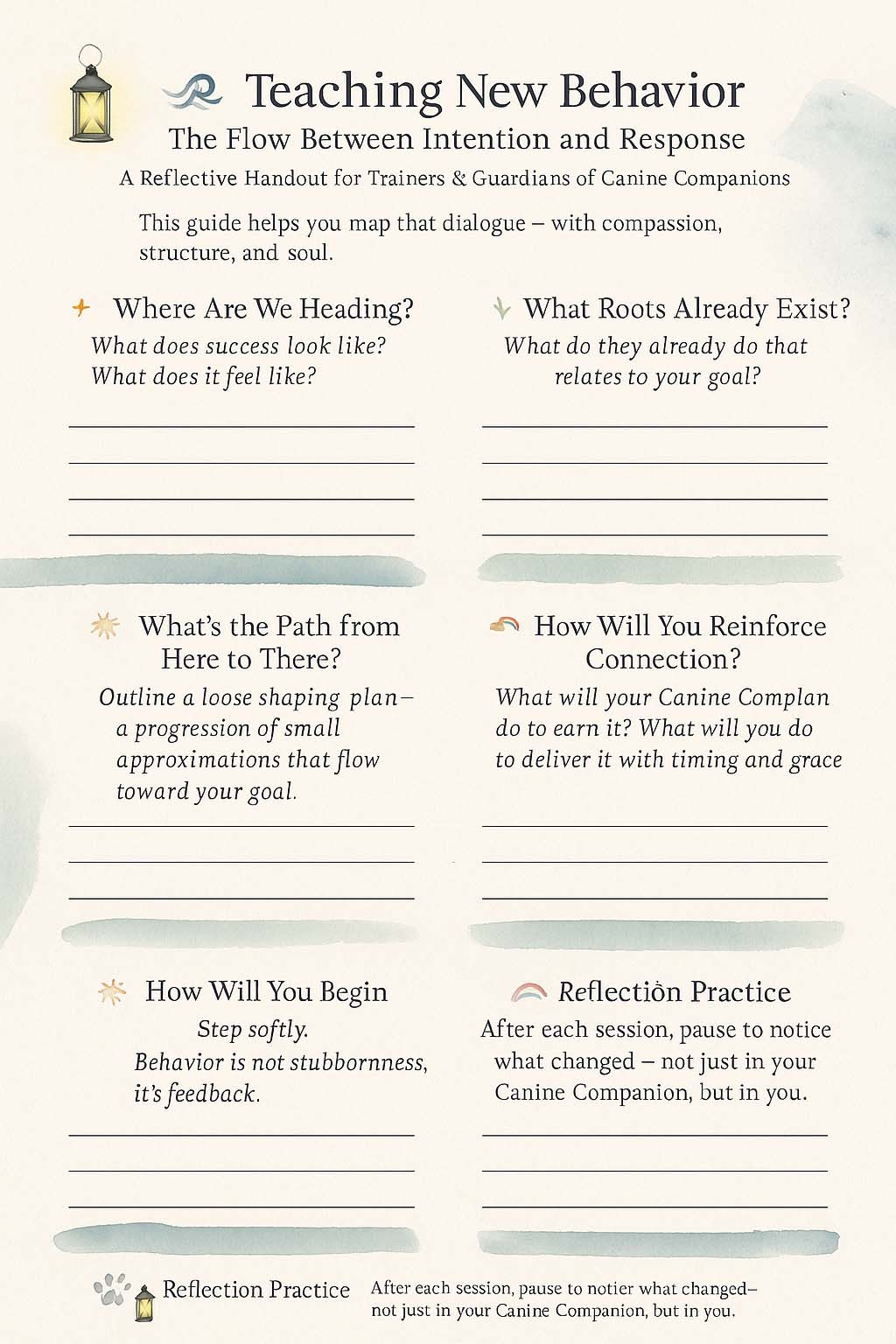
Start with one handout. Keep the whole library. Read The Three D’s and Available first, then choose the situation that sounds like your dog.
About the book
Introduction and full contents
Book page 1
Coaching Canine Companions The Field Handouts
Coaching Canine Companions A Nervous System First Approach
The Field Handouts
Twenty-nine handouts, in one book — from the foundation every dog needs to the situations thatbring people to the door.
We did not win the walk. We came home to each other.
Lorrie J. Harris · North Kingstown, Rhode Island · coachingcaninecompanions.com · (401) 249-4200
Lorrie J. Harris · coachingcaninecompanions.com · (401) 249-4200 1
Book page 2
Coaching Canine Companions The Field Handouts
Lorrie J. Harris · coachingcaninecompanions.com · (401) 249-4200 2
Book page 3
Coaching Canine Companions The Field Handouts
How This Book Is Built
Every dog who comes to us arrives with a different story — a window, a truck, a baby, a new puppy, another dog on the sidewalk. Underneath the stories the work is the same. A nervous system that has been carrying more than it can hold, and a person on the other end of the leash who would like to help and has not been shown where to look.
So the book opens with what every dog needs before any specific problem is touched: the three dials that make hard things easier, the small signals a body offers before it does anything you would notice, and the walk you take together. Then it moves through the quiet dog and the loud one, the house that has grown unsteady, and the words that move a dog without the leash. Only then does it turn to the particular — other dogs, trucks, a door you are leaving through, a herding dog, a baby, a puppy — because by that point the tools are already in your hands and each situation is simply a place to use them.
Read the first two handouts no matter which dog you have. After that, go to the handout that names your situation. The others will be there when you need them.
ONE RULE THAT RUNS THROUGH EVERY HANDOUT
Nothing useful is learned above the line. When your dog can no longer take a treat or a toy they would normally take, cannot hear their name, cannot look away — stop asking, add distance, and let the moment finish. Every handout in this book is a way of staying under that line, or of getting back there.
PRINTING ONE HANDOUT
Every handout starts on its own sheet and is numbered from page 1. To print one, print only the pages listed beside it below. Print two-sided; the blank pages between handouts are there on purpose.
Lorrie J. Harris · coachingcaninecompanions.com · (401) 249-4200 3
Book page 4
Coaching Canine Companions The Field Handouts
The Handouts
NO.
HANDOUT
READ IT WHEN YOUR DOG…
PRINT PAGES
The Foundation
1
The Three D’s Quick Reference
Any dog. The foundation for every reactive or anxious dog: distance, duration, distraction, and how to move one dial at a time.
9–11
2
Available Quick Reference · For the fridge
Any dog, on any walk. What it means to be available — watching the body, ready in the next second, already decided.
13–14
3
The Orientation Walk Experiential Walk
Any dog, when training has stopped working or connection feels far away. A slow walk to find orientation again.
15–23
4
Impulse Control, Emotional Resilience, and Flow in the 3Ds Lesson
Gets swept up in excitement. The three dials through emotional resilience and flow.
25–35
5
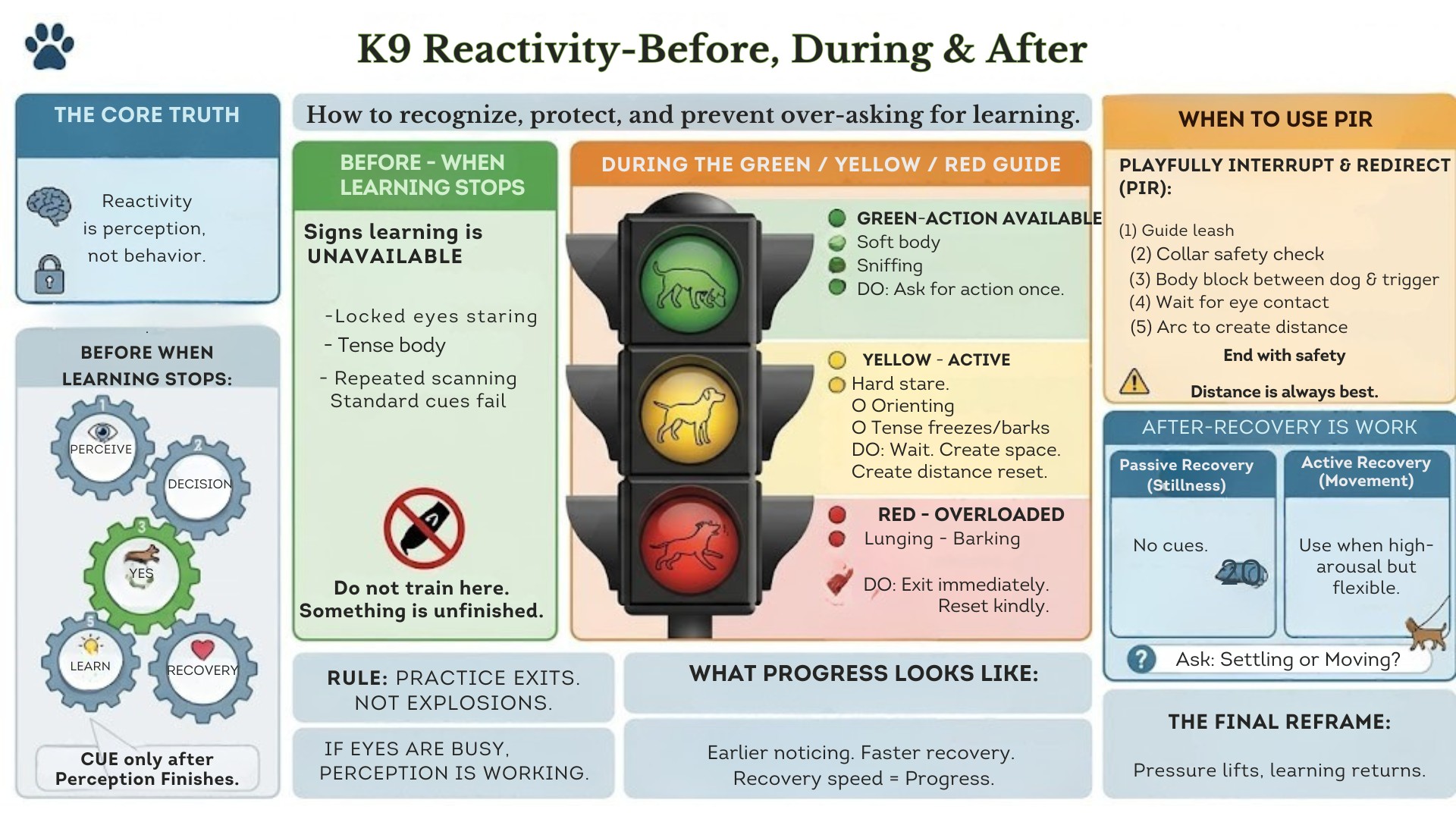
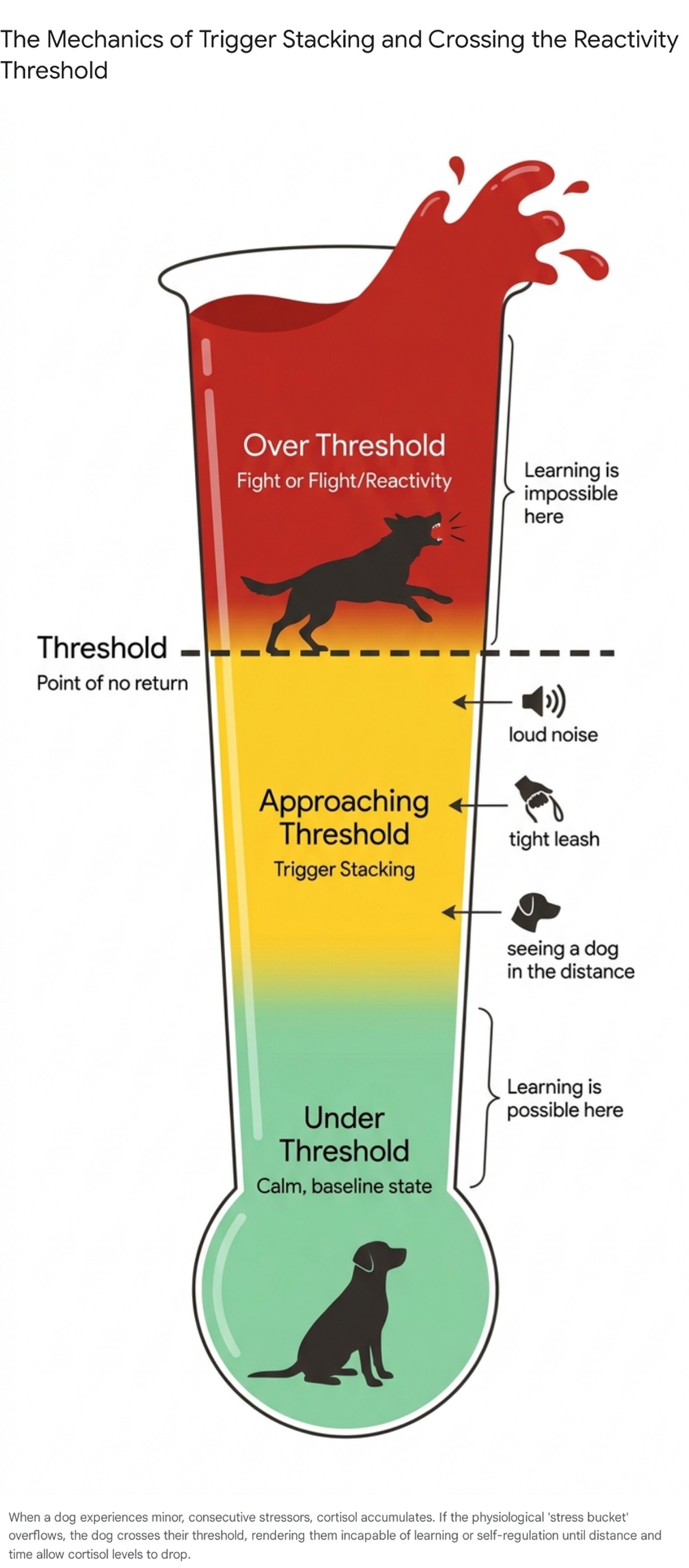
The Reactivity Traffic-Light Chart Chart
Reacts on walks. Green, yellow, red: what your dog needs right now.
37–40
6
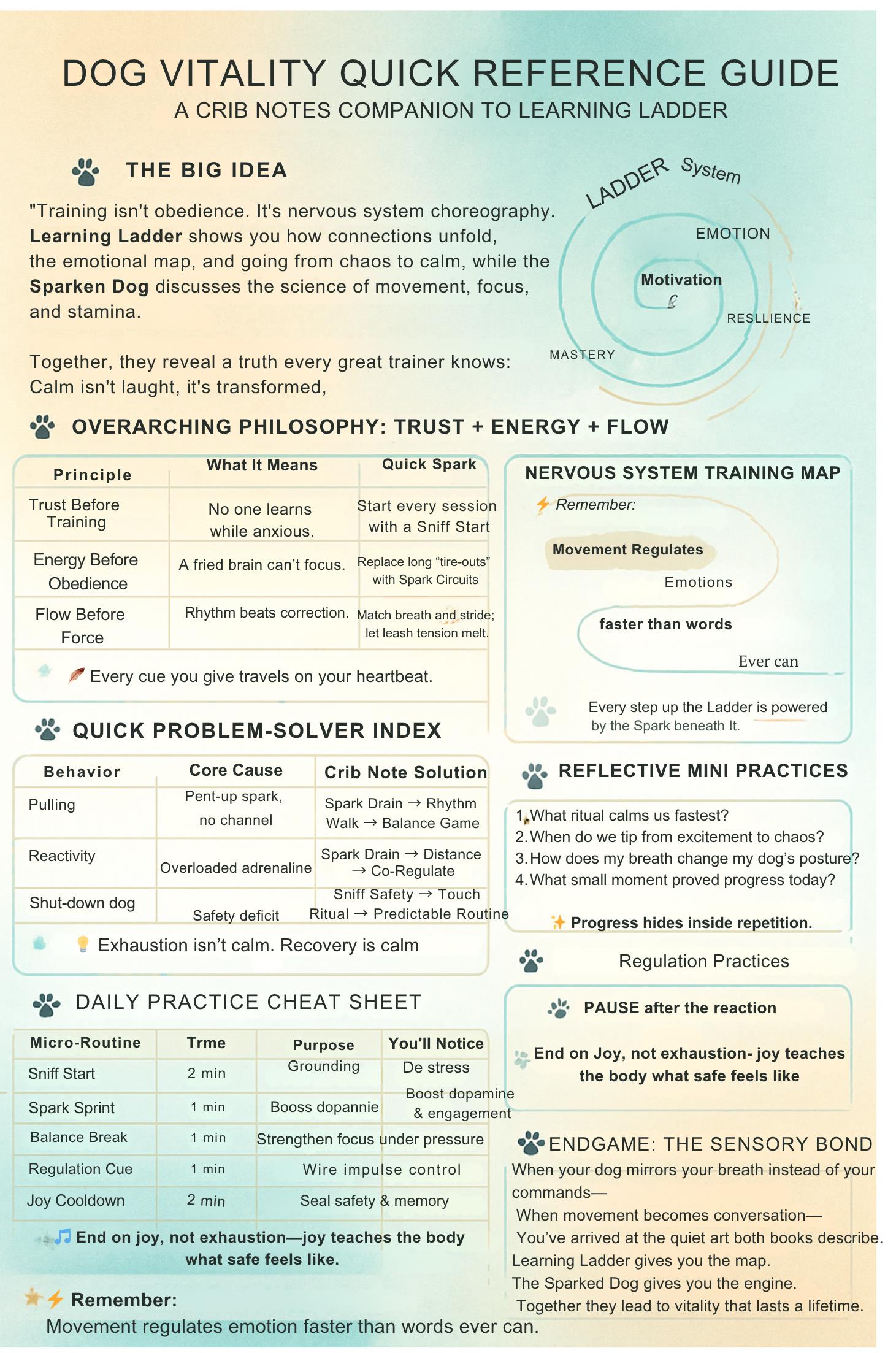
Dog Vitality Quick Reference Guide Quick Reference
Stops listening, comes home wired, or needs calm and vitality. A crib-notes companion to Learning Ladder and The Sparked Dog.
41–50
7
Misfit to Marvel: The Six Modules at a Glance Quick Reference Guide
Plays with other dogs. Play styles, social timing, signals, and when to step in.
51–73
8
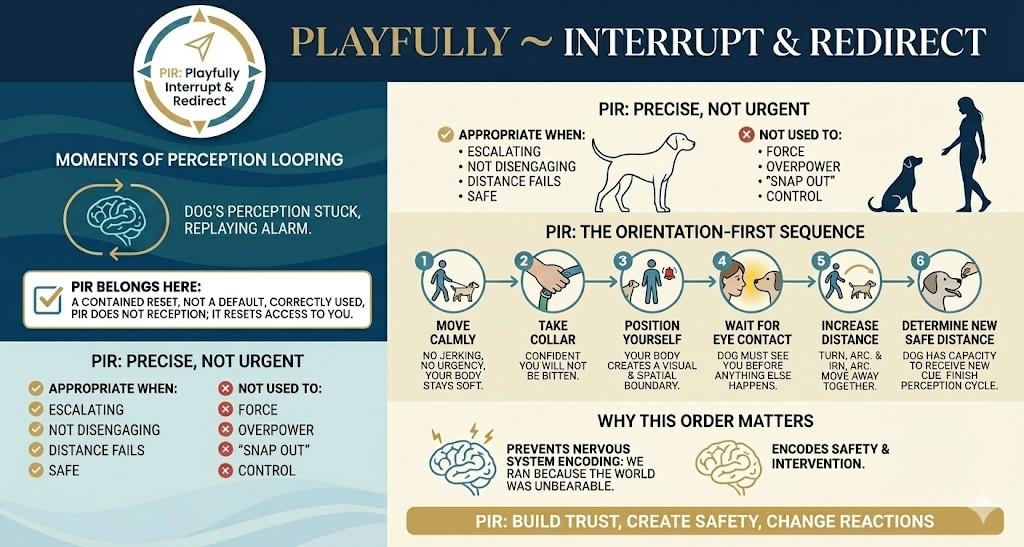
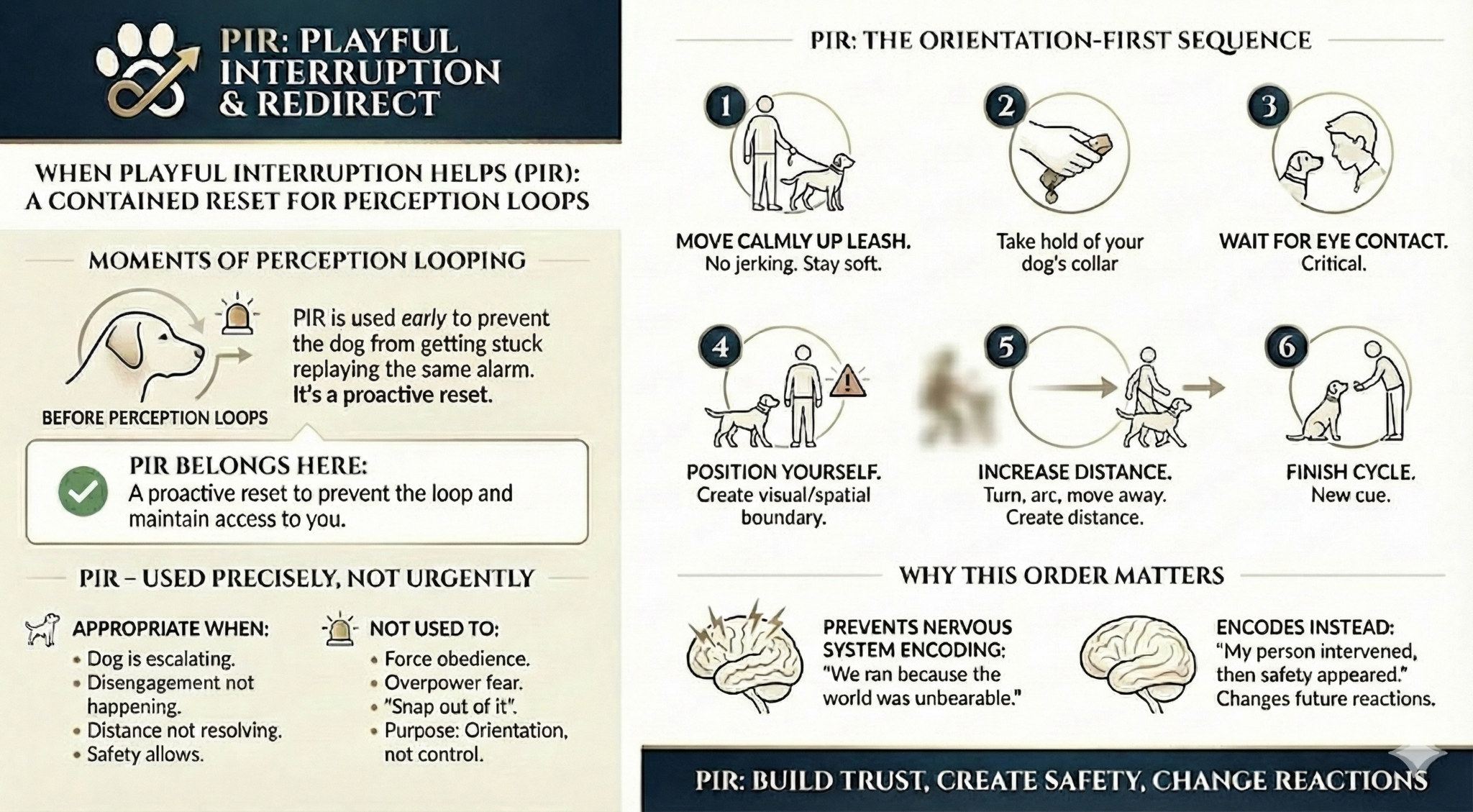
Understanding PIR, Safety, and the Moment When Life Takes Over General Handout
Struggles with arousal, reactivity, or impulse control — knowing which moment you are actually in.
75–81
9
Reading the Mouth Post-Session Notes
Any dog. The first body-language skill, and why the same signal means opposite things in different places.
83–84
10
The Breathwalk A General Handout
Any dog and any person. A moving practice for people and dogs who would rather not sit still.
85–88
11
The Invisible Leash Session Handout
Reads space, sound, and movement — the conversation your dog was listening to before you said a word.
89–93
12
Walking on a Loose Leash Session Handout
Pulls on the leash. For the first weeks of walking together.
95–99
Lorrie J. Harris · coachingcaninecompanions.com · (401) 249-4200 4
Book page 5
Coaching Canine Companions The Field Handouts
Calm at Home
13
The Peace Work Day Training Handout
Watches all day, barks past the point of hearing you, startles at the unfamiliar, struggles to be left. The reasoning.
101–105
14
The Peace Work Day Training Card
Same dog. The what-to-do card — every day, in the moment, and the Ledger.
107–111
15
Building Calm at Home Session Handout
Is insecure and spreading sideways — crate, barking, resource guarding, separation.
113–116
16
The Crate → Calm → Release Loop Session Handout
Barks, paces, or pushes at the crate door. Calm opens the door.
117–118
17
Changing the Language Session Handout
Barks, growls, or escalates to get something from you.
119–120
Energy, Arousal and the Cue
18
Shaping Energy Without Breaking Spirit Session Handout
Is high-energy and over-aroused. The Decision Filter: meaning moments and boundary moments.
121–122
19
The Bucket Session Handout
Has walks that spill over on busy streets. Relief, the first stiffening, PIR, the breath after.
123–127
20
The Four Words Day Training Handout
Needs to be moved without the leash doing the talking. Come · Here · This Way · Hey Hey. Includes the two-dog rule.
129–133
21
Recall Is Trust in Motion Session Handout
Has a recall that breaks down. State, skill, or environment.
135–136
22
The Whistle Recall Session Handout · Advanced
Is already working on a long line and harness.
137–141
23
The First Shift Practice Handout
Knows the cue and loses it when the world gets busy. Advanced emotion regulation, whistle recall, the practiced exit, recovery.
143–154
When Your Situation Calls for It
24
Reactive to Other Dogs First-Week Handout
Barks, puffs, or lunges at other dogs. The first week only: the Breath Walk, the hand work, and the vet question.
155–158
25
The Trucks Practice Handout
Barks at delivery vehicles, yard crews, or the window generally.
159–163
26
The Leaving Signs Practice Handout
Hears you leaving long before you go. Keys, bag, the back door.
165–169
27
The Herding Switch Session Handout
Is a cattle dog or herding mix who goes from calm to all motion around other dogs.
171–174
Lorrie J. Harris · coachingcaninecompanions.com · (401) 249-4200 5
Book page 6
Coaching Canine Companions The Field Handouts
When Your Situation Calls for It
28
Your Dog and Your Baby Preparation Handout
Lives in a house where a baby is coming.
175–179
29
A Puppy in a House That Was Already Full Field Plan
Is a new puppy joining adult dogs — especially an elderly or wary one.
181–185
Lorrie J. Harris · coachingcaninecompanions.com · (401) 249-4200 6
Book page 7
Coaching Canine Companions The Field Handouts
Lorrie J. Harris · coachingcaninecompanions.com · (401) 249-4200 7
Book page 8
Handout 1 of 29
The Three D’s
Book page 9
Coaching Canine Companions The Three D's
Coaching Canine Companions · A Nervous System First Approach
Quick Reference
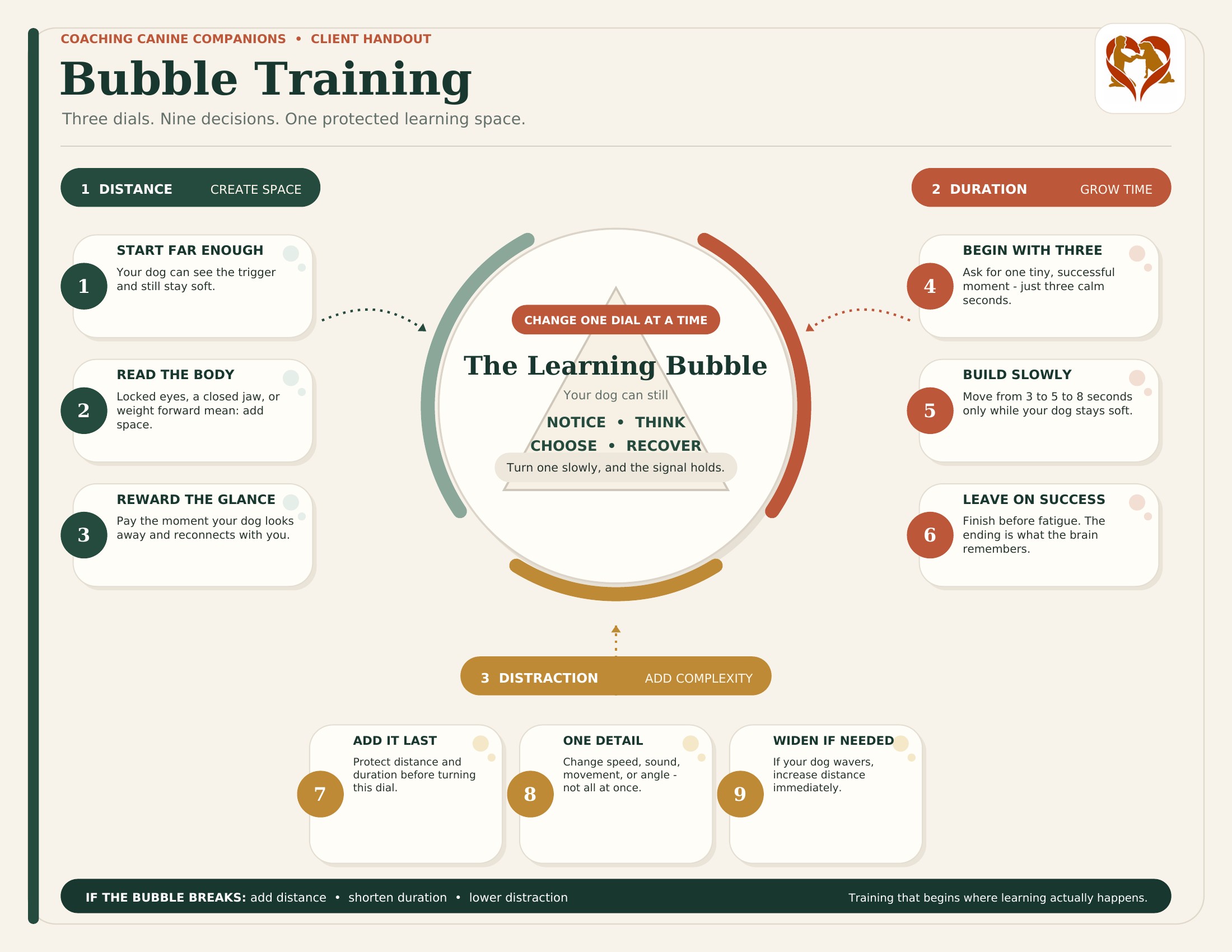
The Three D's
Distance · Duration · Distraction. Your foundation for every reactive or anxious dog.
This session focused on building a safe, predictable environment for your dog by working through the Three D's. The goal is always to find the threshold where your dog can remain calm, then build gradually from there. We do not push through reactivity. We protect against it.
DISTANCE Find how far away your dog needs to be from a trigger to stay calm. Start there — always. It is free and it works instantly.
DURATION Build time at that safe distance slowly before reducing distance or adding complexity. The slowest dial, and the one pushed too fast.
DISTRACTION Add intensity — volume, movement, proximity, a busier room — only after distance and duration are solid.
THE KEY RULE Dogs cannot learn when they are in survival mode. If your dog is over threshold, the session is over. Protect the dog from the trigger — do not push through it.
How to Move a Dial
1 Raise one dial. Leave the other two exactly where they were.
2 Never two in a session. Never three, ever. If two change and the dog comes apart, you cannot tell which
one did it.
3 Four in five. If the dog cannot do it comfortably four times out of five, the dial is too high. Drop back
one full step, not half a step.
4 The engagement test. If the dog will not take a treat or toy they were taking two minutes ago, will not
come in, will not sniff — over threshold. Add distance and end the repetition.
5 End on a success. Two easy wins, then stop for the day. The dog rehearses whatever the session ended
on.
6 The ceiling moves daily. Heat, pollen, a storm coming, poor sleep. On those days do easy reps or none.
That is weather, not regression.
A Worked Example
The target: the dog settled on a mat while a vehicle passes. Only one number changes per line.
Lorrie J. Harris · coachingcaninecompanions.com · (401) 249-4200 1
Book page 10
Coaching Canine Companions The Three D's
SESSI ON
DISTAN CE
DURATI ON
DISTRACTION
WHAT MOVED
1
40 ft
10 sec
Quiet room
Baseline
2
30 ft
10 sec
Quiet room
Distance only
3
20 ft
10 sec
Quiet room
Distance only
4
20 ft
30 sec
Quiet room
Duration only
5
20 ft
30 sec
Radio on, someone moving
Distraction only
6
40 ft
10 sec
Quiet room
Struggled — all dials back
Reminders
· Progress is measured in calm, not courage. Small wins matter enormously. · Do not test new triggers during a stabilization phase — a move, a baby, a change in the household. Hold your priority focus as your only training. · Do not spend precious time recording reactive episodes. Your job in those moments is to protect the dog and give them space — not to document. · Progress is non-linear. A hard day is data, not failure. Observe, log, and bring it to your next session.
DATE
TRIGGER
DISTANCE
DURATIO N
DISTRACT ION
RESULT
❧
We did not win the walk. We came home to each other.
Lorrie J. Harris · Coaching Canine Companions · Lorrie@CoachingCanineCompanions.com · (401) 249-4200 Questions between sessions: email is best, and ten seconds of video beats a paragraph. Scheduling: coachingcaninecompanions.com/contact.
Lorrie J. Harris · coachingcaninecompanions.com · (401) 249-4200 2
Book page 11
Coaching Canine Companions The Three D’s
Lorrie J. Harris · coachingcaninecompanions.com · (401) 249-4200 3
Book page 12
Handout 2 of 29
Available
Book page 13
Coaching Canine Companions · A Nervous System First Approach
Quick Reference · For the fridge
Available
Your dog is asking one question on every walk: am I alone with this? Your attention is the answer.
WHAT AVAILABLE MEANS · ALL THREE AT ONCE
Watching the body. Mouth, breath, weight, gaze. The dog first, the street second.
Ready in the next second. Nothing between seeing the shift and acting on it. Not after the sentence. Not after the call.
Already decided. You know the route, the quiet place, and what happens if the phone rings before you leave the house.
The Guardian Availability Rule If you cannot watch your dog and respond within a second, your dog cannot be on a busy street. Quieter route, hand off the leash, or end the walk. Standing beside a dog while your attention is elsewhere is proximity, not supervision.
ATTENTION DOES NOT SPLIT. IT ALTERNATES. The first shift lives in the gaps. Choose one role before the door, and only one.
Role
You are
Requires
Active handling Walking the dog. Eyes on the body. Acting at the first shift.
Phone away. No headphones. Talk only if it can stop mid-word.
Quiet observation Not walking. Dog settled at real distance from the street, behind you.
Eyes free even if your voice is not. Call ends when the mouth closes.
Transfer Genuinely elsewhere. Someone capable has the leash, or the dog is somewhere quiet and secure.
An adult who knows the first shift and the exit.
There is no fourth role.
SEE THE FIRST SHIFT · THEN ACT, BEFORE YOU KNOW WHY
Window
What you see
What you do
Available Mouth soft or open. Easy breath. Weight even. Gaze can move. Name turns the head.
Continue. This is the only window that teaches.
First shift Mouth closes. Breath changes. Weight onto the front feet. Gaze narrows. Pace changes.
Change one thing now. Distance, turn, step off the line. Ask for nothing yet.
Rising Scanning or fixation. Pulling. Name no longer turns the head.
Run the exit. Purposeful, quiet, no bargaining.
Threshold Cannot orient. Frantic, explosive, or rigid and silent.
Training is over. Distance, quiet place, stay for the full return.
Mouth first. When it closes, make space before you know why. Stillness is not calm. A rigid, silent, staring dog is as far over as a barking one.
Lorrie J. Harris · coachingcaninecompanions.com · (401) 249-4200 1
Book page 14
THE BUSY STREET All three dials at their highest at once: no distance, no pause, every distraction. Not a training environment. You carry your dog through it with everything you have, or you do not take it today. Distance is free. Cross the road, step into a driveway, turn up a side street. Early, not late.
THE EXIT · PRACTICE IT WHEN NOTHING IS WRONG
THE RETURN · THE WALK IS NOT OVER WHEN THE BARKING STOPS
· See the first shift. Stop adding anything.
· Breath slows and deepens.
· Exhale. Soften your hands. Turn your body
· Mouth reopens. Face, spine, tail soften.
toward the way out.
· Gaze widens and can move away. Looks at a leaf,
· One quiet signal, if your dog can still hear you.
at you.
Once. Never repeated.
· Shake-off, sniff, stretch.
· Move to the quiet place with purpose. No
talking, no bargaining, no hauling.
· Takes a treat. Hears the name once and turns. Until you see most of these, you are still inside the encounter. One clean rise and return is a good session. Go home on the quiet route.
· Keep going until the body changes, not just until
the pulling stops. Leaving is not losing.
COME BACK · THE THREE QUESTION RETURN
1 What is actually happening in my dog's body right now?
2 What story am I telling myself about what happens next?
3 What action makes my care visible while my dog still has choices? Hope is a feeling about the future. Your dog is standing in the present. Act from what you see.
YOUR BODY IS PART OF THE ENVIRONMENT · CHECK AT EVERY STOP Shoulders down. Two breaths, five in, five out. Weight onto your heels. Release one layer of grip. Then look at the dog. Four seconds.
BEFORE THE DOOR
Phone away, headphones off?
Route with distance in it chosen?
Quiet place known, steps counted?
Exit practiced this week with no trigger?
Can I stop a conversation mid- word?
Decided what happens if the phone rings?
Any no: quieter route, different hour, hand off the leash, or the dog stays home. That is availability, exercised in advance.
THREE LINES · AFTER ANY ENCOUNTER
One What woke your dog's nervous system, and what pulled your attention at that moment.
Two The first change in your dog's body, and the first change in yours.
Three What you did, whether you left, and how long the return took. No adjectives. Facts only. A month of them becomes a pattern.
❧
We did not win the walk. We came home to each other. Lorrie J. Harris · Coaching Canine Companions · Lorrie@CoachingCanineCompanions.com · (401) 249-4200
Lorrie J. Harris · coachingcaninecompanions.com · (401) 249-4200 2
Handout 3 of 29
The Orientation Walk
Book page 15
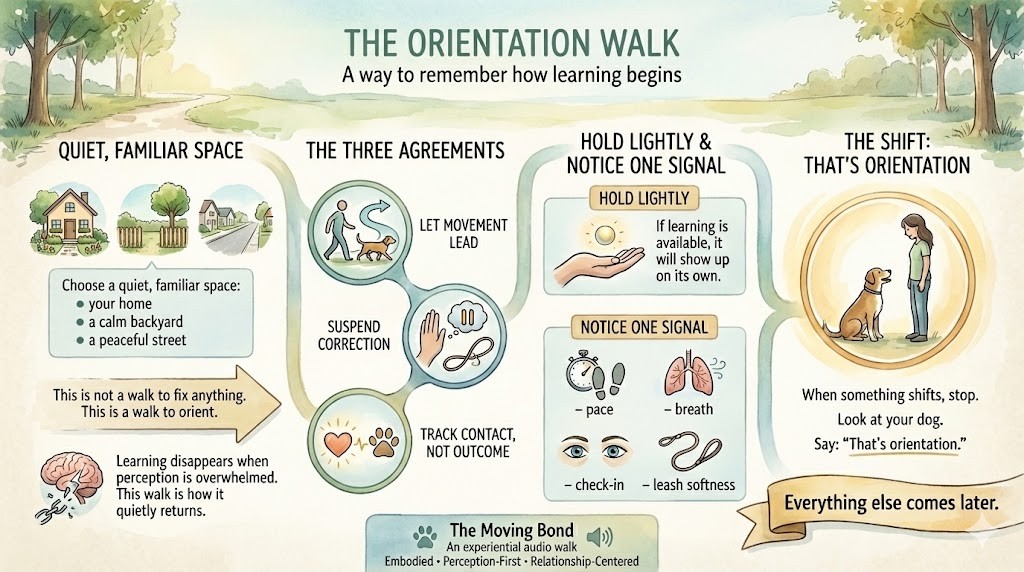
THE ORIENTATION WALK
A way to remember how learning begins
PART I — INTRO
Before you listen, pause for a moment.
This is not a guided audio experience to be consumed while sitting still. It’s an experience meant to be taken in motion, with your dog, in a quiet, low-distraction space.
That space might be:
● a slow walk through your home ● a quiet backyard ● a calm, empty street
This is not the time for busy environments, surprises, or challenges.
1
Book page 16
PART II — THE ORIENTATION WALK
Let’s begin by changing nothing.
You don’t need to prepare. You don’t need to get it right. This is not a walk to fix anything.
This is a walk to orient.
If training hasn’t been working… If cues feel thin, or connection feels far away… That doesn’t mean you or your dog are failing.
Most of the time, it simply means orientation has been lost.
And orientation can return.
Go ahead and start walking.
Let the pace be slow and ordinary. This isn’t about covering distance.
Don’t correct the movement. Don’t manage it.
Just let bodies move in a space that already feels safe.
Bodies know how to walk long before they know how to perform.
On this walk, we’re making three agreements.
You don’t need to memorize them. Just let them sit in the background.
First agreement: We let movement lead.
We’re not asking for behaviors. We’re not shaping responses.
We’re allowing bodies—yours and your dog’s—to move first and noticing what follows.
2
Book page 17
Second agreement: We suspend correction.
Nothing is wrong on this walk.
If your dog pauses, sniffs, wanders, or hesitates— that’s information, not a mistake.
We’re not fixing. We’re listening.
Third agreement: We track contact, not outcome.
Not obedience. Not success.
Contact shows up quietly— in softening, in checking in, in settling.
Those moments matter more than anything you can name.
As you walk, hold this lightly:
If learning is available, it will show up on its own.
You don’t need to make it happen.
Now, notice just one small thing.
Only one.
Maybe it’s a change in pace. Maybe it’s a breath you didn’t plan. Maybe your dog checks in without being asked. Maybe the leash goes quiet for a moment.
Don’t collect them. Just notice one.
3
Book page 18
That’s enough.
Orientation doesn’t announce itself.
It doesn’t feel dramatic. It doesn’t look impressive.
It feels like something coming back online— often quietly, often unexpectedly.
If you notice a small shift— even a subtle one— that’s the signal.
You can keep walking if you want. Or you can stop.
There’s no minimum time.
This walk isn’t about duration. It’s about availability.
Before we finish, take one more breath— not a deep one, just a real one.
Notice where your dog is in space. Notice where you are.
Nothing needs to be concluded.
Just remember the feeling.
This walk is not a solution.
It’s a doorway.
Once orientation returns, training stops being forced and starts sticking.
4
Book page 19
Everything else comes later.
PART III — THE MARKING ORIENTATION MICRO-RITUAL
When something has softened—even slightly—
Do three things:
1. Stop walking for a breath. 2. Look at your dog—not for behavior, but for presence. 3. Say quietly (out loud or internally):
“That’s orientation.”
That’s it.
No analysis. No logging. No repetition required.
This marks the moment so your nervous system remembers it.
5
Book page 20
PART V — THE HANDOUT
THE ORIENTATION WALK
A way to remember how learning begins
Choose a quiet, familiar space:
● your home ● a calm backyard ● a peaceful street
This is not a walk to fix anything. This is a walk to orient.
Learning disappears when perception is overwhelmed. This walk is how it quietly returns.
The Three Agreements
1. Let movement lead 2. Suspend correction 3. Track contact, not outcome
Hold Lightly
6
Book page 21
If learning is available, it will show up on its own.
Notice One Signal – pace – breath – check-in – leash softness
When something shifts, stop. Look at your dog. Say: “That’s orientation.”
Everything else comes later.
The Moving BondAn experiential audio walk Embodied • Perception-First • Relationship-Centered
PART VI — SLIDE DECK (STRUCTURE, UPDATED)
1. The Orientation Walk — Where learning quietly returns 2. Why quiet spaces matter 3. When nothing works, it’s not failure 4. Training begins with orientation 5. This is not / This is 6. The Three Agreements 7. The Orientation Cue 8. What to Notice 9. What This Opens 10. The Closing Line
Final slide:
“That’s orientation. Everything else comes later.”
CLOSING (FOR YOU)
This was the right adjustment.
7
Book page 22
You honored:
● nervous-system reality ● learner dignity ● and ecological truth
You didn’t lower the bar. You cleared the terrain so people could actually step onto the path.
This is now complete, coherent, and safe to release.
When you’re ready, Step 6—connecting this doorway to the wider ecosystem—will feel like a natural next step, not a jump.
You’ve done beautiful work here.
8
Book page 23
Coaching Canine Companions The Orientation Walk
Lorrie J. Harris · coachingcaninecompanions.com · (401) 249-4200 9
Book page 24
Handout 4 of 29
Impulse Control, Emotional Resilience, and Flow in the 3Ds
Book page 25
Lorrie@CoachingCanineCompanion
🐾Lesson: Impulse Control, Emotional
Resilience, and Flow in the 3Ds
Impulse control is not about holding back instinct — it’s about learning to stay steady in motion. True control lives in the nervous system, not in the willpower to “be good.” A dog becomes fluent in calm when it can ride the emotional wave of excitement, recover, and return to center again and again.
This lesson explores the 3Ds — Distance, Duration, and Distraction — through the lens of emotional resilience and flow. Together, they teach both dog and handler how to move through arousal without losing connection or clarity.
🌊 Emotional Flow: The Bridge Between Control and Freedom
Flow, as defined in neuroscience, is the state where challenge and skill meet — the sweet spot between boredom and overwhelm. The same principle applies to emotional regulation in dogs.
Too little challenge, and the dog disengages. Too much, and the nervous system flips into survival.
The 3Ds allow you to tune the environment like an instrument, adjusting intensity so your dog can experience manageable stress and recover repeatedly — stretching the edges of emotional resilience without breaking it.
When practiced well, the leash becomes a current, not a chain — energy moving back and forth between calm and alertness in a rhythm that both species can trust.
“Calm is not the absence of tension; it is the ability to exhale while still in motion.” — Transforming Reactivity in Dogs, Ch. 10
🧭 The 3Ds in Flow Practice
Lorrie@CoachingCanineCompanions.com
1
Book page 26
Lorrie@CoachingCanineCompanion
1️⃣ Distance — The First Flow Variable
Distance sets the level of emotional intensity. It determines whether your dog’s body stays in learning mode or flips into protection mode.
Practice:
●Begin far enough that your dog can notice the trigger without tensing. ●Let curiosity rise — a lifted head, a soft inhale. ●Wait for the natural ebb: the glance back, the exhale. ●Reward the return.
Each repetition — arousal rising and falling — strengthens resilience. You are teaching that emotion can surge and subside safely.
From: Transforming Reactivity in Dogs (Ch. 5):
“Distance is oxygen. Without it, no mind can breathe.”
2️⃣ Duration — The Second Flow Variable
Duration teaches your dog to stay inside the feeling a little longer each time without losing regulation. This isn’t about frozen stillness; it’s about fluid patience.
Practice:
●Ask for a pause — eye contact, stillness, or waiting at the gate. ●Count silently for three seconds. ●If the dog maintains calm, extend to five, then eight. ●When arousal stirs, breathe together and mark the recovery.
Every cycle of rise and return expands the dog’s emotional endurance. Just as an athlete builds stamina through intervals, your dog builds resilience through repeated recoveries.
From: Transforming Reactivity in Dogs Ch. 6:
“Clarity is mercy for the nervous system.”
3️⃣ Distraction — The Third Flow Variable
Lorrie@CoachingCanineCompanions.com
2
Book page 27
Lorrie@CoachingCanineCompanion
Distraction tests your ability to stay in rhythm under movement and noise. This is where the real- world training meets emotional flow.
Practice:
●Begin your calming ritual: Name → Turn → Three Steps → Reward → Release. ●Add mild distractions — a friend walking, a squeak, a tossed toy. ●Let arousal rise briefly, then guide back through the pattern. ●Reward the return to calm, not the absence of reaction.
This practice teaches continuity — that movement and calm can coexist. Flow is built when the dog learns: even when the world moves, we still move together.
💓 Emotional Resilience: Stretching the System Safely
Resilience develops not by avoiding stress but by mastering it. Each time the dog experiences a small wave of arousal and safely returns to calm, the nervous system grows stronger.
Resilience Cycle:
1. Notice arousal rising — body tightens, ears shift, breathing quickens. 2. Stay within threshold — no panic, just alertness. 3. Guide recovery through breath, leash rhythm, or known cues. 4. Mark the exhale — that is the moment resilience is built. 5. Repeat the wave.
Five or six cycles in one session train the brain to expect recovery. This is how emotional elasticity — the ability to bend and return — is formed.
From Ch. 15 (Functional Coherence):
“Wholeness is not perfection. It is the moment when nothing fights itself.”
🌬️ The Flow of Connection
Lorrie@CoachingCanineCompanions.com
3
Book page 28
Lorrie@CoachingCanineCompanion
When both humans and dogs regulate together, they enter shared flow—breathing synchronizes. Pace aligns. The leash hums with a quiet rhythm rather than friction.
This shared state creates functional coherence — two nervous systems operating as one. In this space, the dog learns to trust the human’s rhythm as a guide, and the human learns to trust the dog’s signals as information, not resistance.
Flow replaces command-and-control with conversation.
✨ Practice Summary
Flow Variable
Focus
What to Notice
Desired Response
Distance
Adjust arousal safely Ears, posture, breath Curiosity before fear Build calm endurance Eye contact, slow Stillness that breathes exhale Maintain rhythm Small startles, quick Reconnection without recovery correction Rise → Recover Multiple waves per Faster, calmer session recovery each time
Duration
Distraction
Resilience Loops
🪶 Integration
●Begin each walk with three shared breaths. ●Use your dog’s recovery time as your compass — it tells you when to advance or ease off. ●Celebrate recovery more than control; it is the heartbeat of learning. ●Let sessions feel like dancing, not drilling — a pulse of energy, return, and flow.
🌌 Takeaway
Lorrie@CoachingCanineCompanions.com
4
Book page 29
Lorrie@CoachingCanineCompanion
Impulse control is a flow state between instinct and intention. Distance keeps you safe within the current. Duration strengthens your endurance in that current. Distraction teaches you to move gracefully when the current swirls.
Emotional resilience is what allows the current to grow stronger without sweeping you away. When you and your dog can feel fully recovered quickly and keep moving together — that’s not training anymore. That’s flow.
Lorrie@CoachingCanineCompanions.com
5
Book page 30
Lorrie@CoachingCanineCompanion
Lorrie@CoachingCanineCompanions.com
6
Book page 31
Lorrie@CoachingCanineCompanion
🟢🟡🔴 The Reactivity Traffic-Light Chart
How to know what your dog needs right now
🟢 GREEN ZONE — Perception finished, action invited
What you SEE
●Dog can look at a trigger and look away ●Body feels softer, looser ●Mouth open or relaxed ●Blinking present ●Sniffing is slow and real ●Leash feels lighter ●Dog checks in without being asked
What this MEANS
●The dog has enough information ●The nervous system is “safe enough” ●The brain can learn
What YOU DO
●Ask for one simple behavior (once) ●Move together calmly ●Reward ease, not intensity ●Keep sessions short and successful
Client reminder:“Green means go—but gently.”
🟡 YELLOW ZONE — Perception active, help it finish
Lorrie@CoachingCanineCompanions.com
7
Book page 32
Lorrie@CoachingCanineCompanion
What you SEE
6. Hard staring or repeated orienting 7. Body weight forward 8. Mouth closes tight 9. Ears locked on the trigger 10. Barking in short bursts 11. Hesitation or pacing 12. Takes food, but with tension
What this MEANS
●The dog is still gathering information ●The system is close to tipping ●Action is not ready yet
What YOU DO (in order)
1. Stop forward motion 2. Turn your body sideways 3. Arc away on a curve 4. Increase distance slightly 5. Allow look → disengage cycles 6. Move slowly (figure-8s, zig-zags, sniffing)
❌ Do NOT:
●ask for obedience ●repeat cues ●tighten the leash ●talk more
Client reminder:“Yellow means slow, curve, create space.”
🔴 RED ZONE — Perception stalled, nervous system overloaded
What you SEE
Lorrie@CoachingCanineCompanions.com
8
Book page 33
Lorrie@CoachingCanineCompanion
●Continuous barking or screaming ●Lunging increases in strength ●Dog cannot disengage at all ●Food refused or grabbed frantically ●Body stiff or explosive ●Recovery time getting longer
What this MEANS
●Perception cannot finish here ●Stress chemicals are stacking ●Learning is impossible right now
What YOU DO (no training, just safety)
●Turn away immediately ●Create distance fast (but calmly) ●Use barriers (cars, hedges, buildings) ●Exit the situation ●Once far enough: sniff + scatter ●Move until intensity drops
🚫 Absolutely do NOT:
●wait it out ●demand calm ●keep approaching ●“prove” the dog can handle it
Client rule: 👉 Two RED signs = retreat immediately
Client reminder:“Red means leave. That’s success.”
One-Line Memory Aid (this sticks)
Lorrie@CoachingCanineCompanions.com
9
Book page 34
Lorrie@CoachingCanineCompanion
Green = Teach Yellow = Guide Red = Exit
Plain language
“We are not trying to stop your dog from feeling. We are trying to keep your dog from getting stuck. This chart tells you when to teach and when to change the picture.”
Lorrie@CoachingCanineCompanions.com
10
Book page 35
Lorrie@CoachingCanineCompanion
Lorrie@CoachingCanineCompanions.com
11
Book page 36
Handout 5 of 29
The Reactivity Traffic-Light Chart
Book page 37
🟢🟡🔴
The Reactivity Traffic-Light Chart
How to know what your dog needs right now
🟢
GREEN ZONE —
Perception finished, action invited
What you SEE
● Dog can look at a trigger and look away ● Body feels softer, looser ● Mouth open or relaxed ● Blinking present ● Sniffing is slow and real ● Leash feels lighter ● Dog checks in without being asked
What this MEANS
● The dog has enough information ● The nervous system is “safe enough” ● The brain can learn
What YOU DO
● Ask for one simple behavior (once) ● Move together calmly ● Reward ease, not intensity ● Keep sessions short and successful
Client reminder:“Green means go—but gently.”
🟡
YELLOW ZONE —
Perception active, help it finish
What you SEE
1
Book page 38
● Hard staring or repeated orienting ● Body weight forward ● Mouth closes tight ● Ears locked on the trigger ● Barking in short bursts ● Hesitation or pacing ● Takes food, but with tension
What this MEANS
● The dog is still gathering information ● The system is close to tipping ● Action is not ready yet
What YOU DO (in order)
1. Stop forward motion 2. Turn your body sideways 3. Arc away on a curve 4. Increase distance slightly 5. Allow look → disengage cycles 6. Move slowly (figure-8s, zig-zags, sniffing)
Do NOT: ❌
● ask for obedience ● repeat cues ● tighten the leash ● talk more
Client reminder:“Yellow means slow, curve, create space.”
🔴
RED ZONE —
Perception stalled, nervous system
overloaded
What you SEE
● Continuous barking or screaming ● Lunging increases in strength ● Dog cannot disengage at all ● Food refused or grabbed frantically
2
Book page 39
● Body stiff or explosive ● Recovery time getting longer
What this MEANS
● Perception cannot finish here ● Stress chemicals are stacking ● Learning is impossible right now
What YOU DO (no training, just safety)
1. Turn away immediately 2. Create distance fast (but calmly) 3. Use barriers (cars, hedges, buildings) 4. Exit the situation 5. Once far enough: sniff + scatter 6. Move until intensity drops
Absolutely do NOT: 🚫
● wait it out ● demand calm ● keep approaching ● “prove” the dog can handle it
Client rule: 👉Two RED signs = retreat immediately
Client reminder:“Red means leave. That’s success.”
One-Line Memory Aid (this sticks)
Green = Teach Yellow = Guide Red = Exit
Plain language
“We are not trying to stop your dog from feeling. We are trying to keep your dog from getting stuck. This chart tells you when to teach and when to change the picture.”
3
Book page 40
Coaching Canine Companions The Reactivity Traffic-Light Chart
Lorrie J. Harris · coachingcaninecompanions.com · (401) 249-4200 4
Handout 6 of 29
Dog Vitality Quick Reference Guide
Book page 41
Lorrie@CoachingCanineCompanion
DOG VITALITY QUICK REFERENCE
GUIDE
A Crib Notes Companion to
Learning Ladder & The Sparked Dog
(For guardians who want calm, vitality, and connection—fast.)
Learning Ladder shows you how connection unfolds—the emotional map, from chaos to calm. The Sparked Dog shows you why it works—the science of movement, focus, and stamina.
Together, they reveal a truth every great trainer knows:
Calm isn’t taught. It’s transmitted.
https://www.coachingcaninecompanions.com/
1
Book page 42
Lorrie@CoachingCanineCompanion
OVERARCHING PHILOSOPHY:
TRUST + ENERGY + FLOW
Principle What It Means Quick Spark
Trust Before Training No one learns while anxious.
Start every session with a Sniff Start (2-minute exploration).
Energy Before Obedience
A fried brain can’t focus.
Replace long “tire-outs” with Spark Circuits (short bursts + recovery).
Short Focus Span Weak endurance 10-min Endurance Ritual daily
Exhaustion isn’t calm. Recovery is calm.
https://www.coachingcaninecompanions.com/
5
Book page 46
Lorrie@CoachingCanineCompanion
DAILY PRACTICE CHEAT SHEET
Micro-Routine Time Purpose
Sniff Start 2 min De-stress & build curiosity
Spark Sprint 1 min Boost dopamine & engagement
Balance Break 2 min Strengthen focus under pressure
Regulation Cue 1 min Wire impulse control
Joy Cooldown 2 min Seal safety & memory
End on joy, not exhaustion—joy teaches the body what safe feels like.
https://www.coachingcaninecompanions.com/
6
Book page 47
Lorrie@CoachingCanineCompanion
12-WEEK FLOW BLUEPRINT (MICRO VERSION)
Weeks Focus What You’ll Notice
1 – 3 Foundation Calmer transitions; shorter ramp-ups
4 – 6 Emotion Longer pauses before impulse wins
7 – 9 Resilience Faster recovery from triggers
10 – 12 Mastery Natural synchronicity on walks
Circle a paw print each week you train—watch the spiral grow.
REFLECTIVE MINI-PRACTICES
1. What ritual calms us fastest?
2. When do we tip from excitement to chaos?
3. How does my breath change my dog’s posture?
4. What small moment proved progress today?
Progress hides inside repetition.
https://www.coachingcaninecompanions.com/
7
Book page 48
Lorrie@CoachingCanineCompanion
ENDGAME: THE SENSORY BOND
When your dog mirrors your breath instead of your commands— When movement becomes conversation— You’ve arrived at the quiet art both books describe.
Learning Ladder gives you the map. The Sparked Dog gives you the engine. Together they lead to vitality that lasts a lifetime.
💎 NEXT STEPS
1. Read or listen to the full audiobooks for the complete playbook and rituals.
2. Use this Quick Reference as your daily spark planner.
3. Revisit the Ladder each season—each spiral upward deepens your bond.
“Every calm moment you share rewires both nervous systems. That’s the real obedience—the one that breathes.”
https://www.coachingcaninecompanions.com/
8
Book page 49
Lorrie@CoachingCanineCompanion
https://www.coachingcaninecompanions.com/
9
Book page 50
Lorrie@CoachingCanineCompanion
https://www.coachingcaninecompanions.com/
10
Handout 7 of 29
Misfit to Marvel: The Six Modules at a Glance
Book page 51
Coaching Canine Companions Misfit to Marvel · Quick Reference
Misfit to Marvel
The Six Modules at a
Glance
Quick Reference Guide
Lorrie J. Harris · Coaching Canine Companions
Lorrie@CoachingCanineCompanions.com
https://www.coachingcaninecompanions.com/
Lorrie J. Harris · coachingcaninecompanions.com · (401) 249-4200 1
Book page 52
Coaching Canine Companions Misfit to Marvel · Quick Reference
Before the Six Pages
How to Use This
Six modules. Six pages. Nothing that is not needed at the fence line.
These are not summaries. A summary is the thing you read instead of the module. This is what you carry afterwards — the frameworks in the order you will actually need them, standing at the edge of a field with your hands full and about four seconds to decide.
Each page holds the question the module answers, the tools it gave you, the mistake most people make with them, and the handouts worth having in a pocket. The line in gold is the one to keep if you keep nothing else.
THE PROGRAM, END TO END
THE QUESTION IT ANSWERS
WHAT YOU LEAVE WITH
One
Which conversation is my dog trying to have?
Five play styles, a compatibility chart, and the difference between play, overstimulation and conflict.
Two
When do I speak, and when do I stay quiet?
Two cues, the P.I.R. rhythm, a traffic light — and a schedule for using all of it less.
Three
What did I miss thirty seconds ago?
Meta-signals, the cluster rule, and an order to look in.
Four
What does a pushy dog need that a hesitant one does not?
A ladder, a target behavior, and the line between a disagreement and a fight.
Five
What am I doing out here without realizing it?
A third cue, a calibration, and three levels of intervention.
Six
Does any of it hold when the conditions are not mine?
A profile, a job at the fence line, and a plan for the drive home.
Each module was built on the one before it. Read these six pages in order once, and the shape of theprogram becomes visible in a way it cannot be while you are inside it.
Lorrie J. Harris · coachingcaninecompanions.com · (401) 249-4200 2
Book page 53
Coaching Canine Companions Misfit to Marvel · Quick Reference
Module One · Quick Reference
Understanding Your Dog’s Play
Personality
Which conversation is your dog trying to have?
Most conflict at the park is not temperament. It is translation.
THE FIVE STYLES
STYLE
WHAT IT LOOKS LIKE
WATCH FOR
Wrestler
Whole body. Paws, chest bumps, pinning, rolling. Contact is the conversation, not a route to it.
Pinning that stops being mutual — the dog underneath no longer squirming back up into the game.
Chaser
Motion. Runs, is run after, and finds the point in the pursuit itself. Usually happy in either role.
The moment the other dog stops being a partner and starts being a target. Chase arousal is quiet.
Mouthy Player
Talks with the mouth — gentle nips, ears, legs, collars. Far softer than it looks.
The other dog freezing or turning the head away. That is a no, and mouthy dogs often miss it.
Stalker & Pouncer
Quiet, patient, deliberate. Crouches low, holds still, arrives all at once.
A freeze that keeps extending. A stalker at play releases the tension. A stalker in trouble holds it.
Solo Player
A toy, a stick, their own project. Watches without joining, and is not necessarily missing anything.
The difference between choosing distance and being driven to it. One is a preference. The other is stress.
Lorrie J. Harris · coachingcaninecompanions.com · (401) 249-4200 3
Book page 54
Coaching Canine Companions Misfit to Marvel · Quick Reference
COMPATIBILITY — A STARTING POINT, NOT A VERDICT
WRESTLER
CHASER
MOUTHY
STALKER
SOLO
Wrestler
✓
◆
◆
◆
▲
Chaser
◆
✓
◆
▲
▲
Mouthy
◆
◆
✓
◆
▲
Stalker
◆
▲
◆
◆
◆
Solo
▲
▲
▲
◆
✓
✓ Usually flows — same language; little needed from you beyond attention. ◆ Works with structure — a good pairing that needs breaks, space, or a watchful eye. ▲ Needs active management — different goals. Possible, but only with deliberate setup.
THE THREE MISMATCHES YOU WILL MEET MOST
— Wrestler and Solo Player. One wants contact; the other wants room. Neither is misbehaving. Give the solo player an exit and something of their own.
— Chaser and Stalker. The stalker’s freeze can tip a chaser out of play and into fixation. Break this pairing early and often.
— Mouthy Player and a hesitant dog. An affectionate mouth on the neck reads as a threat to a dog who does not know the dialect. Watch the hesitant dog; they will tell you first.
THREE STATES, NOT TWO
STATE
WHAT YOU ARE SEEING
WHAT YOU DO
Play
Loose and bouncy. Turns taken. Stops periodically, and both dogs choose to start again.
Nothing. Watch, and enjoy it.
Overstimulation
One dog pushing past balance. The other showing small signals — a head turn, a lip lick, a pause that is not answered.
Step in. This is the window, and nothing has gone wrong yet.
Conflict
The pestered dog has stopped playing and started correcting. One animal trying to make another stop.
Separate calmly. Reset before anyone plays again, and reconsider the pairing.
Lorrie J. Harris · coachingcaninecompanions.com · (401) 249-4200 4
Book page 55
Coaching Canine Companions Misfit to Marvel · Quick Reference
SETTING UP BY STYLE
— Wrestlers. Playmates who genuinely enjoy contact. Structured breaks from the start. Give solo players a wide berth.
— Chasers. Partners who swap roles willingly. Recall built at speed and distance. Break more often than feels necessary.
— Mouthy players. Other mouthy dogs, or tolerant wrestlers. A gentle cue taught in calm conditions, before you need it. Keep a chew or tug within reach.
— Stalkers and pouncers. Dogs who do not find stillness threatening. A release cue so the stare has an endpoint. Interrupt an extending freeze rather than waiting to see where it goes.
— Solo players. Respect the preference. Puzzle work and structured engagement. Social exposure short, low-pressure, and always with an exit.
WHAT BALANCED PLAY HAS IN COMMON
Loose exaggerated movement. Turn-taking. Play bows and self-handicapping. Brief pauses, followed by both dogs choosing to re-engage. Every one of those is a dog making themselves less effective than they could be — and that inefficiency is the signature of play. It is remarkably reliable.
THE COMMON MISTAKE Filing the dog under a heading. Style moves with mood, playmate, age and place. A chaser at nine months may be a gentler negotiator at five years. Your job is not to decide. It is to keep watching.
CARRY THESE Play Personality Quick-Guide · Playing or Fighting? self-quiz · Matching Play Styles reference
Lorrie J. Harris · coachingcaninecompanions.com · (401) 249-4200 5
Book page 56
Coaching Canine Companions Misfit to Marvel · Quick Reference
Module Two · Quick Reference
Social Timing & Self-Regulation
When do you speak, and when do you stay quiet?
The difference between play and trouble is not how hard the dogs are going. It is whether either ofthem can stop.
TWO CUES. NOT SIX.
CUE
WHAT IT MEANS
NOTES
The interrupter
Stop what you are doing and look at me.
“Pause.” “Break.” “Reset.” “Easy.” Choose one and never change it.
The release
You may go back.
“Go play!” There is no reason to improve on it. The release is not optional — it is what makes the interrupter affordable.
Check-in, eyes on me, reset, break — these are not extra cues. They are other people’s words for the same two events. The check-in is not a third cue; it is the behavior your interrupter produces.
P.I.R. — A RHYTHM, NOT A RESCUE
P — Play
Let them engage properly, in the style that suits them.
While they play, you are working: watching bodies, watching energy, watching who they chose. Build this in a controlled setting. A crowded park is where you test it.
I — Interrupt
At the first sign of rising arousal, not at the crisis.
Say the word once, quietly. If it is not enough yet, body-block — space, not hands. A collar grabbed mid-arousal often redirects.
R — Redirect
Give the energy somewhere to go.
A sit, eye contact, a sniff, a few seconds of tug. Then release. Three to five seconds of pause — longer stops being a break and starts being a punishment.
Lorrie J. Harris · coachingcaninecompanions.com · (401) 249-4200 6
Book page 57
Coaching Canine Companions Misfit to Marvel · Quick Reference
THE TRAFFIC LIGHT
ZONE
WHAT IT LOOKS LIKE
WHAT YOU DO
Green · Balanced
Turns taken, roles swapping. Bodies loose, movement exaggerated. Play pauses on its own and resumes with both dogs willing.
Nothing. Interrupting green-zone play teaches your dog that your cue is noise.
Amber · Tightening
One dog stops answering stop signals. Movements sharpen. The playmate looks for an exit. The breaks get shorter — then stop.
Interrupt and redirect. Settle, then release. This is the zone the whole module was built for.
Red · Over
Stiff bodies, hard stares, locked eye contact. One dog pinned, cornered, yelping. A dog hiding or showing teeth.
Step in immediately. Calm voice, create space, separate. Reset properly — and reconsider the pairing.
An amber-zone interruption costs four seconds. A red-zone intervention can cost a friendship between two dogs, permanently.
THREE WAYS DOWN
— Pause and reset. Interrupt, call them over, pay the disengagement, release once they soften. The default — most sessions need nothing else.
— Switch gears. Produce a tug or ball and move the energy from the other dog onto the object. Best when the problem is intensity.
— Parallel reset. Separate, walk side by side on leash for thirty to sixty seconds, then let them re-engage. Best when the problem is fixation — two locked dogs cannot be talked down.
A toy handed to a fixated dog often becomes one more thing to guard. Reach for the object when the problem is intensity; reach for a social reset when the problem is focus.
Lorrie J. Harris · coachingcaninecompanions.com · (401) 249-4200 7
Book page 58
Coaching Canine Companions Misfit to Marvel · Quick Reference
THE FADING SCHEDULE — THE CORE OF THE MODULE
Every technique here starts dense and must get thinner. Advance on the criteria, never on the calendar.
STAGE
HOW OFTEN YOU INTERRUPT
WHAT YOU PAY
MOVE ON WHEN
One — Building
Every 20–30 seconds
Every time, generously
They disengage within about two seconds, eight times out of ten.
Two — Generalizing
Every 45–60 seconds
Most times; start varying it
It holds in a new place, and with a new playmate.
Three — Thinning
3–5 times a session, when arousal rises
Occasionally, unpredictably
They offer at least one uncued break per session.
Four — Handing back
Only when you actually need to
Uncued breaks paid more than cued ones
They interrupt themselves before you would have.
Stage One is scaffolding, and scaffolding left up forever is just a building with scaffolding on it. Stage Three is where reward becomes unpredictable, and it is the stage people skip. At Stage Four you deliberately make your dog’s own judgment worth more than your instruction.
THREE WAYS THE PAUSE GOES WRONG
— The pause predicts the end. If you only ever pause before leaving, the cue comes to mean the fun is over. Pause dozens of times and release dozens of times.
— The cue gets repeated. Saying it four times teaches your dog that the first three do not count. Say it once, help with a body block, pay the result — then make the next one easier.
— The pause is too long. Three to five seconds. Frustration is a sign your wait is too long or your release too slow.
LETTING THE PLACE DO THE WORK
The most elegant interruption is the one you never had to make. Large open ground invites sustained chase. A smaller enclosed space shortens every run. Uneven terrain and obstacles force pauses nobody had to ask for. Before you train harder, change the room.
THE COMMON MISTAKE Getting to Stage One, finding that it works, and stopping there. A dog interrupted every thirty seconds forever has not learned self-regulation — they have learned to wait for you, which is the opposite of what this module is for.
CARRY THESE Practicing the Pause · Five Ways to Reset · The Fading Schedule
Lorrie J. Harris · coachingcaninecompanions.com · (401) 249-4200 8
Book page 59
Coaching Canine Companions Misfit to Marvel · Quick Reference
Module Three · Quick Reference
Canine Body Language 101
What did you miss thirty seconds ago?
Watch for the frame, not the content. It is not the arrival of something bad that tells you to step in. Itis the disappearance of the bows, the pauses and the shake-offs.
READ CLUSTERS, NOT SIGNALS
No single movement is a diagnosis. Signals are words, and words only mean something inside a sentence. Before concluding anything, ask three questions:
— What else is the body doing? A lip lick with a loose, bouncy body is not a lip lick with a stiffened spine.
— What just happened? Signals are replies. A yawn straight after another dog crowded them means something. The same yawn on the sofa does not.
— Is it repeating? One lip lick is noise. Four in twenty seconds is data.
THE FIVE META-SIGNALS
A meta-signal is not a message. It is a frame around other messages — a signal whose job is to change how everything after it is understood.
SIGNAL
WHAT IT SAYS
The play bow
What follows is a game. Offered at the start, and again as a reset whenever things get intense.
The pause and look
Are you still with me? A brief check that the other dog is still consenting.
The shake-off
That got a bit much; starting over. A genuine discharge of arousal — reliably good news.
Exaggerated movement
Inefficient on purpose, so nobody can mistake it for the real thing.
Muzzle nudge, hip bump
Small social contact used in place of something harder.
Lorrie J. Harris · coachingcaninecompanions.com · (401) 249-4200 9
Book page 60
Coaching Canine Companions Misfit to Marvel · Quick Reference
WHERE TO LOOK FIRST — THE SCANNING ORDER
You cannot watch everything. This order runs from most informative to least, and takes about four seconds.
LOOK AT
WHAT YOU ARE ASKING
1
The whole bodies, both dogs
Loose and inefficient, or tight and economical?
2
The breaks
Are there any? Are they getting shorter?
3
The quieter dog’s face
Mouth, eyes, head turns — is this still consensual?
4
The meta-signals
Bows, pauses, shake-offs — are they still happening?
5
Individual stress signals
Only now, and only in clusters.
Most people run this list backwards — they spot a single signal, then work outward. That is how a healthy session gets interrupted and a deteriorating one gets missed.
THE SIGNALS MOST PEOPLE MISS
Small, deniable, easy to explain away — which is exactly why they are worth learning. They arrive long before anything you could not miss. Lip licking. Yawning, not from tiredness. Panting with a tight mouth. Whale eye, where the head stays still and the eyes slide sideways. A micro-freeze. Scratching or sniffing at nothing.
— Mouth closing suddenly. The single most useful facial signal there is, and the earliest facial change available to you.
— Weight shifting backward. A dog preparing to disengage, often before they know it themselves.
— A head turned away. The politest no in the language, and the most frequently overridden.
— A full-body shake-off. Arousal discharged, slate cleared. Reward it every time you see it — you are watching a dog regulate themselves in real time.
Be careful with ears. A drop-eared dog shows you almost nothing there, and a cropped dog less still. Put the weight on posture and mouth instead.
Lorrie J. Harris · coachingcaninecompanions.com · (401) 249-4200 10
Book page 61
Coaching Canine Companions Misfit to Marvel · Quick Reference
THE FREEZE — THREE ANSWERS
Two dogs are going hard. One stops, completely still, mid-motion. This is the most important half-second in dog play, and it goes past most people entirely. A freeze is a question; the next two seconds are the answer.
WHAT HAPPENS NEXT
WHAT IT MEANS
WHAT YOU DO
They re-engage
Bounces up, bows, dives back in. Body stays loose.
Nothing. That was a check-in, and both dogs are fine.
They stay still, or leave
Body stiff, eye contact avoided. They turn away.
Give them the break. Call your dog off and let the other reset.
The other dog keeps going
One has frozen; the other is still on them, still climbing.
Step in now. This is the sequence that precedes most play fights.
GROWLING, AND THE CONSENT TEST
— Play growl. Bursts inside the game. Loose, wiggly body. Rises and falls in pitch, almost theatrical. Stops and starts around bows and pauses.
— Warning growl. Lower, flatter, sustained. Stiff posture, hard stare. No social back-and-forth around it.
— Never punish either. A growl is a dog choosing to warn instead of act. Punish the warning and the feeling stays exactly where it was — you have only removed the sentence that used to come first.
When you are unsure: hold the more forward dog for five seconds and let the other go free. Bounces back in — they were enjoying it. Shakes off and walks away — they were not. It converts a judgment call into an observation.
Lorrie J. Harris · coachingcaninecompanions.com · (401) 249-4200 11
Book page 62
Coaching Canine Companions Misfit to Marvel · Quick Reference
FLUENCY — WHAT THE COMPATIBILITY CHART MISSES
Two wrestlers should be a good pairing, and sometimes they are a disaster. What separates the cases is not style but fluency: how well a dog sends signals, and how reliably they answer the ones they receive. A fluent dog offers meta-signals freely, self-handicaps, adjusts to the partner in front of them, and accepts a no the first time.
A socially clumsy dog does not need a stylistically identical partner. They need a patient, fluent one. Usually that is an older dog — and if you know one, that dog is worth more to your dog’s education than a month of training.
THE COMMON MISTAKE Watching the pushy dog. Everyone does; it is the louder animal and the eye goes there naturally. Watch the other one. The quieter dog is the one telling you whether this is still working, and they will tell you well before anything visible goes wrong.
CARRY THESE Where to Look First · Healthy Play Signals · Stress Signals Guide
Lorrie J. Harris · coachingcaninecompanions.com · (401) 249-4200 12
Book page 63
Coaching Canine Companions Misfit to Marvel · Quick Reference
Module Four · Quick Reference
Controlled Play & Conflict
Prevention
Two dogs are out of step. They are not out of step in the same way.
Advocate for the dog who cannot advocate for themselves. Sometimes that is your dog. Often, if youown the confident one, it is not.
TWO WAYS TO BE OUT OF STEP
A character is something a dog has. A skill is something a dog can acquire. Neither of these dogs has a flaw; each is missing one specific skill, and they are not the same skill — which is why the same advice fails both of them.
THE PUSHY DOG
THE HESITANT DOG
What you see
Initiates constantly, rarely waits for an answer. Persistent past the point where the other dog has asked to stop.
Watches before engaging, sometimes for the whole session. Uses head turns, ground sniffing, moving behind you.
The actual issue
Not enthusiasm. Deafness to the reply.
Not that something goes wrong — that nothing happens, and the experiences that would build confidence never accumulate.
Where it comes from
Over-enthusiasm; missing early feedback from other dogs; stored-up energy. Check the third first — easiest to fix, most often misdiagnosed as temperament.
Temperament; a bad history that taught them something accurate; missing early exposure. The three have different prognoses.
What it needs
One behavior interrupted every single time.
Choices, an exit, and a ladder climbed on criteria.
Lorrie J. Harris · coachingcaninecompanions.com · (401) 249-4200 13
Book page 64
Coaching Canine Companions Misfit to Marvel · Quick Reference
THE PUSHY DOG — ONE TARGET BEHAVIOR
Interrupt continuing after another dog has asked them to stop. Let almost everything else go. Body slams, hard chasing, loud play — plenty of well-socialized dogs do all three, and interrupting inconsistently only teaches your dog that interruptions are random.
The asks your dog may be overriding: a head turned away; a freeze lasting a beat; the other dog moving off and being followed; a lip lick, a look away, a shoulder turned.
— Pay the right moments. Backing off when asked. Any self-handicap. An unprompted break, however brief. Gentleness with a smaller or younger dog.
— Most pushy dogs get corrected constantly and reinforced almost never. They are not refusing to be polite. Nobody has pointed at politeness and said that.
THE HESITANT DOG — THE SOCIAL GROWTH LADDER
Confidence does not come from exposure. It comes from having choices and finding they work. Advance on the criteria, not the calendar.
STEP
WHAT YOU ARE ASKING
MOVE UP WHEN
One — Proximity
To exist calmly near another dog. No interaction expected.
They walk, sit and settle nearby without tension.
Two — Contact
A brief sniff greeting, then moving away again.
They approach voluntarily and stay loose through it.
Three — Interest
Following, watching closely, staying in the other dog’s orbit.
They choose to stay, and their body stays soft.
Four — Invitation
A bow, a bounce, a paw — an offer of play.
They offer it themselves, unprompted.
Five — Play
Short bursts, with resets they take on their own.
They re-engage voluntarily after a break.
Pay generously at Steps One and Two, where it looks as though nothing is happening. Something is. And some dogs stop at Step Three — a finished result, not an unfinished project.
Lorrie J. Harris · coachingcaninecompanions.com · (401) 249-4200 14
Book page 65
Coaching Canine Companions Misfit to Marvel · Quick Reference
DISAGREEMENT IS NOT CONFLICT
One dog gets too rough. The other wheels round, snaps, and the first dog backs off. Both shake. Two seconds later they are playing again. Almost every owner watching that reaches for their dog, and almost every one of them is wrong.
DISAGREEMENT
CONFLICT
Duration
Under two seconds
Continues, or repeats
Damage
None. Noise and air.
Contact that connects; skin
Proportion
Matched to what prompted it
Far beyond the provocation
Afterwards
Both dogs shake off and move on
Tension remains; one avoids, or re-approaches stiffly
Step in when the corrected dog cannot leave; the correction is wildly disproportionate; it repeats with the same pair; either dog cannot come down afterwards; or the size difference makes an ordinary correction genuinely dangerous.
RUNNING A GROUP
— Composition. Three is usually right; four is manageable. At least one fluent adult — they do more regulating than you will. Never more than one dog still learning.
— The five-minute rule. Every five minutes of active play, call a pause. Group arousal compounds, and five minutes is roughly how long that takes to become a problem.
— Solo reset, and rotation. A dog climbing faster than the rest comes out for thirty seconds. Shuffle the pairs every ten minutes — it prevents fixation, and stops any one dog becoming the group’s designated target.
— The two-on-one. Two dogs pursuing a third is the single most reliable way group play goes wrong. Interrupt it every time it forms, before you have decided whether it looks serious. This one is worth a reflex rather than a judgment.
THE COMMON MISTAKE Forcing the pushy-and-hesitant pairing, hoping the hesitant dog will get used to it. What they get used to is being overwhelmed without an exit — and that lesson holds. Build each dog’s missing skill separately first.
CARRY THESE Disagreement or Conflict? · Social Growth Ladder · Pushy & Shy Strategy Cards
Lorrie J. Harris · coachingcaninecompanions.com · (401) 249-4200 15
Book page 66
Coaching Canine Companions Misfit to Marvel · Quick Reference
Module Five · Quick Reference
The Role of YOU
Your dog has been reading you the whole time. What have you been saying?
The best play facilitator at any park is usually the one you would struggle to pick out. Watchingproperly, standing far enough back, doing almost nothing — because almost nothing is required,and they can tell.
THE THIRD CUE — AND THE LAST
Your interrupter means stop and look at me. Your release means you may go back. Neither of them means we are finished, so most owners end sessions by using the interrupter and then simply not releasing — which quietly poisons the cue.
The end cue. “All done.” “Finished.” “That’s it.” Chosen once, used only at genuine endings, and followed immediately by something ordinary and pleasant. If pause sometimes means the leash and the car, your dog will start weighing the odds every time you say it. Hesitation on a recall is very often this, and nothing else.
Three cues total. You will see “settle” taught as a fourth; skip it. It does the same job as your interrupter, and a second word for the same behavior halves the clarity of both. If your dog needs longer to come down, hold the pause longer.
THE CALIBRATION
WHAT IT LOOKS LIKE
WHAT YOU SEE IN THE DOG
Over-facilitating
Interrupting more often than every 30 seconds at green. Naming the dog constantly. Standing within a meter.
Frequent checking in mid-play; hesitancy to engage; play that stops when you move.
Calibrated
Watching properly. Interrupting at amber. Letting green run.
Play that flows; a dog who glances at you occasionally and carries on.
Under-facilitating
Attention elsewhere. Noticing at red rather than amber.
Sessions that end badly; one dog repeatedly on the receiving end.
Over-facilitating is by far the most common result, and it is well-intentioned. It looks like diligence. What it produces: a dog who stops self-regulating, a cue that has become background noise, social learning interrupted before dogs can teach each other, and tension passed from a hovering handler to a watchful dog.
Lorrie J. Harris · coachingcaninecompanions.com · (401) 249-4200 16
Book page 67
Coaching Canine Companions Misfit to Marvel · Quick Reference
TONE, POSTURE, MOVEMENT
— Tone. To encourage — light, rising, brief. To settle — low, level, unhurried; flat and slow does more than loud ever will. To interrupt — firm, quiet, once. If you are getting louder, the answer is closer, slower and quieter.
— Posture. Side-on and still is genuinely non-threatening in canine terms. Squared-up and facing is pressure, whether or not you intended it. Squaring up is a tool you pick up and put down — return to side-on the instant the interruption has landed.
— Movement. Never chase; a moving human behind a dog is a chase game with you in it. Move away instead — a fixated dog will often break to follow you. Walk through, not at. Use your feet to shape the space: most handling problems in a corner are solved by not being in the corner.
THREE LEVELS OF INTERVENTION
Start at the top. Go down only if the level above has not worked — each costs more than the one before it, in arousal, in tension, and in your dog’s sense of whether being near you is a good thing.
LEVEL
USE WHEN
HOW
1 — Voice
Both dogs are still reachable. Amber, early.
Your interrupter, once, at conversational volume.
2 — Body
The word has not landed, or one dog is fixated.
Walk in on a calm straight line. Place yourself between them, side-on to the more intense one. Stand still, say nothing, let the space work. Step back out the moment intensity drops.
3 — Leash
A dog cannot disengage on their own, or it is genuinely unsafe.
A light drag line attached before play began. Guide; do not haul. Then take them somewhere and do something — a dog removed to nowhere just wants to go back.
No hands, and never a collar — a dog seized mid-arousal frequently redirects. A block is a moment, not a position. And when the intervention ends, let it end: intervening and then hovering doubles the cost.
Lorrie J. Harris · coachingcaninecompanions.com · (401) 249-4200 17
Book page 68
Coaching Canine Companions Misfit to Marvel · Quick Reference
HIGH ENERGY IS NOT PUSHY
HIGH ENERGY
PUSHY
The issue
Intensity — a volume setting
Not hearing the reply — a communication gap
Reads signals?
Yes, often very well
No, or too late
Matched partner
Excellent. Loud, and entirely mutual.
Still a problem
What it needs
Structure, denser breaks, the right playmate
A specific skill, built deliberately
The most useful thing you can do for a high-energy dog is not training. It is finding them one well-matched friend and seeing them often. And note what a warm-up is not: a hard run before play raises arousal rather than lowering it.
PLAY AS THE PAYCHECK
Food is a fine reinforcer in a quiet kitchen. Mid-session you are competing with the most exciting thing in your dog’s week by offering a piece of cheese. Whatever they are straining toward is your best available reward: stop competing with it and start charging for it.
— Play and train. Not before or after — inside. Let a real game run thirty to sixty seconds, ask for one cue you already own, release straight back in. Three or four repetitions a session.
— Ending well. Ask for one easy thing, pay it with a last short round, then the end cue and something quiet. Never on a failed cue, and never at the peak.
THE COMMON MISTAKE Aiming energy at controlling a session rather than understanding it. Most supervision problems are not problems of insufficient attention. They are problems of the wrong kind of attention.
CARRY THESE The Calibration Card · Intervention Decision Card · Play Cues Chart
Lorrie J. Harris · coachingcaninecompanions.com · (401) 249-4200 18
Book page 69
Coaching Canine Companions Misfit to Marvel · Quick Reference
Module Six · Quick Reference
Play Training Day
Does any of it hold when the conditions are not yours?
Your dog will not know it is a training day. You will. Most of what goes wrong begins in that gap.
BEFORE — THE RULE IS NOTHING NEW
Not a new harness, not a new lead, not a new bag of extraordinary treats, and above all not a new cue rehearsed in the car park. Novelty costs attention, and your dog will want all of theirs for the field. If something genuinely needs changing, change it two weeks out — long enough for the new thing to become the ordinary thing.
— The boring morning. Feed as normal, at the normal time. Walk as normal, and briefly — sniffing is ideal. Do not run them hard to take the edge off.
— Leave unhurried. Early enough not to rush. Not early enough to sit in the car park building tension for forty minutes.
— Loose lead from the car to the gate. The single most-read piece of information your dog will receive all morning, and it is transmitted through your hand without a word.
THE DAY AT A GLANCE
STAGE
WHAT HAPPENS
WHAT IT IS FOR
Arrival and settle
Out of the car, walk, sniff, come down. The trainer takes a first read.
Nobody plays well straight out of a car.
First session — matching
Paired by style, size and confidence. Adjusted live.
The pairing is the intervention.
Break and reset
Leads on. Water. Sniffing. Quiet.
Breaks are content, not intermission.
Second session — play and train
Cues used inside real play, at genuine arousal.
Where the transfer happens.
Handler debrief
What was seen. What it suggests. What next.
The part you came for.
If your dog’s partner is swapped in the first two minutes, nothing has gone wrong. Two dogs wanted different games and it was noticed early. That is the system working.
Lorrie J. Harris · coachingcaninecompanions.com · (401) 249-4200 19
Book page 70
Coaching Canine Companions Misfit to Marvel · Quick Reference
YOUR JOB AT THE FENCE LINE
A training day creates no new handler failures. It makes both of the old ones worse, because now somebody is watching. Over-facilitators narrate and apologize before anything has occurred, preventing the very dog they came to show. Absent handlers hand over the lead and leave, forfeiting the point.
— Hand your dog over, step back to where you were asked to stand, and stay there.
— Watch with the scanning order, not with your nerves. The loop occupies exactly the anxiety that would otherwise become a shout.
— Write down two things you did not expect. Not two problems — two surprises. They are the most valuable thing you take home.
Speak up in three moments: your dog has stopped answering and is looking for an exit; you know something physical the trainer cannot see; or the behavior you booked the day about is happening right now.
THE DRIVE HOME — WHAT ACTUALLY TRANSFERS
What your dog learned is that your interrupter works when things are loud. That is the wholeharvest, and it is the only thing you have to protect.
It perishes by being used only in emergencies. In the first week, use the interrupter in easy, ordinary moments — mid-sniff on a walk, halfway across the garden. Release every time.
— No new dogs for forty-eight hours, and no park on the way home. Whatever social confidence the day produced, this is not the window to test it. The park detour is the most common mistake there is, and it is made out of enthusiasm rather than carelessness.
— Flat on day two is usually fine. Flat on day four is worth attention. Stiffness or reluctance to get up deserves a vet’s eyes, not a training explanation.
Lorrie J. Harris · coachingcaninecompanions.com · (401) 249-4200 20
Book page 71
Coaching Canine Companions Misfit to Marvel · Quick Reference
WHEN SOMETHING SLIPS
At some point something comes undone, and the instinct is to conclude the training did not take. It almost always did — something else changed, and behavior is where changes become visible. Run the diagnosis in this order.
WHAT TO CONSIDER
NOTE
1
Adolescence
Roughly six to eighteen months. It is not a regression; it is a renovation.
2
Pain
A sore hip, a bad tooth, an ear. A dog in discomfort loses tolerance first and skills second. Owners consider it last and should consider it second.
3
A single bad encounter
Often one you did not see. Thirty frightening seconds can reorganize a dog’s expectations of a whole category of dog.
4
Drift in you
The interrupter a little louder each week; the release quietly dropped. The most common cause, and the easiest to fix.
READING THE REPORT
One day, one set of partners, one particular morning. Read every line as here is what was true onSaturday, not here is what my dog is. It is strongest where your own observation is weakest — you have been an ingredient in every session you watched.
Worth booking another when the same difficulty appears in three settings with three sets of dogs; your interrupter fails at amber rather than only at red; or the window of comfortable play shortens over months.
Not for one bad afternoon, and not for a dog who simply does not enjoy group play. A solo player who is content is not a training problem.
THE COMMON MISTAKE Spending the day instead of keeping it. Somewhere around the third roundabout most owners decide to do this properly now — and that enthusiasm is the thing most likely to undo the morning they just paid for.
CARRY THESE The Day at a Glance · Your Job on the Day · My Dog’s Play Profile
Lorrie J. Harris · coachingcaninecompanions.com · (401) 249-4200 21
Book page 72
Coaching Canine Companions Misfit to Marvel · Quick Reference
The Whole Program
If You Keep One Page
Six modules, reduced to what you use standing up.
THREE CUES, AND NO MORE
MEANS
RULE
Interrupter
Stop and look at me.
Say it once. Never end a session with it.
Release
You may go back.
Every single time. It is what makes the interrupter affordable.
End
We are finished.
Only at genuine endings, followed by something ordinary and pleasant.
THE RHYTHM
P.I.R. Play — let them engage while you watch properly. Interrupt — at the first rise, not at the crisis; once, quietly; space rather than hands. Redirect — give the energy somewhere to go, then release after three to five seconds.
THE TRAFFIC LIGHT
Green — turns taken, bodies loose, breaks offered by both. Do nothing. Amber — stop signals ignored, movement sharpening, breaks shortening. Interrupt here. Red — stiff bodies, hard stares, one dog cornered. Separate immediately.
WHERE TO LOOK FIRST
Whole bodies → the breaks → the quieter dog’s face → the meta-signals → individual signals, last and only in clusters. Four seconds, in that order. Most people run it backwards.
Lorrie J. Harris · coachingcaninecompanions.com · (401) 249-4200 22
Book page 73
Coaching Canine Companions Misfit to Marvel · Quick Reference
THE TWO PROGRESSIONS
FADING SCHEDULE — FOR REGULATION
GROWTH LADDER — FOR CONFIDENCE
Direction
You do steadily less.
They are asked for steadily more.
Stages
Building → generalizing → thinning → handing back.
— Most conflict at the park is not temperament. It is translation.
— Watch for the frame, not the content. The disappearance of the bows tells you more than the arrival of anything else.
— Enthusiasm is not the fault. Deafness to the reply is.
— Advocate for the dog who cannot advocate for themselves.
Your dog has not been fixed. They were not broken, and a wrestler will still be a wrestler at nine.What changed is that they now live alongside somebody who can read them, and who steps in earlyenough that they never have to escalate in order to be heard.
❧
From misfit to marvel. One playful moment at a time.
Lorrie J. Harris · coachingcaninecompanions.com · (401) 249-4200 23
Book page 74
Handout 8 of 29
Understanding PIR, Safety, and the Moment When Life Takes Over
Book page 75
Understanding PIR, Safety, and the Moment
When Life Takes Over
One of the most important skills in working with dogs—especially dogs who struggle with arousal, reactivity, or impulse control—is knowing what moment you are actually in. Not every escalation is the same. Not every response should be the same. Confusion here leads to frustration, guilt, and unsafe expectations for both dog and human.
This lesson exists to clarify that distinction.
PIR: A Regulated Training Tool, Not an Emergency Exit
PIR is not an emergency maneuver. It is not a last-ditch escape. It is not something to rely on once a dog has already lost access to thinking.
PIR is a proactive, intentional interruption used early—while the dog is still within a workable range of nervous system regulation. Its purpose is to gently interrupt momentum, reorient attention, and restore choice before arousal tips into overwhelm.
When PIR is used correctly, the dog still has access to:
● perception
https://www.coachingcaninecompanions.com/
1
Book page 76
● cognition ● motor control ● relational connection
In other words, the dog can still learn.
PIR works best when it is applied before escalation gathers speed. It supports the dog in staying organized enough to respond, recover, and continue moving forward without collapse or explosion. This is training. This is skill-building. This is where growth happens.
Trying to use PIR once the dog is already over threshold does not mean PIR “failed.” It means it was asked to operate outside the conditions it was designed for.
When Life Happens: The Shift From Training to Safety
There is another moment that looks similar on the outside but is fundamentally different on the inside.
Something unexpected happens. A trigger appears too close, too fast, or too intense. Arousal spikes rapidly. The dog accelerates beyond their capacity to process cues or engage with learned skills.
At this point, the dog is no longer choosing. The nervous system has taken over. Thinking is offline.
This is no longer a training moment.
This is a safety moment.
When a dog has exceeded their ability to self-regulate, our priority shifts. We are no longer shaping behavior or teaching skills—we are preventing harm. In these moments, physical intervention or force may be necessary to create containment and keep everyone safe.
This is not punishment. This is not a training strategy. This is not something to practice or prefer.
It is a reality-based response to a situation that has already exceeded what training alone can manage.
Why the Distinction Matters
These two moments—PIR and emergency containment—are often confused, and that confusion causes unnecessary suffering.
https://www.coachingcaninecompanions.com/
2
Book page 77
PIR is for before the slide. Force is for after the ground is already gone.
Treating them as the same leads people to expect learning when learning is not neurologically possible. It also leads dogs to be blamed for responses that were driven by biology, not choice.
Understanding this distinction allows you to:
● intervene earlier, when learning is still possible ● recognize when safety must take priority ● stop asking the nervous system for something it cannot give ● respond with clarity instead of panic or self-judgment
Good training is not about avoiding reality. It is about meeting reality accurately—early when possible, decisively when necessary, and without confusion about which moment you are in.
https://www.coachingcaninecompanions.com/
3
Book page 78
Step-by-step: PIR Method
(Before the Dog Spins Out of Control)
Your goal: interrupt early, re-establish relational control, and exit with clarity—not flight.
PIR only works when the dog is still within a thinking, perceiving window. This method is designed to keep the dog oriented to you rather than teaching her that the solution is to flee from the distraction.
Step 0 — Confirm you’re still in the PIR window
You may proceed if the dog shows early signs of escalation, such as:
● increased scanning or fixation ● forward weight shift ● tightening leash but no explosive lunging ● faster breathing, mouth closing, alert posture
If the dog is already thrashing, screaming, or fully disengaged, do not attempt PIR. Move to safety removal instead.
Step 1 — Walk up the leash while interrupting socially
Stop forward motion.
While walking your hand calmly up the leash, make friendly, light sounds designed to pull attention without pressure:
● kissy noises ● “hey, hey” ● soft name call ● upbeat verbal markers you’ve practiced before
Your tone matters. This is not a correction. It is an invitation.
The leash walk-up is not a jerk or snap—it is a closing of space so you can engage the dog directly.
Step 2 — Secure the collar to control head orientation
https://www.coachingcaninecompanions.com/
4
Book page 79
Once close enough:
● Take a firm but calm hold on the dog’s collar ● Your intention is control of head direction, not restraint of the body
The head determines where the dog is looking. Where the dog is looking determines what she is neurologically organizing around.
This step creates clarity and prevents the dog from rehearsing fixation.
Step 3 — Step in front of the dog and meet her eyes
This is the most critical part of PIR—and the most commonly missed.
With the collar secure:
● Step directly in front of the dog ● Position your body so she must orient toward you ● Allow her to see your eyes
Pause just long enough for eye contact or a softening signal:
You are not staring her down. You are saying, “I’m here. Follow me.”
Step 4 — Then—and only then—step away from the distraction
Once the dog has seen your eyes and oriented to you:
● Begin moving away from the distraction ● Maintain collar control briefly if needed ● Transition smoothly into leash guidance
Timing matters here.
https://www.coachingcaninecompanions.com/
5
Book page 80
If you turn and move away before the dog has oriented to you, she may interpret the movement as retreat or escape—reinforcing the belief that the distraction “won” or that flight was necessary.
By letting her see you first, you teach:
● leadership ● clarity ● direction ● confidence
You are not running away. You are deciding where to go next.
Step 5 — Redirect into a simple regulation task
Once distance is gained:
● release the collar when the dog softens ● offer a low-cognitive task such as:
○ “find it” (scatter treats) ○ slow hand target ○ patterned walking ○ sniff cue if regulating for this dog
Reward:
● turning away ● staying with you ● soft body language ● recovery signals
You are reinforcing re-engagement, not obedience.
Step 6 — Assess and decide
● If the dog stabilizes: continue at a safer distance ● If arousal keeps climbing: end the rep and leave the area
PIR should reduce intensity, not require repetition in rapid succession. If you need to repeat PIR multiple times in a minute, the environment is too much.
https://www.coachingcaninecompanions.com/
6
Book page 81
The Core Principle (Please Burn this in)
The dog must see your eyes before you exit.
That single beat of orientation is what separates:
● leadership from flight ● guidance from avoidance ● regulation from rehearsal
PIR is not about getting away from the distraction. It is about teaching the dog who to organize around before leaving the scene.
When done with correct timing, PIR builds trust, clarity, and follow-through—without escalating the dog or creating fear of the world.
https://www.coachingcaninecompanions.com/
7
Book page 82
Handout 9 of 29
Reading the Mouth
Book page 83
Coaching Canine Companions Reading the Mouth
Coaching Canine Companions · A Nervous System First Approach
Post-Session Notes
Reading the Mouth
One of the most underrated skills in canine body language — and why context decides what it means.
A dog's mouth — open or closed — tells you a great deal about where the dog is in their stress window. But the same signal means opposite things depending on where you are and what is going on. The environment sets the meaning.
ON A STIMULATING WALK The dog is navigating the world — traffic, other dogs, new smells, unexpected sounds. Arousal is expected here.
AT HOME AFTER A MEAL A low-arousal, familiar, safe environment. The dog is resting and digesting. The baseline should be calm.
OPEN MOUTH
CLOSED MOUTH
On a walk
Good sign. The dog is breathing, processing, and coping. The nervous system is staying engaged — not shutting down or escalating. They are working through it.
Proceed with caution. A clamped, tight jaw during stimulation often means the dog is building pressure. They may be holding back a response, and that window can close fast. This is your cue to create distance or redirect before the dog hits threshold.
At home
Look closer. Open-mouthed panting in a calm home setting after a meal is not necessarily relaxation. It can mean the body is not metabolizing well — digestive discomfort, internal stress load, or overheating. Worth noting if it becomes a pattern.
All is well. A closed, relaxed mouth at home in a calm moment is a great sign. The dog is settled, regulated, and comfortable.
THE GOLDEN RULE OF BODY LANGUAGE No single signal is the whole story. Always ask: what else is the dog telling me right now? Look at the eyes, the weight distribution, the set of the tail, and the softness or stiffness of the overall posture before drawing a conclusion.
Lorrie J. Harris · coachingcaninecompanions.com · (401) 249-4200 1
Book page 84
Coaching Canine Companions Reading the Mouth
This Week — What to Watch For
·During walks: does the mouth open when the dog first notices a trigger — or does the dog freeze with a tight jaw? ·Timing: how quickly does the mouth relax after the trigger passes? Faster recovery means more resilience. ·At home after meals: any unexplained panting at rest? Log it with the time and what the dog ate. ·Your own body: are you holding your breath or tightening your grip when you notice the dog tense up? Your body is part of the dog's data.
DAY
WHERE
MOUTH OPEN OR CLOSED?
WHAT ELSE I SAW
HOW FAST IT RELAXED
❧
We did not win the walk. We came home to each other.
Lorrie J. Harris · Coaching Canine Companions · Lorrie@CoachingCanineCompanions.com · (401) 249-4200 Questions between sessions: email is best, and ten seconds of video beats a paragraph. Scheduling: coachingcaninecompanions.com/contact.
Lorrie J. Harris · coachingcaninecompanions.com · (401) 249-4200 2
Handout 10 of 29
The Breathwalk
Book page 85
The Breathwalk A General Handout
Coaching Canine Companions · A Nervous System First Approach
❧
The Breathwalk
A moving practice for people and dogs who would rather not sit still
A General Handout
The Breathwalk is not something to master.
It is something to return to.
Before you begin
If your dog’s behavior has changed suddenly, or your dog seems sore, stiff, slow to rise, or reluctant to be touched, that is a veterinary question before it is a walking question. Pain changes what a dog can tolerate and what a dog can hear. Rule it out first.
If there has been a bite, a near-bite, or an injury to any person or animal, write to me before you practice any of this on your own.
❧
What a dog already knows
Watch a dog on a walk and you will see something most of us set down years ago. When a dog walks, the dog walks. It is not replaying the morning. It is not grading its own performance. It is inside the rhythm of its own feet.
Now look at the other end of the leash. Half of the person is on the sidewalk. The other half is at work, or back in last week’s conversation, or three blocks ahead scanning for the neighbor’s dog. The leash runs between a body that is here and a body that is only partly here, and the dog feels the difference long before either of them could name it.
A walk is never neutral ground. It is something two nervous systems do together. The Breathwalk starts from that. It is not a training walk, and it is not something to get right. It is a way of walking that lets the breath, the body, and the dog find one another again.
The Walk
What you need
An ordinary route that asks little of you: a familiar block, a quiet road. A loose leash, five or six feet. Nothing else.
The steps
1. Before the first step, stand still for one breath. Notice weight: your feet on the ground, the
leash resting in your hand, your dog’s body somewhere near yours.
2. Begin at a pace that feels almost boring. Steady. Not purposeful, not wandering. Let your arms
swing. Let the leash be information, not a conversation.
Coaching Canine Companions · Lorrie J. Harris · coachingcaninecompanions.com 1
Book page 86
The Breathwalk A General Handout
3. After a minute or two, bring your attention to your steps. Heel, toe. Heel, toe. No commentary.
No correction.
4. Find your breath without changing it. Wherever it is today is where it belongs.
5. Let the two rhythms meet. One breath may cover two steps, or three, or land unevenly at first.
There is no correct ratio. Stay with the pairing that wants to happen.
6. When you notice you are thinking again, and you will, come back to the next step and the next
breath. No fixing. No judging. That return is the practice.
7. To finish, pause for one breath before you go inside or turn back. Notice whether anything
feels different. Not better. Different.
One step. One breath. One shared pace.
An optional anchor for a busy mind
For some people, step and breath are enough. For others, the mind wants one more rail to lean on. If that is you, you are not failing. You are listening to yourself. Silently repeat four sounds, one for each step, then begin again. Let them be cadence rather than meaning.
Sa
Ta
Na
Ma
step
step
step
step
If your pace changes, the sounds change with it. If you lose them, return. Some days you will use this. Some days you will not. Both are right.
When the World Won’t Slow Down
Many people quietly decide that calm only counts on an empty street. Then they look at their real neighborhood, full of squirrels and bicycles and barking behind fences, and conclude before they reach the end of the driveway that this practice is for someone else.
Look more closely at the moment a walk comes apart. The squirrel rarely ends it. What ends it is the half-second when we leave our own bodies to deal with the squirrel. Breath shortens. The hand tightens. The mind races ahead. We stop walking and start bracing, and the dog is now beside someone who has gone.
So the question changes. Not how to stop the chaos, but how to keep one small rhythm alive while life moves.
1. When your dog notices movement and you feel the familiar surge, keep one thread. Step,
breath. Step, breath. Nothing more.
2. Do not restart the walk. Stay in it, even if your dog is excited, even if your heart is quick.
3. If your breath wobbles or your focus flickers, come back as soon as you notice. The aim is not
to hold the rhythm without a break. It is to return sooner and more gently each time.
If a squirrel appears, you do not have to think, “We failed.”
You can think, “Here is where the practice begins.”
Coaching Canine Companions · Lorrie J. Harris · coachingcaninecompanions.com 2
Book page 87
The Breathwalk A General Handout
When You Lose the Rhythm
There is a moment nearly everyone reaches. The dog surges, a sound startles you, your thoughts flood back, and the rhythm is simply gone. Then comes the sentence that does more damage than the surge ever did: I ruined it.
You did not. The real skill in this practice was never staying steady. It is coming back without turning against yourself. Most of us were taught to push through and do better next time. Very few of us were taught to return gently, and gentleness is what makes the return possible.
You are not starting over. You are re-entering. Starting over carries pressure. Re-entering carries permission.
1. Notice that you have lost it. The noticing is already the beginning of the way back.
2. Do less than you think you should. You do not need to fix the walk, correct your dog, or reset
everything.
3. Find one thing that is still here: your feet touching the ground, the air coming in, the leash in
your hand.
4. Hold that one thread lightly. Let step and breath follow when they are ready.
5. If embarrassment or frustration arrives first, notice it without adding a story. Then come back
to the simplest thing you can feel. Step. Breath. Contact.
Your dog does not need you to be flawless. What your dog notices is the moment you soften and come back into yourself, however slowly. Even a partial return is still a return.
Where Flow Begins
This part is for the person who prepares early, thinks ahead, and wants things to go well for their dog. That person often carries a belief so familiar it no longer feels like a belief: if I do not stay on top of everything, it will fall apart.
From the inside, that kind of control does not feel harsh. It feels responsible. It feels like caring. But sometimes it is fear wearing a competence costume, and the dog walks beside it all the way around the block.
Flow rarely waits for everything to be settled. More often it arrives in the moment the grip loosens just enough for rhythm to breathe. Not when you stop guiding. When you stop gripping.
1. At the start of the walk, notice the grip. Shoulders lifting. Breath shortening. Thoughts running
ahead.
2. Do not try to make it disappear. Just see it. Seeing it is often where it first loosens.
3. Let the first minutes be uneven. The walk does not have to begin well to become meaningful.
4. Keep leading. Soften the hands, not the attention. Steady without being clenched.
You are not being asked to care less or lead less. You are being asked to carry the walk differently, so that your dog stops feeling like something to manage and starts feeling like someone beside you.
Coaching Canine Companions · Lorrie J. Harris · coachingcaninecompanions.com 3
Book page 88
The Breathwalk A General Handout
After the Walk
Do not measure the walk by how often you lost the rhythm. Measure it by how you came back. Ask yourself:
·Did I leave myself less quickly?
·Did I find my breath sooner?
·Did I come back more gently, with less punishment in my thoughts?
·Did I catch myself gripping sooner?
If the answer to any of them is yes, even a little, something is already changing.
When this is not enough
If your dog is lunging, cannot take food, or cannot hear you, that is not a Breathwalk moment. Create distance first; practice later. If walks keep ending that way, write to me at coachingcaninecompanions.com/contact and we will look at it together.
❧
We did not win the walk. We came home to each other.
Coaching Canine Companions · Lorrie J. Harris · coachingcaninecompanions.com 4
Handout 11 of 29
The Invisible Leash
Book page 89
Coaching Canine Companions The Invisible Leash
Coaching Canine Companions · A Nervous System First Approach
Session Handout
The Invisible Leash
Space, sound, and movement. The conversation your dog was listening to longbefore you said a word.
Your dog knew you were leaving before you reached for your keys. Something in the way you stood up from the table, the direction your shoulders turned, the particular pace of your feet down the hall. By the time you said a word, the dog was already at the door.
Nobody taught that. Your dog learned to read you the way dogs read each other.
Watch two dogs meet in an open field and you will see a whole conversation with almost no sound. One turns a shoulder. The other curves instead of coming straight in. One slows, and the other slows with it. Much of what passes between dogs is settled in how close they get and how they move, long before anyone barks.
Then we clip on a leash and begin to speak in the two languages dogs understand least: words, and pressure through a line. When the word does not land, we say it again. When that does not land, the leash does the talking. The dog was listening the whole time. We were speaking in the wrong channel.
WHAT THIS EXERCISE DOES
For a few minutes each day, you set the words and the leash aside and speak to your dog the way dogs speak to each other: with space, sound, and movement. The leash stays on, for safety. It simply stops being the thing that moves your dog.
Your body leads. The leash keeps you safe.
Lorrie J. Harris · coachingcaninecompanions.com · (401) 249-4200 1
Book page 90
Coaching Canine Companions The Invisible Leash
One · The Three Channels
SPACE · WHERE YOU STAND
Dogs move into an opening and away from a wall. Turn your body slightly sideways and the space beside you opens like a door. Face your dog squarely, lean forward, or reach out, and that same space closes. Step gently into the space in front of your dog and you are asking them to slow or yield. Step back, and you are inviting them in.
SOUND · WHAT YOU SAY WITHOUT ASKING
These are invitations, not instructions. They ask for nothing, so they cannot be disobeyed.
A tongue click or a kissy sound. Light, quick, friendly.
·
A soft “come on” or “let’s go.” Said the way you would say it to a friend beside you, low and easy, as an invitation to stay with you.
·
A hum or a light pat on your leg. Something your dog can find you by.
·
Keep these separate from your real cues. “Come on” is a friendly nudge, never a stand-in for Come. And Hey hey stays reserved for emergencies, as in The Four Words. One sound, once. Then let your body finish the sentence.
MOVEMENT · HOW YOU GO
Direction. Turning away from your dog is the strongest invitation you own. Most dogs follow a person who is going somewhere.
·
Pace. Quicker feet lift your dog’s energy. Slower feet settle it. Your dog will often match you before either of you notices.
·
Height. Soft knees and a lowered body read as welcome. Standing tall and still reads as a pause.
·
Two · Before You Begin
Gear. A 6-foot leash on a comfortable harness. In a fenced yard, a light line can drag on the ground instead.
·
Hold the leash so it cannot speak. Anchor your hand at your belt and keep the leash in a loose U. If you feel it go tight, stop moving your arm. Move your feet instead.
·
A quiet place. A hallway, the backyard, a driveway. Somewhere your dog is relaxed enough to take food easily.
·
Lorrie J. Harris · coachingcaninecompanions.com · (401) 249-4200 2
Book page 91
Coaching Canine Companions The Invisible Leash
Small, soft treats, and a marker your dog already knows, such as “Yes.” Pay at your side, where you want your dog to be.
·
Three · The Exercise
Five short rounds, each building on the last. Spend a few days on each. Three to five minutes is a full session.
1Follow me. Without a word, turn and walk away from your dog. Open your side. The moment your dog arrives beside you, mark and pay at your leg. Walk a few steps, then turn and go another way. Movement and space only.
2Add a sound. Now click, kiss, or say a soft “come on” a half second before you turn. Sound, then turn, then your dog follows, then pay. The sound becomes the heads-up that you are about to change the conversation.
3Slow and stop. While walking together, slow your pace. Soften your knees. Then stop, and stand easy. When your dog stops with you, mark and pay the stillness at your side. You never said stop. Your body did.
4Shape with space. Walk a gentle curve around a chair, a tree, or a trash can. Use your body, not your hand, to guide your dog around it. Step slightly into their path to steer them wide. Open your side to draw them close.
5Take it for a walk. Choose five minutes of every walk to be invisible. Turn, slow, curve, and invite, without cues and without leash pressure. Let the rest of the walk be ordinary.
IF YOU FEEL YOURSELF REACHING FOR THE LEASH
Pause. Ask what your body could have said first. Almost every time, there was a turn, a step, or a sound that would have done it, a half second earlier. The leash is where the conversation goes when the earlier channels were missed.
Four · What the Leash Is For
The leash stays on. It keeps your dog safe near roads, other dogs, and anything else the world sends. It is a safety line, not a steering wheel.
No pops, snaps, or tugs to move or correct your dog.
·
No steering with pressure. If you need your dog to change direction, change yours.
·
Lorrie J. Harris · coachingcaninecompanions.com · (401) 249-4200 3
Book page 92
Coaching Canine Companions The Invisible Leash
No repeating. If a sound does not land, do not say it again louder. Make your movement bigger, or move farther from whatever is holding your dog’s attention.
·
If safety calls for the leash, use it. A car, a loose dog, a sudden hazard. Safety always comes first. Then return to the invisible leash when the moment has passed.
·
Five · When It Falls Apart
What you seeWhat to do
Your dog does not follow when you turn.
Make the turn bigger and livelier. Quicken your feet for a few steps. Pay generously the moment your dog catches up.
Your dog follows, then drifts off to sniff.
That is information, not defiance. Give a “Go sniff” break, then invite them back with a sound and a turn.
Your dog is too excited to notice you.
The place is too busy. Go somewhere quieter, or add distance. Your body cannot be heard over a world that is too loud.
You keep reaching for the leash. Hand to your belt. Exhale. Stand still for one breath. Then move your feet instead of your arm.
Your dog lunges or barks at a trigger.
That is no longer a communication moment. Create distance first, then bring it to your next session.
Lorrie J. Harris · coachingcaninecompanions.com · (401) 249-4200 4
Book page 93
Coaching Canine Companions The Invisible Leash
Your First Week
A few words a day is enough. Notice which channel your dog answers first. That is the one your dog already trusts.
Space, sound, or Day Round One thing I noticed movement?
1
2
3
4
5
6
7
Somewhere in the first weeks, you may notice that you are the one who has changed. You hear your own footsteps. You catch the moment your shoulders turned before your mind decided where to go. You begin to see that your dog was never waiting for instructions.
Your dog was waiting for you to say something they could understand.
We did not win the walk. We came home to each other.
Lorrie J. Harris · coachingcaninecompanions.com · (401) 249-4200 5
Book page 94
Handout 12 of 29
Walking on a Loose Leash
Book page 95
Coaching Canine Companions Walking on a Loose Leash
Coaching Canine Companions · A Nervous System First Approach
Session Handout
Walking on a Loose Leash
For the first weeks of walking together. The leash has been saying something allalong. Here is how to change what it says.
"We don't train dogs to behave. We build the conditions under which they can rest."
The Aim
Write this at the top of everything, because every technique here is a means and this is the end: a serene, peaceful life. Not a dog who heels. Not a dog who never barks. A dog whose baseline is rest — who can be surprised without unraveling, and left without freezing or pacing.
Hold that fixed, and everything else becomes negotiable. If a practice here is not producing more peace in your house within a few weeks, we change the practice. We do not change the aim, and we do not decide the dog is the problem. Obedience is what a dog does. Peace is what a dog lives in. In my experience the first arrives on its own once the second is in place, and almost never the other way around.
ONE LINE ABOUT THE BODY
Everything here assumes your dog is comfortable. Discomfort lowers a startle threshold and slows recovery. On the days the body is working harder, the ceiling sits lower. The plan bends to that. It does not push through it.
Two Problems, Two Tools
The quiet watching and the loud barking get collapsed into one all the time, because the same dog does both and both get called "anxiety." They are different problems, they cost the dog different things, and they answer to different tools.
THE SCAN — HYPERVIGILANCE
THE EXPLOSION — FEAR REACTIVITY
What you see
Quiet. Ears up and back, watching, never fully going down. No noise required.
Barking that runs away with the dog. Cannot take the toy, cannot hear you, cannot stop.
When
All day, in the background.
At a specific trigger, past a specific line.
What it costs
A body that never powers down.
A spike, a long recovery, and a lower ceiling for a day or two after.
Top priority
Being off duty.
Feeling safe.
Lorrie J. Harris · coachingcaninecompanions.com · (401) 249-4200 1
Book page 102
Coaching Canine Companions The Peace Work · Handout
THE SCAN — HYPERVIGILANCE
THE EXPLOSION — FEAR REACTIVITY
The tool
Relaxation work.
Distance first, then enrichment.
The mistake
Trying to tire it out.
Trying to jolly the dog through it while over the line.
They feed each other. A dog who never powers down begins every day closer to the line, so the explosions come more easily. And every explosion raises the baseline for a day or two, so the watching gets worse. Treat only one and the loop pulls it back. Work both at once.
The scan
The word that gets used for a dog like this is hyper. It is the wrong word, and it points at a solution most guardians have already spent years supplying. The exercise is there. The walks, the nose work, the games. The scanning is still there. That is not evidence you did too little. It is evidence the scanning was never about energy. The dog is over-employed — a nervous system that took a job, watch and warn, and does not retire from it when tired. A watchman cannot be exhausted into resting. What changes hypervigilance is relief of duty.
The explosion
Barking that starts at a trigger, builds past the point where the dog can stop it, and does not end when the trigger does. It is not disobedience and not a dog trying to run the house. It is a frightened animal using the only strategy that has ever worked — and from where the dog stands it works every time, because the thing does eventually go away. The better strategy is not a command. It is distance, and enough felt safety that the distance stops being necessary. Quiet produced by pressure is not calm. It is a dog who has stopped reporting.
Fear of the unknown
Every mammal brain runs a rolling forecast of the next few seconds. When the world breaks the forecast, the alarm fires before the thinking arrives. Novelty — a new object, an unfamiliar room, a person who was sitting and is suddenly standing — is the forecast breaking, over and over. This sits underneath both of the others. A broken forecast is what the dog scans to prevent, and it is what most of the barking is about.
Separation
Unease at being left — a slow settle, a sigh at the door — responds well to the same work as everything else. True separation panic does not. It does not respond to being occupied or distracted, and pushing duration on it makes it worse. Until we have watched a few recorded departures together, work the conservative version: under threshold, unhurried, and never baited at the door.
Over Threshold
Threshold is the line between a dog who is looking at something and a dog who has stopped being able to think about it. Below the line the dog can notice, take the toy, hear their name, and choose. Above it, none of those are available. The out-of-control barking is not the problem. The barking is the receipt.
Nothing useful happens above the line. Above the line the dog is not learning — they are rehearsing.
Lorrie J. Harris · coachingcaninecompanions.com · (401) 249-4200 2
Book page 103
Coaching Canine Companions The Peace Work · Handout
The Three D's
This is the engine of everything on the Card. Three dials, and only three.
DIAL
WHAT IT MEANS
SPECIFICALLY
Distance
How far the dog is from the thing.
The most powerful dial you own, and the one you can always adjust instantly. Distance is free. Use it before anything else.
Duration
How long it lasts — the exposure, the task, the absence.
The slowest dial and the one that gets pushed too fast. Duration is where most plans break.
Distraction
How much else is competing.
The kitchen at 7 a.m. is not the barn at 2 p.m. Same exercise, different dog.
THE ONE RULE Raise one D at a time. Hold the other two easy. Never two in the same session. Never three, ever. A repetition is only useful if it tells you something. Raise two dials and the dog comes apart, and you have learned nothing — you cannot repair what you cannot locate.
A WORKED EXAMPLE — THE DRIVEWAY
The target is the dog settling on a mat while a vehicle passes. Only one number changes per line.
SESSI ON
DISTAN CE
DURATI ON
DISTRACTION
WHAT MOVED
1
40 ft
10 sec
Quiet, no guests
Baseline
2
30 ft
10 sec
Quiet, no guests
Distance only
3
20 ft
10 sec
Quiet, no guests
Distance only
4
20 ft
30 sec
Quiet, no guests
Duration only
5
20 ft
30 sec
Radio on, someone moving
Distraction only
6
40 ft
10 sec
Quiet
Struggled — all dials back
Session six is the most important line. When it goes wrong, you do not push through and you do not repeat it. Drop every dial back to the last place the dog was comfortable, get two easy wins, and stop for the day. Ending on a success is not sentiment — it determines what the dog rehearses.
THREE RULES UNDER THE ONE RULE
·The four-in-five rule. If the dog cannot do it comfortably four times out of five, the dial is too high. Drop back one step, not half a step.
Lorrie J. Harris · coachingcaninecompanions.com · (401) 249-4200 3
Book page 104
Coaching Canine Companions The Peace Work · Handout
·The engagement test. If the dog will not take the toy they were taking two minutes ago, will not come in, will not sniff, will not turn toward you — over threshold. Add distance immediately and end the repetition. ·The ceiling moves daily. High pollen, poor sleep, a storm coming, a stressful morning. On those days you do easy reps or nothing, and you do not read it as regression. It is weather.
Enrichment — the Tool for the Barking
Enrichment is not distraction. Distraction is what you reach for when a dog is already over the line, and it does not work there. Enrichment does two things, neither of them entertainment. It lowers the load the dog carries into the trigger — forty unhurried minutes with the nose down means starting the afternoon further from the line. And it finishes the episode afterward — sniffing, searching, shredding, chewing are what dogs do when the emergency is over. This is where recovery time shortens.
WHEN
WHAT TO DO
Before a trigger window you can predict
Twenty to forty minutes of nose-down work first. You are spending down the load before the thing arrives.
After the dog has come back down enough to take a toy
A search game in the grass, a chew, a long sniff home. Let it end properly rather than hang.
Never while over the line
The dog cannot take it in, and a toy or a hand arriving while frightened teaches them you show up in their worst moments asking for something. Add distance. Enrich afterward.
The order never changes: distance first, then safety, then enrichment. Enrichment is not a way of holding a dog under the line. It is a way of moving the line.
Relaxation — the Tool for the Scan
This is the half that usually gets left out, because it does not look like training. Nothing is taught. Nothing is asked. That is the point. For a dog on duty, rest is a skill rather than a mood. Lying down and being off duty are not the same thing.
1 Pay the rest the dog already does. Weight fully given to the floor, hip rolled, loose jaw, a sigh. Crouch,
one slow stroke, low murmur, three seconds, leave. Ten to fifteen times a day. Do not attach a word to it yet, and do not turn it into play — bright praise wakes a dog up.
2 Close the sightlines. A watchman with a view stays employed. Film on the lower half of the window, a
curtain during the busiest hour, a bed placed where the drive is not visible. You are taking away the shift, not the courage.
3 Give the dog somewhere nothing is ever asked. One spot, away from doors and windows, never
called from, never handled, never interrupted.
4 Make the shape of the day predictable. A dog who can forecast the day scans less, because the
forecast does some of the work the eyes are doing.
5 Protect the rest once it starts. Do not call, move, tidy around, or check on a dog who has finally gone
down. Interrupted rest teaches a watchful dog that going down is not safe.
Lorrie J. Harris · coachingcaninecompanions.com · (401) 249-4200 4
Book page 105
Coaching Canine Companions The Peace Work · Handout
Your End of the Leash
Your dog's nervous system does not operate alone. It operates inside a house with other nervous systems in it, and dogs read bodies rather than intentions. Two patterns show up in almost every attentive household, and neither is a flaw — they are what care does under adrenaline.
THE ONE WHO MOVES FIRST Speed is the fastest form of caring, and in most emergencies it is exactly right. With a startle it reads as corroboration: the threat must be real, look how fast they are moving. The coaching: decide first, then move. Not slower. Not less. Just decided.
THE ONE WHO LOCKS ON Sharp focus, held breath, narrowed attention — vigilance in a person who takes the job seriously. To the dog it reads as a second animal who has also spotted something. The coaching: soften the scan. It cannot be performed; a tight body saying "you're fine" sends two signals and the dog believes the body. On the days real calm is not available, say less and breathe more.
The Coherence Breath — five counts in through the nose, five out — runs one direction. You offer a steady rhythm for the dog to organize around. You are the metronome; the dog finds the beat. Rehearse it ten times a day away from any trigger. You cannot learn to swim in a storm.
When This Is Not Enough
· If startle intensity climbs rather than settles — recovery times lengthen, new triggers appear, storm fear spreads — that is information, not failure. Bring it to me before you train harder through it. · Separation work has a harder ceiling than anything else here. If distress begins within the first minute or two, or recording shows panic rather than unease, stop building duration and bring me the footage. · A sudden change in breathing, posture, or tolerance can be pain, illness, or a change in vision or hearing. Start with your veterinarian.
This document is a map, not a guide walking beside you. Bring me the footage, bring me the Ledger, and bring me the moments that did not go as written — those are the useful ones.
❧
We did not win the walk. We came home to each other.
Lorrie J. Harris · Coaching Canine Companions · Lorrie@CoachingCanineCompanions.com · (401) 249-4200 Questions between sessions: email is best, and ten seconds of video beats a paragraph. Scheduling: coachingcaninecompanions.com/contact.
Lorrie J. Harris · coachingcaninecompanions.com · (401) 249-4200 5
Book page 106
Handout 14 of 29
The Peace Work — the daily card
Book page 107
Coaching Canine Companions The Peace Work · Day Training Card
Coaching Canine Companions · A Nervous System First Approach
Day Training Card
The Peace Work
What to do — and how. For the dog who watches all day, barks past the point of hearing you, startles at the unfamiliar, and struggles to be left.
A serene, peaceful life — a dog whose baseline is rest. Not a dog who heels, not a dog who never barks. A dog who can be surprised without unraveling and left without falling apart.
One · The Two Problems
They are not the same thing, and they need opposite handling.
THE SCAN — THE QUIET WATCHING
THE EXPLOSION — THE BARKING
What it looks like
Awake, alert, tracking the window or the drive. No noise. The dog never fully goes down.
Barking that runs away with the dog. Cannot take a toy, hear you, or stop on their own.
What the dog needs
To be off duty — which is not the same as being tired.
To feel safe — not to be obedient, and not to be quiet.
So you do
Step Two: pay the rest, screen the window, leave the dog alone once down.
Step Three: distance first, play or a fuss only once the dog is back under the line.
Never
Never try to exercise it out of them. A tired watchman is still on duty.
Never jolly the dog along while over the line, and never make them face it.
They feed each other: a dog who never powers down begins each day closer to the line, and every explosion raises the baseline for a day or two afterward. Work both at once.
Two · Every Day
About forty-five minutes in total, most of it walking.
Lorrie J. Harris · coachingcaninecompanions.com · (401) 249-4200 1
Book page 108
Coaching Canine Companions The Peace Work · Day Training Card
HOW OFTEN
WHAT
EXACTLY WHAT YOU DO
10–15× a day
Pay the rest
Only when the dog is already lying down and loose — hip rolled, jaw soft, weight given to the floor. Crouch beside them, one slow stroke along the shoulder, one low murmur. Three seconds, then get up and leave them there. Bright praise wakes a dog up; the whole point is that going down is what pays. If touch brings them up, use a soft word from a few feet away. If that rouses them too, leave them entirely — an uninterrupted rest is itself the payment.
Once a day
Sniff walk, 30–40 min
Loose lead, nose down, the dog chooses the route and the pace. Not a fitness walk, no destination. If they stop for four minutes at one fence post, you stand there for four minutes.
10× a day
Coherence Breath
Away from the dog, with nothing happening — at the coffee maker, at a red light, before you open the back door. Five counts in through the nose, five counts out. You are practicing so it turns up on its own when the motorcycle does.
As it happens
One line in the Ledger
Anything that took the dog's peace. Thirty seconds. The table is in Section Nine.
Once
Close the sightlines
Cover the lower half of whichever window the dog works. Draw a curtain during the busiest hour. Move a bed so the drive is not visible from it. Once the dog is down, do not call, move, or tidy around them.
Three · When the Dog Barks Out of Control
Over threshold. What to do in the moment, in this order.
1 Say nothing. No name, no repeated cue, no shushing, no reaching for them yet. They cannot hear you,
and every word is one more thing coming at them.
2 Turn and walk away from the trigger, and bring the dog with you on a loose lead. Do not pull, do not
make them look at it, do not wait it out to prove they are fine. Ten steps, thirty steps, around the corner — whatever the distance turns out to be.
3 Offer the toy, or crouch and invite them in for a fuss. If they take it, they are back under the line
and you can stop moving. If they cannot — will not take the toy, will not come in, will not sniff — you are still too close. Go further and offer again.
4 Now let it finish. Hide the toy in long grass and let them hunt it out, give a chew somewhere they are
not overlooked, or let them sniff their way home at their own pace. This is the step people skip, and it is the one that shortens how long the dog stays lit.
5 Write one line in the Ledger. The number that matters is how many minutes it took to come back
down.
Lorrie J. Harris · coachingcaninecompanions.com · (401) 249-4200 2
Book page 109
Coaching Canine Companions The Peace Work · Day Training Card
Four · The New-Object Session
Ten minutes, twice a week, no more. This one is for the fear of the unknown, and it is the only session where you deliberately do nothing.
1 Before the dog is in the room, put one ordinary object somewhere odd: a cardboard box on its side, an
open umbrella on the floor, a folded tarp, a broom laid flat, a suitcase.
2 Place it far enough away that the dog could see it from the doorway without stiffening. If you are
guessing, guess further away.
3 Let the dog in. Then do nothing at all. No pointing, no luring, no coaxing, no encouraging voice.
Encouragement is still pressure, and pressure is the thing this session exists to remove.
4 Watch for the exhale: the careful approach, the held breath, then the release — a sigh, a jaw drop, a
shift of weight back, a lip lick. That is the nervous system deciding it is manageable.
5 Whatever the dog chooses — investigate it, ignore it, walk out — is a correct answer. Take them out of
the room, have a quiet fuss or a short game, and end there.
6 Next time, change exactly one thing: the object closer, or the session longer, or the same object in a
busier room. Never two at once.
Five · Departure Practice
The cues many times a day; the absences once a day.
PART A — THE CUES. YOU NEVER ACTUALLY LEAVE.
· Pick up the keys. Put them down. Sit back down. Eight times today. · Put your shoes on and cook dinner in them. · Coat on, walk to the door, touch the handle, coat off. · Open the door, stand in it, close it, sit down.
By the time your hand is on the door the dog has already been climbing for ten minutes. These reps cost you nothing and they take the climb away.
PART B — THE ABSENCES, ONCE A DAY.
1 Out the door, close it, back in after three seconds. Come back before the dog wonders, not after they
cope.
2 Come in calmly. No greeting, no apology, no big hello. The return should be as unremarkable as the
leaving.
3 Repeat until three seconds is boring. Boring is the goal — it means it has moved into the body.
4 Then ten seconds. Then thirty. Then back to ten. Vary it, because a ladder that only climbs teaches the
dog every departure is longer than the last.
THE RULE THAT HOLDS ALL OF IT
Never leave the dog past the point where they come apart — not once, and not to see how they are doing. Every absence that ends in distress is a rehearsal of distress. Every absence that ends before it is a deposit.
Lorrie J. Harris · coachingcaninecompanions.com · (401) 249-4200 3
Book page 110
Coaching Canine Companions The Peace Work · Day Training Card
Six · The Three Dials
This is how you make anything above harder.
DIAL
WHAT IT MEANS
Distance
How far the dog is from the thing. Your first move, always — it is free and it works instantly.
Distraction
How much else is going on. Quiet room, then ordinary household noise, then someone walking past, then outdoors.
Duration
How long it lasts — the exposure, the rest, or the absence. The slowest of the three. Move it in seconds before minutes.
Raise one dial. Leave the other two exactly where they were. Never two in a session, never three, ever — if two change and the dog comes apart, you cannot tell which one did it. If the dog misses two out of five, drop back one full step, not half a step. On high-pollen or storm days the ceiling sits lower: easy repetitions, or none at all.
Seven · Over Threshold
Threshold is the line between a dog who is looking at something and a dog who has stopped being able to think about it. Below it the dog can notice, take the toy, hear their name, and choose. Above it, none of those are available — the dog is not ignoring you and is not being stubborn. The part that could listen has gone offline for a few minutes.
Over the line when you see any of these: will not take the toy they would normally take · will not engage with you at all · cannot look away · no response to their name · barking continues after the trigger has gone · the bark changes pitch or turns rhythmic · it takes several minutes to come back down.
Nothing useful is learned above the line — it is only rehearsed. Add distance and end the moment.
Eight · Reading the Dog
The quiet signals come long before the bark.
CLIMBING — ACT HERE, BEFORE THE BARK Ear set shifts — usually the very first thing Mouth closes and goes firm Stillness — not calm, stillness Weight shifts back, or forward Whale eye — white showing at the corner A lip lick or hard swallow with nothing offered
FINISHED — THE STATE WORTH PAYING A full-body shake-off — never interrupt it A yawn, a sigh, a long stretch A return to sniffing Weight fully given to the floor A hip rolled to one side, not squared Loose jaw · soft eye · slow blink
The right-hand column is your cue for Section Two — that is the state worth crouching down beside.
Lorrie J. Harris · coachingcaninecompanions.com · (401) 249-4200 4
Book page 111
Coaching Canine Companions The Peace Work · Day Training Card
Nine · The Ledger
Two weeks. One line per event, thirty seconds each. Put an S in the first column if it was a scan the dog could not let go of, or a B if it was barking that went over the line. Recovery is the number to watch — how many minutes to come back to normal. It moves long before the barking does.
S / B
WHEN
WHAT HAPPENED
FIRST SIGNAL
RECOV ERY
WHAT HELPED
B
Tue 4:10p
Motorcycle in the drive
Mouth closed, froze
4 min
Walked to the barn, hunt-the-toy
❧
We did not win the walk. We came home to each other.
Lorrie J. Harris · Coaching Canine Companions · Lorrie@CoachingCanineCompanions.com · (401) 249-4200 Questions between sessions: email is best, and ten seconds of video beats a paragraph. Scheduling: coachingcaninecompanions.com/contact.
Lorrie J. Harris · coachingcaninecompanions.com · (401) 249-4200 5
Book page 112
Handout 15 of 29
Building Calm at Home
Book page 113
Coaching Canine Companions Building Calm at Home
Coaching Canine Companions · A Nervous System First Approach
Session Handout
Building Calm at Home
Crate · barking · resource guarding · separation. For the insecure dog whose behavior is spreading sideways.
The big picture here is not stopping behaviors. It is helping your dog feel safer, more regulated, and more able to make good choices — especially when big changes are happening in the home. We are not managing barking, crate training, guarding, and separation as separate issues. We are building security from the inside out.
WHY THESE BELONG TOGETHER
When a dog feels less secure, behavior spreads sideways. Barking gets louder. Guarding gets stronger. Separation gets harder. That is why we are not putting out fires. We are building steadiness.
One · Crate Training Comes First
If we do nothing else well, this is the place to start. The crate is not punishment. It is meant to become a place of safety, rest, and emotional organization. For a dog who comes apart easily, the crate creates structure and predictability.
1 Feed all meals in the crate.
2 Leave toys or chews in the crate at random times.
3 Use the crate during peaceful downtime, not only when things are going wrong.
4 Keep your own energy soft and matter-of-fact at every entry. The crate should feel like support, not
social exile.
5 Set a 30-minute timer for each crate stay and let the dog out before they fuss — you control the exit.
Hold 30 minutes for a full week. After one clean week, add 10 minutes; add again after three successful days.
AT NIGHT
Begin with the crate close to the bed, near enough that the dog does not feel cut off. Move it farther away gradually over weeks.
Let the dog out when settled — not while barking. That teaches that calm helps the door open. Barking does not.
Lorrie J. Harris · coachingcaninecompanions.com · (401) 249-4200 1
Book page 114
Coaching Canine Companions Building Calm at Home
Two · Not All Barking Is the Same
One of the biggest mistakes people make is treating all barking as though it comes from the same place. If we mix these up, we make the wrong problem worse.
FEAR BARKING "I'm not okay with this." Needs support, distance, and help coming back down. Never correction.
ALERT BARKING "Something is out there." Needs your calm curiosity. Urgency from you means more arousal in the dog.
DEMAND BARKING "I want something, and I want it now." Needs to stop working. Calm disengagement, no drama.
Fear barking — the "easy" anchor
The word easy is not magic language and not a command that fixes the moment. It is a cue that begins to mean: we are moving out of pressure now. Used consistently, it becomes a bridge between activation and safety. The art is catching it early — not waiting until the dog is fully escalated and trying to talk them down.
1 Step in early — at body tension, staring, ears forward, the loading-up before sound comes out.
2 Pick the dog up if that is appropriate for the dog and the situation.
3 Say easy in a calm, steady voice. Once.
4 Turn away from the trigger. Create distance and reduce the intensity of the moment.
TV BARKING — PRACTICE ON PURPOSE
The TV can be a training setup. Instead of waiting for random episodes, use nature programming to create controlled sessions.
1 Start from a room where the dog can hear the TV but not see it. That is your safe distance. If the dog
hears a commercial from another room without reacting, that is your starting point. Honor it.
2 One person works with the dog; the other controls the TV.
3 As soon as the dog begins to load toward barking, step in early. Say easy. Pick up if it helps.
4 The second person turns off the TV. Everyone resets.
5 Three short sessions a day — morning, afternoon, evening — and never more than one per hour. Do not
decrease the distance until you have three calm sessions in a row at the current one.
ALERT BARKING — THE "LET'S SEE" RESPONSE
When the dog barks at something outside, do not react with urgency or frustration. Make eye contact with the dog, then slowly let your gaze meander around the trigger. You are saying: I see it. I am calm. You can be calm too.
WINDOW BARKING
Same approach: interrupt early, guide the dog away, say easy, reduce the stimulation. When the dog is home alone, management is not cheating — it is good training. Close the shades. Turn off overstimulating media. Keep the environment quieter and simpler.
Lorrie J. Harris · coachingcaninecompanions.com · (401) 249-4200 2
Book page 115
Coaching Canine Companions Building Calm at Home
DEMAND BARKING — A DIFFERENT RESPONSE
When the dog is barking to get something from you — attention, movement, access — the goal is to make barking less effective. Back away. Pause the activity. Remove your attention. Do not move forward with what the dog wants while they are barking. No drama, no anger, no lecture. A clean, calm consequence.
Three · On Walks
1 When you see a trigger ahead, create distance before the dog reacts. Walk farther away, go up a
driveway, turn around.
2 If the dog is already reacting and you cannot make distance quickly, pick them up to interrupt and exit,
if the dog is small enough.
3 Tender tugs on the leash — not steady pulls. Steady pressure amplifies panic.
4 Meander when guiding away. Rushing reads as panic. Meandering reads as safety.
The goal is a dog who experiences other dogs and people from a safe distance and moves on. That is the training.
Four · Resource Guarding Needs a Structured Plan
This is not something to handle casually or inconsistently. It improves when worked step by step, with no rushing. If a baby or a move is coming, this piece deserves serious follow-through.
THE TREAT-IN-HAND EXERCISE
1 Close your hand around a treat. Let the dog sniff and paw. Do not open.
2 The moment the dog looks away from your hand, open it and give the treat.
3 You are teaching: backing off gets me what I want. Pushing does not.
4 Progress to treats on the ground, then to leave it with leash control — only after the treat-in-hand is
fluent. Use a leash indoors during this phase.
The dog should learn that a human near a valued item predicts safety and good outcomes — not pressure, conflict, or loss. Follow the resource guarding program in order. Do not skip ahead because one day went well.
Five · Separation Matters More Than People Think
Separation anxiety is not clinginess. It is distress. And in an insecure dog, separation trouble intensifies everything else — barking and guarding included. Work the fear-and-reactivity materials in the Learning Portal, keep departures short and under the point where the dog comes apart, and bring your questions to the next session.
Six · Less Is Often More
With a sensitive or easily activated dog, people do too much. Too many repetitions. Too much talking. Too much fixing the moment after it is already gone. What helps more: shorter sessions, earlier intervention, more consistency, clearer categories, calmer energy, better timing.
Lorrie J. Harris · coachingcaninecompanions.com · (401) 249-4200 3
Book page 116
Coaching Canine Companions Building Calm at Home
One good repetition is worth more than five flooded ones.
HEALTH NOTE
Excessive nighttime water drinking, sudden appetite change, or new restlessness at night are potential physical signals and should not be assumed to be anxiety. Book a veterinary appointment before changing water access or routine.
Your Priorities Right Now
FOCUS
THIS WEEK
1
Crate training
30-minute timed stays for 7 days straight. Out before fussing.
2
Fear barking
Early intervention with easy and distance. Three TV sessions a day from the safe room.
3
Resource guarding
Treat-in-hand daily. Pay the look-away, not the pawing.
4
Separation
Portal materials. Short departures only. Bring questions.
Do not test new triggers if you are in a stabilization phase — a move, a baby, a change in the house. Do not spend your energy recording reactive episodes; your job in those moments is to protect the dog and give them space, not to document. Progress is non-linear. A hard day is data, not failure.
That is enough. You do not need to do everything at once. You do need to be steady. Your dog does not need perfection from you. Your dog needs consistency, clarity, and a calmer roadmap.
❧
We did not win the walk. We came home to each other.
Lorrie J. Harris · Coaching Canine Companions · Lorrie@CoachingCanineCompanions.com · (401) 249-4200 Questions between sessions: email is best, and ten seconds of video beats a paragraph. Scheduling: coachingcaninecompanions.com/contact.
Lorrie J. Harris · coachingcaninecompanions.com · (401) 249-4200 4
Handout 16 of 29
The Crate → Calm → Release Loop
Book page 117
Coaching Canine Companions The Crate → Calm → Release Loop
Coaching Canine Companions · A Nervous System First Approach
Your dogs are not being difficult. They are trying to solve a problem:
“How do I exist in a world that feels unpredictable?”
When that answer is missing, they fill the gap themselves — with barking, pacing, urgency, and noise. They are not broken. They are adaptive. They are filling a silence that structure should be filling.
The Crate → Calm → Release Loop gives them something better than a correction. It gives them a rhythm. And when their nervous system finds a rhythm it can trust, the urgency fades — not because you silenced it, but because it no longer needs to be there.
The Loop — Step by Step
1Crate — “This is where nothing is required of you.” When you are not actively engaging with your dog, they go to their crate. This is not confinement. This is relief. No decisions to make. No environment to monitor. No pressure to perform. Just be.
2Calm — “This is how you influence the world.” When you approach the crate, you wait. Excitement — wait. Whining — wait. Frantic energy — wait. Not ignoring. Teaching. The moment their body softens, even slightly, that is your opening. That is your moment.
3Release — “Calm creates access.” The door opens because of regulation, not in spite of it. Their nervous system begins to connect: this is what works. Over time, escalation fades because escalation no longer opens doors.
4Loop — “We repeat until it becomes who they are.” Out of the crate, brief engagement, back to rest. Again. And again. Repetition turns effort into instinct, thinking into knowing, chaos into rhythm.
Where This Usually Breaks Down
The most common moment that undoes everything:
Lorrie J. Harris · coachingcaninecompanions.com · (401) 249-4200 1
Book page 118
Coaching Canine Companions The Crate → Calm → Release Loop
“They’ve been in there long enough… they really want to come out… they’re getting more workedup…”
So the door opens while the dog is still escalated.
And just like that, the lesson becomes: intensity works better than calm.
It does not matter how long they have been in the crate. It does not matter how worked up they are getting. The door opens when there is a moment of softening — not a moment before.
The Hidden Multiplier
Once you have the loop running, add this: sit in the room while they are in their crates.
No fixing. No talking. No doing. Just sit. Breathe. Let your nervous system settle.
Dogs co-regulate. Your calm is not invisible to them. When you are still, their nervous system notices. This is where the loop deepens — because calm becomes something they feel, not just something they perform.
Your Daily Practice
✓ Crate when not supervised — every time, no exceptions.
✓ Wait for calm before opening — even if it takes longer than you expect.
✓ Release because of softness — not because of time or guilt.
✓ Return to crate after engagement — the loop closes here.
✓ Add 5–10 minutes of shared stillness each day.
YOUR DAILY ANCHOR
“If it is not calm, it is not time.”
My Commitment
The one thing I will do differently starting today is:
Lorrie | Coaching Canine Companions
Lorrie J. Harris · coachingcaninecompanions.com · (401) 249-4200 2
Handout 17 of 29
Changing the Language
Book page 119
Coaching Canine Companions Changing the Language
Coaching Canine Companions · A Nervous System First Approach
Your dog is not trying to be difficult. They are doing something far more intelligent than that.
They are using the language that has worked.
At some point — not every time, maybe not even most of the time — barking, growling, or escalating produced a result. You moved. You responded. You gave something. And that was enough.
Because eventually is enough for the brain to learn.
This is not bad behavior. This is successful communication in the only language currently available. Our work together is about teaching a new one.
The Core Principle
Only calm opens doors.
Not barking. Not growling. Not escalation. Not spinning.
Calm. A pause. A breath. A moment of stillness. That is the new language. And your job — starting today — is to respond only to that.
Even one moment of giving in during noise teaches: “Ah, this level of intensity works.” That is how dogslearn to go from barking… to spinning… to full overwhelm.
Your Practice — Four Steps
Keep this simple. Keep it repeatable. Do it every day.
1Start before the storm. Place your dog in the pen when they are relatively calm — not already demanding, not mid-escalation. You are shaping the nervous system before it floods.
2When barking begins — do nothing. No eye contact. No talking. No movement toward them. Even frustration on your face is engagement. This is the hardest step. It is also the most important.
3Watch for the smallest shift. You are not waiting for silence. You are watching for a pause, a breath, a weight shift, a moment of stillness. That tiny shift is everything. That is your signal.
Lorrie J. Harris · coachingcaninecompanions.com · (401) 249-4200 1
Book page 120
Coaching Canine Companions Changing the Language
4Meet them there — immediately. The moment you see that shift: walk over calmly, offer quiet attention or a treat, keep your energy grounded. You are saying with your body: this is what works.
What to Do When It Escalates
If your dog begins spinning, chasing their tail, or becoming frantic — pause and wait.
Do not step in during escalation.
Stepping in at that moment teaches: “Losing control is the winning strategy.” Instead, wait for the very first moment of softening — and meet them there.
The escalation will pass. Your job is simply to not respond to it while it does.
A Note on What You’re Teaching
Right now, without realizing it, the pattern is:
Bark → eventually get something
Pause → connection returns
Escalate → get something faster
Calm → the world opens
This is not about suppressing your dog’s voice. They do not have to work so hard to be heard. That is what we are building — a conversation that is easier for both of you.
YOUR DAILY ANCHOR
“Today, I will only respond to calm.”
My Commitment
The one thing I will do differently starting today is:
Lorrie | Coaching Canine Companions
Lorrie J. Harris · coachingcaninecompanions.com · (401) 249-4200 2
Handout 18 of 29
Shaping Energy Without Breaking Spirit
Book page 121
Coaching Canine Companions Shaping Energy Without Breaking Spirit
Coaching Canine Companions · A Nervous System First Approach
High-energy behavior is not bad behavior. It is energy without direction.
Your dog’s enthusiasm, alertness, and drive are not flaws to be corrected. They are features that need a framework.
The goal of our work is never to suppress your dog’s spirit. It is to shorten the time betweenexcitement and manageability — so that your dog can be fully themselves without causingharm or chaos.
Expression is allowed. Impact is not. You are shaping where the energy lands.
The Decision Filter
Every reactive moment your dog has belongs to one of two categories. Knowing which one you are in changes everything about how you respond.
MEANING MOMENT
BOUNDARY MOMENT
Excitement, not danger. Relationship matters here. Examples: greetings with people, play that escalates, social over-arousal, something that startles but does not threaten.
Safety is the priority. Relationship waits. Examples: chasing squirrels or wildlife, fixating on a dangerous target, launching toward an unsafe situation.
Use it in meaning moments — when your dog is excited but not unsafe.
1P — Playfully. Your energy is warm, not alarmed. You are stepping in, not shutting down. Your dog should feel your presence as an invitation, not a correction.
Lorrie J. Harris · coachingcaninecompanions.com · (401) 249-4200 1
Book page 122
Coaching Canine Companions Shaping Energy Without Breaking Spirit
2I — Interrupt. Step into your dog’s visual field BEFORE the leash interruption. They must see you first. This is the step most people skip — and it is the step that protects relationship.
3R — Redirect. Guide them toward a better choice — toward you, toward movement, toward a cue they know. You are not pulling them away from life. You are becoming the better part of it.
In Boundary Moments
When the situation is genuinely unsafe — wildlife, dangerous fixation, a serious risk — you do not need PIR.
Go straight to the leash interruption. No build-up. No soft entry. No delay.
The dog does not need to see you first. Safety outranks sentiment. The lesson is clear and immediate: some behaviors end now.
This is not harshness. Clarity is kindness.
The Question to Ask on Every Walk
Is this a meaning moment or a boundary moment?
You will not always be certain. That is okay. The habit of asking is what builds the skill. Over time, you will feel the difference before you have to think about it.
YOUR DAILY ANCHOR
“Expression is allowed. Impact is not.”
My Commitment
The one thing I will do differently starting today is:
Lorrie | Coaching Canine Companions
Lorrie J. Harris · coachingcaninecompanions.com · (401) 249-4200 2
Handout 19 of 29
The Bucket
Book page 123
Coaching Canine CompanionsThe Bucket
Coaching Canine Companions · A Nervous System First ApproachSession Handout
The Bucket
Relief · the first stiffening · PIR · Twinkle Toes · the breath after. For the dog whose walks spill over on busy streets.
“The walk did not go wrong at the corner. The bucket was already full when you left the house.”
In a quiet place, with other dogs nearby, your dog may notice them and stay loose. No stiffening, no heavy feet, no alarm. It is the same dog you walk every day. The ground under them is different.
That difference is where this handout begins.
THE CORE READING
Before we ask your dog to learn more, we help them empty the bucket.
One · A Bucket That Never Empties
Picture your dog carrying a bucket through their day. Every engine, every stranger’s footsteps, every dog behind a fence adds a little water. In a quiet place, the bucket drains between those moments. On tight streets with constant noise, it rarely gets the chance.
A full bucket spills over at the smallest thing. That spill is what you see on your walks.
Commands and treats can hold their attention for a moment. They may not teach their body that it is safe to set the bucket down.
Two · Relief Comes First
For now, this matters more than any new skill. Look for ground where nothing is asking anything of your dog: a family member’s house, a quieter town nearby, a park on a weekend when the weather allows.
On busy days, keep their exercise indoors where you can, and keep potty trips short and calm. If a plan hasn’t taken shape by our next session, we will work it out together.
Three · The Moment Their Body Changes
Watch your dog’s body before you watch the street.
Lorrie J. Harris · coachingcaninecompanions.com · (401) 249-4200 · 1
Book page 124
Coaching Canine CompanionsThe Bucket
A settled dog
A worried dog
Loose. A little jiggly.
Alert and stiff.
Easy through the shoulders.
Stance widens. Feet grow heavy.
The first sign of stiffening is your cue: redirect them, or leave. Once they are stiff and stomping, no teaching will reach them. In that moment, your only job is distance.
Four · Playfully Interrupt and Redirect
PIR is how you reach your dog early, while they can still hear you. If it hasn’t been catching their attention, here is one possibility.
If your dog has mostly heard PIR when something worrying was near, it may have started to sound like a warning. A warning tells a body to brace, not to turn toward you.
So we give it a new meaning, at home, where nothing is wrong.
1. Say it in your happiest voice, then play. A tug, a toss, a quick chase across the living room.
2. Short rounds, different rooms, every day. Over time, PIR may begin to mean: something fun is
about to happen, and I am safe.
3. Then bring it outside, and use it at the first hint of stiffening, before the spill.
Five · Twinkle Toes
Twinkle Toes is a different tool for a different moment. When your dog plants their feet and won’t move:
1. Take a gentle hold of their harness.
2. Lift just enough to lighten their front feet.
3. Take a step together.
It gets them moving. It is not PIR, and it isn’t meant to be a game. It lets you take the lead when words aren’t reaching them.
THE BODY FIRST
Planted feet can come from sore joints as easily as from worry. If your dog plants often, or seems stiff getting up, a visit to your vet is worth making.
Six · After You Have to Take Hold
Sometimes safety means grabbing your dog quickly. That’s all right. What matters is what comes next.
Soon after, ideally before they sleep, spend a few minutes with your hands on their harness or collar, paired with a treat or a game. We want their body to remember the hand, and what followed it.
Lorrie J. Harris · coachingcaninecompanions.com · (401) 249-4200 · 2
Book page 125
Coaching Canine CompanionsThe Bucket
Seven · The Three D’s
The dial
On the walk
Distance
Walk parallel to what worries your dog, not toward it. Cross the street when you can.
Distraction
Use what’s around you: a scent to follow, a toss, a change of direction.
Duration
Decide how long you stay, and leave before their bucket fills.
Eight · Treats, Used Well
Treats still belong here. They tell your dog, clearly, that they made a good choice. Use them to reward what you want to see, not to hold your dog together through a hard walk.
And keep them a little unpredictable, like a slot machine that pays now and then. A dog who never knows when the next one is coming keeps offering the behavior. A dog who expects one every time may quit when it doesn’t appear.
Nine · Eye Contact Begins Indoors
Practice looking at each other in the house when your dog is relaxed. Out on your street, their attention belongs to staying safe. Connection comes more easily where they already feel safe.
You may have seen how your dog shifts: soft and loving with the people they know, braced around strangers. Both are true of them. The dog on your couch is the one ready to learn this.
Ten · The Breath After
When you come home from a hard outing, don’t simply unclip the leash and move on. Sit with your dog somewhere quiet. Breathe slowly. Count backward in your head. Let your own shoulders drop. Stay five to ten minutes.
Their nervous system may begin to borrow your pace. This is what I call heart-brain coherence, and it is one of the ways the bucket drains. Make it daily.
This Week
☐ Give PIR its new meaning at home, with play, several short rounds a day.
☐ Save Twinkle Toes for planted feet only.
☐ Follow any grab with gentle handling and a treat or game before bed.
☐ Find one place of relief and take your dog there.
☐ Watch for the first stiffening, then redirect or leave.
☐ Practice eye contact inside, when your dog is relaxed.
☐ Spend five to ten minutes breathing together after every hard outing.
Lorrie J. Harris · coachingcaninecompanions.com · (401) 249-4200 · 3
Book page 126
Coaching Canine CompanionsThe Bucket
☐ Look back over the quick win materials and videos I sent you.
When This Is Not Enough
· Any reluctance to move that comes with a limp, hesitation on stairs, a flinch when
touched, or a change in how your dog holds themselves — veterinary question, and it outranks every page I have given you.
· If your dog freezes rather than escalating — still, hard, and quiet at the sight of a trigger.
Different reading, different answer. Tell me.
· Any bite that breaks skin, on a person or a dog. Stop and contact me.
· If the hand work goes backward — your dog moves away before your hand arrives, stiffens
under a hold, or ever growls or air-snaps. Stop the repetitions and contact me the same day.
· If you have begun to dread the walk. That is not failure. It is accurate, and worth saying out
loud.
If something here doesn’t match what you’re seeing, write to me. We’ll look at it together at our next session.
❧
We did not win the walk. We came home to each other.
"The word is not the beginning. It is the confirmation of something the dog has already felt."
Why One Word
The aim of everything here is a dog who changes direction because you said so — not because the line said so. The leash is a safety device. It is not a sentence and it is not a cue. Every time a word is said and the outcome is then produced by the line, the line becomes the real instruction and the word becomes weather. Dogs work that out quickly, and they are not wrong to.
What goes wrong is not disobedience. It is dilution. Under pressure the word turns into a sentence — "come on — come here — let's go — will you come!" — four sounds where one was needed, one of them the dog's name used as a correction. The dog now has to find the instruction inside the noise, in the exact moment their system is least able to. And the sequence teaches something none of us mean to teach: the first one does not count.
THE ONE RULE
One word. One time. Then your body finishes the sentence.
If it does not land, do not repeat it and do not raise your voice. Something in the picture is too hard — too far, too much happening, or the dog is over their line. Make it easier and ask again from there.
These words are for a dog under threshold. Above it, none of them are available, and no amount of clarity will change that. When the dog is over the line, you are not in this handout. You are in the barking sequence on the Day Training Card: distance first, then play. Come back here when the dog can take the toy again.
The Four Words
Four sounds. Each means exactly one thing, and none overlap. That non-overlap is the whole design — the moment two words can mean the same thing, the dog has to guess, and guessing costs the half-second you were trying to buy.
THE WORD
WHAT IT MEANS TO THE DOG
WHAT KIND OF CUE
WHERE YOU USE IT
Come
Travel all the way to me and sit facing me, close enough to touch.
The full recall. Expensive, and kept that way.
Emergencies. Road edges. An open gate. Ending something that has gone wrong.
Lorrie J. Harris · coachingcaninecompanions.com · (401) 249-4200 1
Book page 130
Coaching Canine Companions The Four Words
THE WORD
WHAT IT MEANS TO THE DOG
WHAT KIND OF CUE
WHERE YOU USE IT
Here
Come in this direction and be near me. No sit. No formality.
The everyday workhorse. Cheap, and used constantly.
Off the fence line. Away from the drive. Around to this side. Out of the doorway. Come off that.
This way
We are turning, and I want you closer while we do it.
Directional. Always given in motion.
Turns on a walk. Narrow paths. A dog appearing at distance. Passing a driveway or a gate.
Hey hey
Something is happening. Look at me and move with me — now.
A sound, not a cue. It has no criteria, so it cannot be failed.
Sudden, unplanned, no time to think. Safety only.
This way is two words rather than one, and that is deliberate. There is no single English word meaning "we are turning and I want you nearer" that does not collide with come or here — and a collision costs far more than a syllable. Treat it as one sound. Thisway — one beat, same rhythm, every time. Not "this way now," not "come on, this way."
Come — and the Flyby
The criteria, exactly: the dog turns toward you, travels the whole distance without detour, arrives, and sits facing you — close enough that you could take hold of the collar without leaning forward.
A dog who comes when called, arrives at speed, sweeps past your legs and carries on has not recalled. They have passed by. We call it the flyby, and it is one of the most common ways a recall looks finished when it is not. It is not defiance. Somewhere the dog learned that come means approach the general area — fine on an ordinary day, not nearly enough on the day it matters, when what you need is a hand on the dog, stationary, now. The sit is the receipt.
THREE RULES THAT PROTECT THIS WORD
1 · Never call a dog to something they would not choose. Nail trims, baths, the end of a good run, the crate. Walk over and collect them instead. Every recall that ends in something unpleasant is a small withdrawal, and this word has no spare balance.
2 · Never spend it when you cannot back it up. Too far, too excited, already committed to something — use here, or go and get the dog.
3 · Never say it twice in a row. If nothing happened, the answer is not louder. Go quiet, close the distance, and make the next one easy.
And one habit: let the dog go again afterward. Call, pay properly, then send them back to what they were doing — off you go. A recall that always ends the fun teaches a clever dog that answering is what costs them the walk.
Lorrie J. Harris · coachingcaninecompanions.com · (401) 249-4200 2
Book page 131
Coaching Canine Companions The Four Words
Here, and This Way
HERE — THE WORD YOU CAN AFFORD
Change direction, come toward me, end up within a few feet. No sit. No ceremony. Most of the time, straight back to whatever the dog was doing. Keeping this separate from come is the most useful decision in the handout. Come is expensive — spend it forty times a day on small things and it becomes a small thing. Here is cheap on purpose. Use it all day and it will not wear out.
The move that makes it work: as you say here, turn your body slightly away and open the space at your side. Dogs move into an opening and away from a wall. Facing square-on, leaning forward, arms out — all of it reads as pressure, and pressure slows the approach even when the dog wants to come. Open the door. Do not go and fetch the dog through it.
THIS WAY — GIVEN IN MOTION
Never given standing still. The walking is half of the information, and the order matters: decide first, then move, then say it. The turn is the instruction. The word is only the label for the turn.
1 Decide the direction. Fully — not a drift, a decision.
2 Turn your shoulders and step. Your body commits before your mouth does.
3 As your foot lands, say it once. Middle tone.
4 Keep walking. Do not stop and look back to see whether it worked — checking is hesitation, and
hesitation undoes the turn.
5 When the dog arrives at your side, one soft word or a hand along the shoulder, and carry on.
If the dog lags: keep walking and let the line come gently taut. No jerk, no reeling in, no repeating. The instant they move with you, the line softens and they get paid. The line is only ever the consequence of not moving — never the thing that moves the dog.
The Emergency Sound
Sometimes there is no time and no word. Under real pressure your voice changes — the pitch climbs, the volume jumps, the word comes out sharp. To a dog, a cue said in that voice is a different cue, the version they have never practiced. So the trained word fails at exactly the moment it was trained for. A sound sidesteps all of that. It has no criteria, so it cannot be disobeyed. Its only job is to get everybody moving in the same direction at once.
THE SPECIFICATION
The sound. Two beats. Hey hey. Same rhythm every time.
The tone. Middle. Warm rather than bright, lower than your instructing voice. A high, sharp sound raises arousal in a dog who is already climbing — you get their attention and their adrenaline in the same instant.
Then move. The sound only buys the look. Your movement is what the dog follows. Turn and go. Do not stop to check.
Rehearse it cold, five times a week, when nothing is happening. Sound — turn — three quick steps away — a real fuss — carry on. Fifteen seconds. If hey hey only ever appears in genuine emergencies, the dog learns the sound predicts danger, and it starts producing the very state you were using it to escape. Never rehearse it near a real trigger.
Lorrie J. Harris · coachingcaninecompanions.com · (401) 249-4200 3
Book page 132
Coaching Canine Companions The Four Words
How to Say Any of Them
1 The name is not a cue. It means look at me — nothing else. It does not mean come, and it is never
used as a correction. If the dog's attention is already on you, skip it.
2 One word. One time. Say it, then close your mouth. Praise while the dog travels.
3 Middle tone. Lower than your speaking voice, warmer than your instructing voice. Not bright, not
sharp, not pleading.
4 Body first. Decide, then move, then speak. The word confirms what your body has already made clear.
The other way around, it argues with what the dog is already feeling — and the feeling wins.
5 Pay it every time for the first month. A dog who works for food is paid in food; a dog who works for
the game is paid in the game. Mixing them dilutes both.
6 Release.Off you go. Most repetitions end with the dog returning to what they were doing.
In a House With Two Dogs
A word said into a room with two dogs in it has no address on it. Both hear it. One answers and gets paid for a word never meant for her — and the other learns something quietly damaging: that word does not always mean me. A month of ordinary life is enough for it to stop meaning much to either of them.
THE TWO-DOG RULE
The name goes first. Then a small pause. Then the word.
The name is the address. The word is the instruction. Half a second between them is enough — long enough for one dog to look up and the other to stand down. When you genuinely want both, give the pair its own sound — both or together, one of them, never varied, and never used for one dog alone.
Train them separately. One dog works. The other rests — in another room, or settled with a chew, or held quietly at a distance. A dog watching a word being said, answering it in her head, and being paid nothing is learning that the word sometimes produces nothing. Ten minutes with each dog separately is worth more than twenty with both. The waiting dog is also working, and deserves paying quietly for it. Bring them into the same room only once each answers her own name reliably alone — that is the graduation, not the starting point.
The Next Two Weeks
DAILY
A FEW TIMES A WEEK
ONCE
Come — 5 quiet reps, indoors, each dog separately
Hey hey rehearsal, cold — one round
Agree the exact wording between everyone in the house
Here — 8 to 10 in real moments
One session where you make only one thing harder
Write the words (and both names, and the word for both) on a card
This way — 10 to 15 on every walk
Ten minutes on the long line
Tell me which word is landing least well
Lorrie J. Harris · coachingcaninecompanions.com · (401) 249-4200 4
Book page 133
Coaching Canine Companions The Four Words
DAILY
A FEW TIMES A WEEK
ONCE
One playful interruption before it is needed
If a week gets away from you, keep here and this way. Those two run all day inside ordinary life and cost nothing extra. Let the rest go.
ONE HONEST NOTE ABOUT OFF LEASH
Off-leash reliability in open, unfenced ground is the highest bar in dog training, and higher still with two dogs, because dogs move each other. A long line on a harness stays on far longer than feels necessary. There is no prize for taking it off early, and the cost of being wrong is not recoverable.
❧
We did not win the walk. We came home to each other.
Lorrie J. Harris · Coaching Canine Companions · Lorrie@CoachingCanineCompanions.com · (401) 249-4200 Questions between sessions: email is best, and ten seconds of video beats a paragraph. Scheduling: coachingcaninecompanions.com/contact.
Lorrie J. Harris · coachingcaninecompanions.com · (401) 249-4200 5
Book page 134
Handout 21 of 29
Recall Is Trust in Motion
Book page 135
Coaching Canine Companions Recall Is Trust in Motion
Coaching Canine Companions · A Nervous System First Approach
Recall is not just a command. It is trust at a distance.
When your dog chooses you over the world, you are witnessing clarity, influence, and relationship — not just obedience.
And when recall breaks down, most of us ask: “Why isn’t my dog listening?” A more useful question is:
“What system is failing right now?”
Because recall does not break randomly. It breaks predictably. And once you understand the three ways it breaks, the fix becomes obvious every time.
The Three Ways Recall Breaks
STATE
The nervous system is flooded. The thinking brain goes offline. Signs: dilated pupils, tunnel vision, sudden “deafness” to known cues, explosive movement. This is not defiance. This is biology. Fix: Lower the load. Increase distance. Reduce intensity. Return to an easier environment. Regulation restores recall faster than pressure ever will.
SKILL
The recall was never fully built. It looked solid in controlled settings — but fluency was never truly installed. Signs: inconsistent response even in calm settings, slow recalls without distraction, recall only works when food is visible, no solid front-sit finish. Fix: Return to structure. Rebuild indoors. Tighten mechanics. Strengthen the finish. Fluency grows in calm environments, not chaotic ones.
ENVIRON- MENT
The dog knows the cue. Their nervous system is stable. But the world is simply louder than you. Signs: perfect recall in the yard, collapse at the park. Strong indoors, weak outdoors. Performance tied to location. Fix: Adjust the criteria ladder. Add distance from distractions. Use long lines. Train at quieter times. Layer environments gradually.
Lorrie J. Harris · coachingcaninecompanions.com · (401) 249-4200 1
Book page 136
Coaching Canine Companions Recall Is Trust in Motion
When Recall Breaks — Run This Sequence
1Pause the emotion first. No sighing. No sharp tone shift. No urgency spike. Dogs read emotional weather faster than words. Your first job is your own neutrality.
2Diagnose: State, Skill, or Environment? Ask the question. The right diagnosis determines everything that follows. A wrong fix creates a more fragile recall.
3Adjust the right lever. State → lower intensity. Skill → increase structure. Environment → reduce difficulty. One adjustment at a time.
4Return to the last place your dog succeeded. If the 10-foot line gets messy, go back to 6 feet. If the park is chaos, return to the backyard. This is not regression. This is intelligent training.
5Create a fast win. Engineer a success within the next 60–120 seconds. Short distance. High reinforcement. Clean finish. The brain remembers endings more than attempts. Always close on clarity.
The Complete Recall — What It Actually Looks Like
COME → WATCH → GOOD → (if they drift) NO → COME → LAND → CELEBRATE
A recall begins with the cue “Come” and ends when your dog sits directly in front of you. Not near you. Not looping past you. All the way in, sitting, facing you.
Every successful front sit should feel like winning the lottery — for both of you.
Big praise. Big warmth. Big energy. You are not just reinforcing the recall. You are reinforcing the decisionto choose you.
If the world is exciting and you are neutral, you lose. Move backward. Lift your tone. Softenyour body. Become the most interesting thing in the environment.
YOUR DAILY ANCHOR
“Recall breaks predictably. So does recovery.”
My Commitment
The one thing I will do differently starting today is:
Lorrie | Coaching Canine Companions
Lorrie J. Harris · coachingcaninecompanions.com · (401) 249-4200 2
Handout 22 of 29
The Whistle Recall
Book page 137
Coaching Canine Companions The Whistle Recall
Coaching Canine Companions · A Nervous System First Approach
Session Handout · Advanced
The Whistle Recall
For dogs already working on a long line and harness. A signal that sounds thesame on your best day and your worst.
Listen to a person calling a dog who has not come back. The first call is easy, almost cheerful. The second is a little higher. By the third, the voice has thinned and sharpened, and anyone within a hundred yards can hear the worry in it.
So can the dog.
A voice carries more than a word. It carries our mood, our hurry, our fear, and every time that word was said before: the call that ended the game, the call that meant a bath, the call that came with an edge. By the time we need a recall most, our voice is often the least trustworthy thing we own.
WHY A WHISTLE
A whistle carries farther than a voice across open ground and wind. It sounds the same whether you are calm or frightened, and the same from you, your partner, or your neighbor. And it arrives with no history at all.
That last part is the gift. A whistle is only as good as what it has beentaught to mean. On these pages, we teach it to mean one thing.
One · Before You Begin
WHAT YOU NEED
A loud whistle. A plastic boat or safety whistle works well. Keep it on a lanyard or clip so it is always with you. Until you begin Step Two, keep it in a drawer. Do not blow it to test it or to see what your dog does.
·
One sound pattern. Choose it once, for life: two short notes, or a quick trill. Everyone in the household uses the same pattern.
·
Lorrie J. Harris · coachingcaninecompanions.com · (401) 249-4200 1
Book page 138
Coaching Canine Companions The Whistle Recall
A long line, 15 to 30 feet, light and flat, clipped to the back ring of a well-fitted harness, never a collar. Gloves save your hands if the line runs.
·
The best food you have. Something your dog rarely gets anywhere else. The whistle earns this food, and only the whistle earns it.
·
THE FOUR PROMISES
Every rule below protects what the whistle means. Break one, and the meaning quietly wears thin.
1One whistle, once. If your dog does not come, you do not blow again. You go to your dog.
2The whistle always pays. Every time, for the rest of your dog’s life. The reward may change. It is never nothing.
3The whistle never ends the fun or leads to anything your dog dislikes: no nail trims, no baths, no leaving the park right after.
4State before skill. Whistle in Green and Yellow. If your dog is in Orange or Red, it is not the moment to call. It is the moment to support.
Two · Charge the Whistle
For the first week, the whistle is not a cue. It is a promise. Your dog does not have to do anything to earn it. You are teaching the sound itself to mean that something wonderful is about to happen.
1 Indoors, with your dog near you and relaxed, blow the whistle once in your chosen pattern.
2 Within a second, lean back slightly and feed three or four pieces of that special food between your feet, one after another.
3 Step away. Wait a minute or two. Repeat. Five to eight times per session, two or three sessions a day, for about a week.
4 Move the practice around the house: kitchen, hallway, bedroom, back step. Vary the time of day.
Lorrie J. Harris · coachingcaninecompanions.com · (401) 249-4200 2
Book page 139
Coaching Canine Companions The Whistle Recall
HOW YOU WILL KNOW IT IS CHARGED
Blow the whistle once while your dog is mildly busy in another part of the room, sniffing or chewing. If the head turns toward you right away and the body follows, the promise has taken hold. If your dog looks around and then decides, give it a few more days of free pairings.
Three · Take It Outside on the Long Line
Now the whistle becomes a call. Begin somewhere quiet and familiar: your yard, a fenced field, an empty corner of a park.
1Whistle when your dog is already coming. The first outdoor reps happen when your dog is already turning or moving toward you. The sound lands on a success.
2Call from 6 to 8 feet. Whistle once. As your dog turns, back up a few steps to draw them in. Feed between your feet when they arrive.
3Add a landing. Ask for a Safety Anchor on arrival: Touch, Sit, or Down. Hold a moment, reward, and release with “Go play!” This is what ends the fly-by.
4Earn each step out. When your dog comes three times out of three, on the first whistle, within 2 to 3 seconds, add a few feet. Work toward 15, then 20 to 30 feet. If your dog hesitates, cut the distance in half.
TURN ONE DIAL AT A TIME
Distance, duration, and distraction are three separate dials. Move one, and hold the other two easy.
DialStart hereBuild toward
Distance 6 to 8 feet 20 to 30 feet on the line
Duration A 3-second Safety Anchor 10 seconds, or Touch and three steps of Heel
Distraction Nothing but you Sniffing, then a toy, a person, a calm dog, and at last wildlife, far away first
Lorrie J. Harris · coachingcaninecompanions.com · (401) 249-4200 3
Book page 140
Coaching Canine Companions The Whistle Recall
The hardest moment to call a dog is in the middle of sniffing, the moment the nose has found something. Build toward it slowly. When your dog leaves a good smell for the whistle, the reward is often the smell itself: “Go sniff.”
Four · Handling the Long Line
The line is a safety net, not a steering wheel. If you reel your dog in, the recall belongs to the line. If your dog chooses to come while the line lies slack, it belongs to your dog.
Keep it slack and tidy. Let it trail behind your dog or gather it in loose loops in your hand. Never wrap it around your hand or fingers.
·
Watch for tangles. A line wrapped around a leg can injure a running dog. Stop, calm, untangle.
·
Never let your dog hit the end at a run. Slow them before the line runs out by gathering it, calling with your voice, or moving the way they are going.
·
If the whistle fails, walk up the line. Hand over hand, quietly, until you reach your dog. No second whistle, no scolding. Then make the next rep easy.
·
Let it drag, later. Only once the whistle holds at 20 to 30 feet, and only where it is safe and legal, let the line drag behind your dog as a backup.
·
Five · When It Wobbles
What you seeWhat to do
Your dog looks at you, then away.
Use P.I.R. Playful: soften, brighten. Interrupt: step back or curve away. Redirect: Touch, reward. Then make the next rep easier.
The whistle works in the yard but not the park.
The recall has not traveled yet. Start close again in each new place. A recall learned in one yard belongs to that yard until you show your dog it travels.
Your dog comes, grabs the food, and leaves.
Go back to the Duration dial. The Safety Anchor turns arriving into a place, not a pass.
Your dog comes more slowly than before, or someone blew it twice.
The whistle has been drawing from the account. Spend a few days on free pairings indoors, and check that the food is still your dog’s favorite.
Lorrie J. Harris · coachingcaninecompanions.com · (401) 249-4200 4
Book page 141
Coaching Canine Companions The Whistle Recall
End the session if two whistles in a row take longer than 3 seconds in an easy setting, or your dog slips into Orange. Stopping is not failing. It is guarding what the whistle means.
KEEPING IT CHARGED, FOR LIFE
Once a week, even when all is going well, blow the whistle in the kitchen for no reason at all and pay generously. The meaning is kept by use, and it fades without it.
Your 7-Day Field Log
Three first-whistle recalls a day is enough. Write down what happened, not what you hoped, and bring it to our next session.
First Response Day Dial turned Notes whistle? time
1
2
3
4
5
6
7
Months from now you will lift the whistle almost without thinking, and your dog will already be turning before the second note has finished.
It will look as though the sound reached them. It will be every time the sound was true.
Lorrie J. Harris · coachingcaninecompanions.com · (401) 249-4200 5
Book page 142
Handout 23 of 29
The First Shift
Book page 143
Coaching Canine CompanionsThe First Shift
Coaching Canine Companions · A Nervous System First ApproachPractice Handout
The First Shift
Advanced emotion regulation · whistle recall · the practiced exit · recovery. For the dog who knows the cue and loses it when the world gets busy.
“By the time the cue fails, the dog has been telling you for a while.”
You and your dog are ready to move beyond whether a cue works in calm conditions. Advanced work asks whether your dog can remain available to you as movement, novelty, and social energy change their internal state, and whether you can recognize that change early enough to help them recover.
This lesson develops regulation and recall together. We will observe your dog before asking for behavior, use distance while their thinking brain is still available, and practice a recall that leads all the way back to safety and recovery.
THE AIM
The goal is not perfection. The goal is recoverability.
Training Focus
· Read the first shift in your dog before activation becomes obvious.
· Recognize when your own attention can no longer support safe participation.
· Adjust one environmental dial at a time.
· Build a whistle recall that remains clear under mild arousal.
· Practice leaving as a fluent skill rather than an improvised response.
· Measure recovery instead of judging the moment as good or bad.
One · Your State Is Part of the Environment
In advanced work, your dog is not the only nervous system we read. Your attention, pace, breath, priorities, and willingness to interrupt the moment all shape the conditions in which your dog is asked to function. Your state helps determine whether you notice their first shift while they still have choices.
Presence and Proximity Are Not the Same You may be physically beside your dog while your attention is with a conversation, the room, or the wish that everyone remain comfortable. When your awareness leaves their body, they lose the person responsible for noticing the change, making space, and ending access before behavior becomes urgent.
Lorrie J. Harris · coachingcaninecompanions.com · (401) 249-4200 · 1
Book page 144
Coaching Canine CompanionsThe First Shift
This is not a failure of love. It is a moment of divided attention. Advanced handling makes that division visible early and changes the arrangement before either of you loses the ability to respond well.
Hope Is Not Evidence The thought that your dog may settle is a possibility, not a safety plan. Evidence is observable: their body remains flexible, their gaze can move, one familiar cue changes their direction, and reduced intensity begins a recovery. When those facts are absent, optimism cannot be used as permission to continue.
The Guardian Availability Rule If you cannot actively monitor your dog and respond immediately, they cannot remain freely exposed to a complex environment. Arrange supported separation or transfer responsibility to another capable adult before your attention goes elsewhere. Standing nearby while unavailable does not count as active supervision.
The Three Question Return
1. What is actually happening in my dog’s body right now?
2. What story am I telling myself about what will happen next?
3. What action makes my care visible while my dog still has choices?
Congruence means allowing your action to match what you see, even when the safer choice interrupts the atmosphere you hoped to preserve.
Two · State Before Skill
A trained response and a regulated nervous system are related, but they are not the same thing. Your dog may know a cue and still lose access to it when the environment asks more than their body can organize. At that point, repeating the cue adds pressure without restoring the capacity to respond.
Advanced handling begins earlier. You watch how your dog receives the environment, notice the first change from baseline, and decide whether to continue, lower the difficulty, or leave.
The Four Regulation Windows
Window
What may be visible
Your response
Available
Soft body, flexible gaze, easy orientation, able to take information
Practice briefly. Reinforce connection and choice.
First shift
Mouth closes, breathing changes, weight moves forward, gaze narrows, movement speeds up
Lower one dial. Add distance before asking for more.
Stop the exercise. Use the practiced exit and move to quieter space.
Threshold
Cannot orient, cannot recover in place, explosive or frantic movement
Training is finished. Secure distance and support full recovery.
Lorrie J. Harris · coachingcaninecompanions.com · (401) 249-4200 · 2
Book page 145
Coaching Canine CompanionsThe First Shift
Your Advanced Standard Do not wait for the loudest behavior to prove that your dog needs help. When you see the first reliable shift, change the conditions while they can still learn from your decision. If the threshold window closes, the lesson changes from training to safety and recovery.
The most skilled choice may be to stop. Ending at the right moment protects your dog’s confidence and preserves the meaning of your cues.
Three · See the First Shift
The purpose of this exercise is to identify the smallest reliable change in your dog before you ask them to return, settle, or move away. Use a familiar area and a mild, controllable source of movement. Keep enough distance that your dog can observe without becoming fixed or urgent.
Begin With Baseline
1. Stand or sit quietly with your dog for sixty seconds before adding movement.
2. Notice their mouth, breath, spine, weight distribution, gaze, and ability to orient back to you.
3. Introduce one small change. Do not add distance, duration, and distraction together.
4. At the first shift, pause the setup and create more space.
5. Record what changed and how long your dog needed to return to baseline.
Receive · Suggest · Guide
Step
What you do
Receive
Notice what your dog’s body is already telling you before you reach for a cue.
Suggest
Offer orientation through your breath, position, movement, or one familiar cue.
Guide
If your dog cannot use the suggestion, change the environment and move them toward space.
What Counts as Success Success is the moment you notice sooner and respond cleanly. Your dog does not need to remain perfectly calm. They need repeated experiences in which activation rises only as far as they can organize, and your response helps them return.
Four · Recall Through Arousal
An advanced recall is more than movement toward the handler. It is a practiced transition from environmental pull back into relationship. The whistle must remain singular, predictable, and worth answering.
Lorrie J. Harris · coachingcaninecompanions.com · (401) 249-4200 · 3
Book page 146
Coaching Canine CompanionsThe First Shift
Build the Signal in Layers
1. Quiet pairing. Use one whistle signal, then immediately deliver your dog’s strongest appropriate
reinforcement. Complete only five repetitions. No distance and no competing activity are needed yet.
2. Familiar movement. Allow your dog to move a short distance in a familiar area. Whistle once,
turn your body into the return path, and reward close to you. Keep the line loose enough that their turn is their own response.
3. Mild competing interest. Add one low-level environmental interest while working on a long line.
Use the whistle only while your dog can still process it. If they cannot turn, the setup was too difficult. Increase distance and rebuild; do not repeat the signal.
4. Recall into exit. After your dog returns, continue moving together toward quieter space. Reinforce
again when their breathing, gaze, and movement begin to soften. This teaches them that recall can change the whole state of the moment.
PROTECT THE WHISTLE
Use one clear signal. Repeating it teaches your dog that the first one is optional.
Do not test it after the regulation window has closed.
Do not use it to call your dog into something they experience as unpleasant.
After an emergency use, restore its value with several easy pairings.
Five · Practice the Emergency Exit
Leaving should be rehearsed when nothing is wrong. A practiced exit prevents hesitation when the environment changes quickly. The sequence stays the same so your dog can recognize it even when their body is becoming activated.
The Exit Sequence
1. Notice the first shift and stop adding difficulty.
2. Exhale, soften your hands, and orient your own body toward the exit path.
3. Use the whistle once if your dog is still able to receive it.
4. Move with purpose toward quieter space. Avoid bargaining, repeated cues, or abrupt leash
pressure.
5. Continue until your dog can begin a genuine recovery rather than merely hold still.
The Sanctuary Transfer The destination may be a quiet room, a familiar station, the vehicle, or another secure low-stimulation area appropriate to the setting. Prepare the destination before you need it whenever possible.
If your dog is reluctant to enter the first resting place, treat that reluctance as information. Choose another secure and quieter option. Their preference helps you select the route; it does not remove the need for a safe boundary.
Lorrie J. Harris · coachingcaninecompanions.com · (401) 249-4200 · 4
Book page 147
Coaching Canine CompanionsThe First Shift
The Attention Plan Before entering a complex environment, choose your role in advance: active handling, quiet observation, or transfer to secure rest with another capable adult. If active handling ends, your dog’s access ends or transfers with it. A clear role prevents divided attention and helps your dog recognize where guidance will come from as the environment changes.
Six · Complete the Recovery Arc
The behavior ending does not necessarily mean the nervous system has recovered. A dog can stop moving while remaining tense, vigilant, or internally flooded. Stay with the recovery long enough to observe a real change in state.
Look for Return
· Breathing becomes slower and less shallow.
· The mouth, face, spine, and tail regain softness.
· The gaze widens and can move away from the environment.
· Movement becomes less urgent and more flexible.
· Your dog can receive simple information without repeated prompting.
Measure Instead of Judge After each practice, write three factual lines. Avoid adjectives such as good, stubborn, dramatic, or fine. The notes should help you recognize patterns in intensity and recovery.
Line
What it records
One
What woke the nervous system
Two
Which direction it moved and how much
Three
What you did and how long recovery required
When to End the Session End after one clean regulation cycle. More repetitions are not automatically better. If your dog needs more distance, more time, or a quieter setting to recover, give them that information through your actions.
The Next Seven Days
Practice for five to ten minutes. Change only the dial named for that day. Begin each session with a baseline observation and finish with recovery.
Lorrie J. Harris · coachingcaninecompanions.com · (401) 249-4200 · 5
Book page 148
Coaching Canine CompanionsThe First Shift
Day
Practice
One dial
Stop when
1
Pair the whistle with immediate reinforcement in a quiet room
Duration
Five clean repetitions are complete
2
Repeat in two familiar rooms
Location
Your dog turns promptly each time
3
Add one mild competing interest
Distraction
Their response slows or their body tightens
4
Practice a calm turn and exit indoors
Movement
The turn loses softness
5
Move outdoors on a long line in a quiet area
Distance
Scanning replaces orientation
6
Combine whistle recall with the exit path
Sequence
One cue does not produce a turn
7
Repeat the easiest successful version
Recovery
They have completed one clean cycle
The week is complete when you can identify your dog’s first shift, make one clean decision, and guide one full return to baseline. Repeat the easiest successful version before increasing difficulty.
Field Notes
Use these notes during our session and for the final practice day. Write only what you can observe. We will use the record to choose the next training dial.
Read the remaining pages slowly before our next session. Mark the places where you recognize your dog. Complete the written knowledge check and bring five factual observations from daily life. Do not create difficult situations for the assignment; use only events that occur naturally and can be managed safely.
Lorrie J. Harris · coachingcaninecompanions.com · (401) 249-4200 · 6
Book page 149
Coaching Canine CompanionsThe First Shift
Arousal Has Direction and Intensity Positive and negative describe the emotional direction of the arousal. They do not tell us whether your dog is regulated. Excitement can feel good and still rise beyond their ability to think, respond, or control movement. Fear, frustration, and conflict can also narrow their choices. In both directions, the central question is whether they remain flexible and available.
Direction
What drives it
Early evidence
First response
Positive high arousal
Excitement, anticipation, play, social access
Speed increases, movement becomes less flexible, vocalizing rises, responses become hurried
Reduce one dial and look for a prompt return to flexibility
Negative high arousal
Fear, frustration, conflict, defensive distress
Mouth closes, body tightens, gaze fixes or avoids, weight shifts, breathing changes
Add distance promptly and prepare to end access to the environment
The Required Question Do not ask only whether your dog looks happy or unhappy. Ask whether they can still receive information, change direction, and begin recovery. A single body part, including a wagging tail, cannot answer that question by itself.
Seven · Positive Dysregulation
Positive dysregulation begins with an experience your dog wants. Greeting, play, movement, anticipation, scent, or access may increase their energy. The shift becomes dysregulation when wanting the experience starts to reduce their behavioral flexibility.
What May Happen Before the Obvious Behavior
· Their speed increases and their movement becomes less curved or adjustable.
· Breathing quickens beyond what the physical activity requires.
· Vocalizing becomes sharper, faster, or more repetitive.
· They begin jumping, pawing, mouthing, spinning, crowding, or repeatedly reentering the activity.
· They take reinforcement hurriedly or cannot pause long enough to receive it comfortably.
· A familiar cue takes longer, must be repeated, or no longer changes their direction.
When to Continue Lower one dial and continue only if your dog remains physically flexible, responds to one familiar request, and begins to soften promptly when distance or intensity changes. The return of flexibility matters more than the appearance of enthusiasm.
When to Use Supported Separation End access when excited movement becomes frantic or unsafe, one familiar request no longer changes their direction, or reducing the intensity does not begin a recovery. Positive emotion does not make
Lorrie J. Harris · coachingcaninecompanions.com · (401) 249-4200 · 7
Book page 150
Coaching Canine CompanionsThe First Shift
loss of control safe. Move your dog to a prepared low-stimulation setting and remain responsible for the recovery.
Eight · Negative Dysregulation
Negative dysregulation may grow from fear, frustration, conflict, uncertainty, or defensive distress. It can move outward through barking, chasing, growling, or lunging, and it can move inward through freezing, shrinking, withdrawal, or apparent stillness. Both directions require attention.
What May Happen Before the Obvious Behavior
· The mouth closes or the pant changes suddenly.
· The body, face, spine, or tail loses softness.
· Weight shifts forward toward the concern or backward in preparation to leave.
· The gaze fixes, repeatedly returns to one point, or avoids contact altogether.
· Movement slows into a freeze or accelerates into pacing, pulling, escape, or pursuit.
· Orientation and familiar responses become slower or disappear.
When to Use Supported Separation Act earlier with negative dysregulation. Increase distance at the first reliable shift. If stiffness, fixation, avoidance, pursuit, defensive signaling, or reduced responsiveness continues after distance is added, end access and move your dog to supported separation. A growl, lunge, snap, frantic escape, or inability to orient closes the training window immediately.
What Stillness Can Hide Quiet behavior is not enough to prove regulation. A still dog may remain rigid, vigilant, or shut down. Recovery requires evidence of returning flexibility in breath, gaze, posture, movement, and responsiveness.
Nine · When to Change the Environment
Supported separation means moving your dog to a secure low-stimulation area so their nervous system can recover. It is neither punishment nor abandonment. The decision is based on their remaining capacity, not on whether the emotion began as positive or negative.
Level
Capacity
Decision
Available
Body remains flexible and your dog can orient without repeated prompting
Continue briefly at the current level
First shift
Arousal rises but your dog can still receive one familiar cue
Lower one dial, add distance, and reassess
Capacity fading
Response slows, fixation or frantic movement grows, and distance does not restore flexibility
End access and move to supported separation
Threshold
Your dog cannot orient or shows
Use immediate secure separation
Lorrie J. Harris · coachingcaninecompanions.com · (401) 249-4200 · 8
Book page 151
Coaching Canine CompanionsThe First Shift
explosive, defensive, chasing, grabbing, or escape behavior
and begin recovery
Use Supported Separation Immediately When
· One familiar cue cannot produce orientation or a change in direction.
· Arousal continues to rise after you add distance or reduce intensity.
· Movement becomes frantic, defensive, pursuing, grabbing, lunging, or escape driven.
· The current environment cannot be made simpler or safer.
· The responsible handler cannot remain fully available to the dog.
If the First Resting Place Is Unavailable Use another secure and quieter option. A crate, pen, room, station, or other sanctuary must be conditioned during calm periods. Reluctance to enter one location changes the route to safety; it does not return your dog to the stimulating environment.
After a Threshold Event When your dog has barked, growled, lunged, chased, grabbed, or become unable to orient in a type of setting, do not use unrestricted exposure to discover whether they will cope next time. Begin with prevention: secure management, a prepared exit, sufficient distance, and full handler availability. Future practice must be controlled enough that the first shift, rather than another threshold event, is the information you work with.
Knowledge Check
Answer in your own words without using labels such as good, bad, stubborn, dramatic, or fine. Use observable body changes and specific handler decisions.
Foundational Questions
1. What is the difference between high arousal and dysregulation?
2. Why can a positively felt experience still become dysregulating?
3. List five changes your dog may show before positive dysregulation becomes obvious.
4. List five changes your dog may show before negative dysregulation becomes obvious.
5. What evidence tells you that your dog is still available for learning?
6. What is your first response when you notice a reliable first shift?
Decision Questions
1. Name the conditions that require supported separation rather than continued practice.
2. Why should you act before barking, growling, lunging, frantic movement, or escape behavior
appears?
3. If your dog will not enter the first resting place, what do you do next?
4. Why does the end of visible behavior not prove that recovery is complete?
Lorrie J. Harris · coachingcaninecompanions.com · (401) 249-4200 · 9
Book page 152
Coaching Canine CompanionsThe First Shift
5. When should the whistle be used, and what should you do if one signal does not produce a turn?
6. Describe your dog’s baseline using only observable details.
State and Availability Questions These questions are about your end of the leash. Answer honestly and specifically. The purpose is not self-criticism. It is to identify the moment when your own state or attention changes the safety plan.
1. What is the difference between being physically near your dog and being available to them?
2. Name three signs in your body, attention, or behavior that tell you your focus is leaving your dog.
3. What thoughts might tempt you to wait and hope instead of changing the environment?
4. If you want to continue a conversation or activity but cannot monitor your dog at the same time,
what must happen first?
5. Explain why supported separation is an act of care rather than rejection or punishment.
6. Complete these three statements: What I hope is happening. What the evidence shows. What I will
do now.
Choose the Training Decision For each situation, identify the likely direction of arousal and choose one response: continue, lower one dial, or use supported separation. Then name the evidence that determined your choice.
· A. Your dog becomes bouncy during a familiar greeting. Their body remains loose, they turn after
one cue, and their breathing softens when distance is added.
· B. Your dog’s mouth closes, their weight moves forward, and their gaze repeatedly fixes on fast
movement. Their response to a familiar cue becomes delayed.
· C. Your dog is highly excited, spinning and jumping, and one whistle does not change their
direction. Increasing distance does not soften their movement.
· D. The environment becomes quiet and your dog stops vocalizing, but their body remains rigid and
their gaze continues scanning.
· E. You know your attention will be divided in a complex environment. What must be arranged
before your dog enters it?
· F. You become absorbed in conversation while your dog closes their mouth, leans forward, and
repeatedly tracks movement. What must happen now, and what should have been arranged earlier?
Five Observations Before the Next Session
Bring five Three Lines records to our next session. Observe naturally occurring moments only. Do not provoke your dog, repeat a trigger, or increase difficulty to obtain an example.
Lorrie J. Harris · coachingcaninecompanions.com · (401) 249-4200 · 10
Book page 153
Coaching Canine CompanionsThe First Shift
Record
What to capture
Line One · Line Two · Line Three
1
A positive rise in arousal that remains regulated
2
A positive rise that requires you to lower a dial or use supported separation
3
A negative shift caught before the obvious behavior
4
A recovery in which you can describe the return toward baseline
5
A moment when your own attention or state shifted, what alerted you, and how you changed the arrangement
· Line One: what changed in the environment, and what drew your dog’s attention or your own.
· Line Two: the first observable change in your dog’s body, or in your own body, focus, or
responsiveness.
· Line Three: your decision, whether supported separation was used, and the evidence and time of
recovery.
Readiness for the Next Level At our next session, you will explain the difference between positive and negative dysregulation, identify your dog’s earliest signals and your own, choose the correct environmental response, and demonstrate one clean recall into an exit and recovery. We will increase distraction only after these skills are clear and repeatable.
When This Is Not Enough
· If there is a bite, a near-bite, or a moment that genuinely frightened you, stop the practice
and contact me. That situation is workable, but it is not workable from a handout.
· If reactions grow more intense rather than shorter, or recovery times stretch instead of
shrink, that is information, and it belongs in front of your veterinarian before it belongs in front of another training plan. No practice outruns a body under load.
· If a threshold event happens in a new kind of setting, tell me the same day, before you practice
there again.
· If you have begun to dread the walk. That is not failure. It is accurate, and worth saying out
loud.
The work is to see what is present, decide while choice remains available, and complete the return.
Lorrie J. Harris · coachingcaninecompanions.com · (401) 249-4200 · 11
Book page 154
Coaching Canine CompanionsThe First Shift
❧
We did not win the walk. We came home to each other.
A dog who barks, puffs, and lunges at other dogs is not making themselves look bigger because they feel big. A dog making themselves look bigger has already decided they are smaller. The puffing is not anger arriving. It is fear finding a strategy.
And the strategy gets a perfect record. Behind a fence, on a leash, at a window: the dog barks, the other dog leaves, every single time. The dog cannot see the fence or the leash as the explanation. They can only see the result. So it worked, and then it widened — what began as that dog, at that fence becomes the answer to a dog, anywhere.
WHAT THIS DOES AND DOES NOT MEAN
The reaction is real and it will not resolve on its own. But it is conditional, not fixed. Balanced, secure, and unreachable, most reactive dogs have room to be curious instead of loud. Remove any one of those three conditions and you get a different dog. Conditions are the part we can change. That is the whole plan.
The Question That Comes Before All of It
Has your dog had a recent veterinary examination that specifically looked at pain, gait, and airway?
I ask this about every dog. A dog who sometimes plants and will not move is asking a question a training plan is not qualified to answer. Discomfort lowers the ceiling on how much a dog can absorb before the barking starts. I am not telling you your dog is in pain — nobody who has not examined them could. I am telling you it costs one appointment to find out, and ruling it out may be the first move in the reactivity work rather than a detour from it. Flat-faced breeds carry a well-documented orthopedic and airway load and are stoic about all of it; ask hardest there.
The Walk
On most walks with a reactive dog, the dog is choosing all of it — direction, forward and back, when to stop, when the walk is over — and the person's part is to follow. That is not a criticism. You were never in the negotiation. The decisions were being made six feet ahead of you.
The reactivity work has nowhere to happen from until the two of you can walk twenty yards without a negotiation over who is steering. So we start with the pulling, using the Breath Walk. The planting waits.
Lorrie J. Harris · coachingcaninecompanions.com · (401) 249-4200 1
Book page 156
Coaching Canine Companions Reactive to Other Dogs
THE BREATH WALK — TEN MINUTES A DAY
You do not stop the dog from pulling. You stop. Pulling takes two — a dog going forward, and something solid to pull against. Take away the second one and the first has nothing to do.
Before you go out: harness and a six-foot leash, no retractable line. Both hands on the leash at your waist, elbows soft — your hands stay at your midline the whole session. Set a ten-minute timer; when it sounds you are finished, even if it is going well. Boring ground: your driveway, or the same twenty yards of sidewalk, back and forth.
1 Two steps. Two ordinary steps, at the pace you would use crossing your own kitchen.
2 Stop. Both feet planted. Hands at your waist. No talking, no leash correction, no looking down at the
dog.
3 Two breaths. Five counts in through the nose, five counts out. Twice. Slowly enough that it feels long.
4 Wait. Nothing moves until the dog turns some part of themselves back toward you — a glance, a head
turn, the leash going slack on its own, a breath out or a shake-off. Then the next two steps.
Two steps. Stop. Two breaths. Wait. For ten minutes. That is the whole session. Do not say the name, make a noise, or tug — if you produce the acknowledgment, neither of you has learned anything. A tight leash, however still the dog is standing, does not count.
When the dog pulls: stop the instant the leash goes tight. Do not pull back — you are a post, not an opponent. Say nothing. Breathe, five in, five out, twice. Wait for the acknowledgment, then two steps. If ten minutes gets you eleven feet, that was a good session.
Check yourself at every stop: shoulders climbed toward your ears — let them drop. Breath held — five in, five out. Weight tipped forward — settle onto your heels. Grip tightened — release one layer. The dog is reading your body through the leash.
Everyone who walks the dog does it the same way. One person holding the stop while another lets a pull go through teaches the dog that the rule is a person rather than a rule. And leave the planting alone this week: when the dog refuses to move, do not haul and do not negotiate. Wait a moment, walk in the direction the dog is willing to go, and end the session without ceremony.
Hands
Most reactive dogs develop a mild aversion to hands. Not from roughness — from arithmetic. Every necessary grab lands at exactly the moment things are going badly, because those are the moments that require a hand. With a reactive dog it runs hotter: your hand goes to the collar the instant another dog appears, so the hand has become one of the earliest reliable announcements that a dog is nearby.
It is light, which is why it is cheap to fix now.
HAND WORK — TEN REPETITIONS A DAY, ABOUT NINETY SECONDS
1 Dog calm and near you. Reach and touch the harness or collar gently — two fingers, slow hand, no
ceremony.
2 Then, within one second, something good arrives. Hand first, good thing second, in that order every
time. Reversed, you have taught the dog that food sometimes comes with an ambush.
3 Move up only when the current version is boring: touch, then a light hold, then a firmer hold, then a
brief hold while mildly excited.
Lorrie J. Harris · coachingcaninecompanions.com · (401) 249-4200 2
Book page 157
Coaching Canine Companions Reactive to Other Dogs
4 Once a week, take hold the way you would in an emergency — quickly, firmly — and then throw a
party. That version needs to stay in the dog's vocabulary as something that ends well.
This Week
1 Breath Walk, ten minutes a day, everyone who walks the dog.
2 Hand work, ten repetitions a day, everyone who handles the dog.
3 Do not walk past the place where the reaction is rehearsed — the neighbor's fence, the yard with
the dog in it. Every pass rehearses the old answer. Go the other way out of the driveway.
4 Do not test the dog on other dogs. A controlled introduction on my ground, with a line on the dog and
a place they could not be reached in, is one thing. A sidewalk offers none of that.
5 Book the veterinary exam, and say specifically that you want pain, gait, and airway looked at.
6 Keep a short log: where the dog plants or reacts, and what happened in the sixty seconds before. Three
weeks of a plain list beats any single memory of it.
DAY
WHERE
WHAT HAPPENED IN THE 60 SECONDS BEFORE
HOW LONG TO COME BACK
What We Do Next
Once the walk has a rhythm underneath it, we map the dog's bubble — the honest distance at which another dog goes from interesting to too much — and work at its edge, where the dog can notice a dog without needing the old answer. Not before.
When This Is Not Enough
· Any reluctance to move that comes with a limp, hesitation on stairs, a flinch when touched, or a change in how the dog holds themselves — veterinary question, and it outranks every page here. · Any change in breathing — louder or noisier at rest rather than only after exertion. In a short-muzzled dog this is not minor. · If the dog freezes rather than escalating — still, hard, and quiet at the sight of a dog. Different reading, different answer. Tell me. · Any bite that breaks skin, on a person or a dog. Stop and contact me. · If the hand work goes backward — the dog moves away before your hand arrives, stiffens under a hold, or ever growls or air-snaps. Stop the repetitions and contact me the same day.
Lorrie J. Harris · coachingcaninecompanions.com · (401) 249-4200 3
Book page 158
Coaching Canine Companions Reactive to Other Dogs
· If you have begun to dread the walk. That is not failure. It is accurate, and worth saying out loud.
What is underneath a reactive dog is usually an insecure dog who has been managing the world alone because, as far as they can tell, nobody else was going to. That is the part we change first.
❧
We did not win the walk. We came home to each other.
Lorrie J. Harris · Coaching Canine Companions · Lorrie@CoachingCanineCompanions.com · (401) 249-4200 Questions between sessions: email is best, and ten seconds of video beats a paragraph. Scheduling: coachingcaninecompanions.com/contact.
Lorrie J. Harris · coachingcaninecompanions.com · (401) 249-4200 4
Handout 25 of 29
The Trucks
Book page 159
Coaching Canine Companions The Trucks
Coaching Canine Companions · A Nervous System First Approach
Practice Handout
The Trucks
Delivery vans · panel trucks · yard and maintenance equipment. For the dog who barks at the window.
"The bark did not start when you heard it. It started twenty seconds earlier, in a sound only the dog could hear."
The Twenty Seconds You Missed
It looks like it comes from nowhere. The dog is asleep on the floor, or working on a chew — and then they are at the window and the house is full of sound. By the time you reach the glass, the truck is only just slowing at the curb.
Watch closely for a week and you will find nothing came from nowhere. Somewhere before the bark there was a smaller moment. An ear that rotated toward the road while the head stayed still. A jaw that stopped mid-chew. A breath that paused. A big engine broadcasts a low, carrying sound that arrives well ahead of the truck making it, and the dog has been listening to it for most of a block before it reaches you. The dog did not react suddenly. The dog reacted early. You arrived late.
Everything easy in this work happens inside those twenty seconds. Everything difficult happens after them. So the first skill is not a cue, a correction, or a treat. It is learning to see what your dog does before the thing you have been noticing.
Why Trucks and Not Cars
Cars pass all day. If the dog lets most of them go by, the question is not why they bark at trucks. It is what a truck does that a car does not. Three things, and they stack.
·It arrives in a register the dog feels as much as hears. A diesel at idle is lower than a sedan. Low sound travels farther, moves through walls, and reaches the body as vibration. A passing car is information. A truck at the curb is information in the floorboards. ·It stops. Cars are weather — they never resolve into anything. A delivery truck slows, downshifts, hisses, and stops, often in front of your house. From inside a dog's experience, a vehicle that stops in front of your house has made a decision about you. ·Someone gets out and walks toward the door. Then the whole sequence runs in reverse.
One delivery, from the dog's side of the window: the low approach · the air brake · the roll-up door · the backup alarm · a hand truck over concrete · footsteps and a package landing. We count that as one trigger. The dog is having six, in about ninety seconds, with no time to recover between them.
Lorrie J. Harris · coachingcaninecompanions.com · (401) 249-4200 1
Book page 160
Coaching Canine Companions The Trucks
The Record the Dog Is Keeping
The dog barks. The truck leaves. The dog barks harder at the yard crew. Eventually the yard crew leaves too. This experiment has been running for as long as the dog has lived with you, and it has never once failed. Nothing else the dog does works with that reliability.
THE CORE READING
Your dog is not being stubborn, dominant, or badly behaved. Your dog is being accurate — according to the only evidence they have ever been given.
We are not going to argue with the data. We are going to change what the data says.
Every practice here gives the dog a second experiment to run — one where something good and reliable happens when they notice the truck and turn toward you instead. A dog will always choose the method with the better record, and right now they only have one method on file.
The mower is not the same problem. A delivery truck is a startle that keeps getting rewarded. A mower is a startle that never gets to finish — it circles the property for forty minutes, fading and returning. The leaf blower is worse. A dog can recover from a loud event. What no dog recovers well from is a loud event that will not end. So mowing days get a different plan: not training, protection.
Before You Begin
1 Rule out the body. If the noise reaction has grown noticeably worse in recent months, or the dog
seems stiff, sore, slow to rise, or reluctant to be touched — that is a veterinary conversation first. Pain and hearing changes both lower the volume at which the world becomes intolerable.
2 Tell me if there has been a bite or a near miss with a delivery person, a yard worker, or anyone else.
That situation is workable. It is not workable from a handout.
3 The dog does not meet the truck while we are working. Indoors, behind a closed door, or on leash
with you whenever a delivery or a crew is expected. Not as punishment — as arithmetic. Every rehearsal at full volume undoes several quiet sessions.
4 Equipment. A well-fitted harness. A six-foot leash — no retractables. A mat that becomes the dog's
post, the same one every time. Payment the dog actually wants, reserved for this work.
First, for You
Two practices that belong to you, not the dog. Learn them until they are boring. A skill only becomes available in a loud moment after it has stopped requiring your attention in a quiet one.
THE COHERENCE BREATH In through the nose for five counts, out through the nose for five. You are not matching the dog's breathing — you are offering yours, a steady rhythm the dog can organize around. You become the metronome. The dog finds the beat. Ten times a day, away from anything loud. It has to be that rehearsed, because it needs to appear on its own when the truck does. A tight body
THE HANDLER STATE SCAN Six beats, run the moment something shifts in the dog: Notice — what shifted? Ear, head, jaw, breath, weight. Check — where am I holding? Breathe — five in, five out. Choose — distance or direction, before you move. Stay — two seconds longer than feels right. Release — leash to quiet, grip to soft.
Lorrie J. Harris · coachingcaninecompanions.com · (401) 249-4200 2
Book page 161
Coaching Canine Companions The Trucks
saying calm words sends two signals at once, and the dog believes the body every time.
The hardest beat is Choose. In a startle most of us move first and decide after, and the dog reads speed as confirmation.
IF YOU DO NOTHING ELSE Run the Coherence Breath ten times a day for five days before you begin the practice sequence. Handlers who skip this find the later practices do not hold.
The Practice Sequence
Four practices, in this order. Do not move to the next until the current one has become uneventful. Two short sessions that end calmly are worth more than a week of long ones that end badly.
PRACTICE ONE · FINDING THE FIRST SIGNAL — FIVE DAYS, WATCHING ONLY
When a truck comes, do not manage it, correct it, or fix anything. Watch the dog and note what came first. Almost every dog has a reliable opener: an ear rotating toward the sound while the head stays still · a head lifting off the floor · the mouth closing · chewing or licking stopping mid-motion · weight shifting forward · stillness a beat before the noise. By day five, one signal will repeat. That signal is now where your work begins — not the bark.
DAY
WHAT I HEARD FIRST
WHAT THE DOG DID FIRST
SECONDS BEFORE THE BARK
Example
Nothing — I only heard the truck when the bark started
Head lifted off the rug, right ear turned to the street
About 15
1
2
PRACTICE TWO · THE SOUND WITHOUT THE TRUCK — 3× A WEEK, 5 TO 8 MINUTES, INDOORS
Recorded sound gives you the one thing the street never will: a volume knob. Find a recording of a diesel idling, an air brake, or a backup alarm.
1 Set the dog up with something to do — a chew, a scatter of food on the mat, a stuffed toy.
2 Start the sound at a volume so low you have to check it is playing. The correct starting volume is one
where the dog's ear moves and nothing else does.
3 Play it 30 to 60 seconds. The instant the ear flicks toward it, say one warm word — the same word every
time — and pay. Then let the dog go back to the chew.
4 Three repetitions per session, 60 seconds of quiet between. Then stop and go do something else.
5 Move the volume up one small notch only after two consecutive sessions in which the dog noticed,
looked at you, and went straight back to the chew. Two boring sessions in a row is the entry fee for every increase.
Lorrie J. Harris · coachingcaninecompanions.com · (401) 249-4200 3
Book page 162
Coaching Canine Companions The Trucks
6 Always end on quiet. If the dog barks or comes up off the mat, turn it off, say nothing, wait a full minute,
run one repetition at a clearly lower volume, pay it, and end. Next time start two notches down.
PRACTICE THREE · THE WINDOW, REBUILT — AFTER TWO WEEKS OF COMFORTABLE SOUND WORK, REAL TRUCKS, INDOORS
First, management, for the length of this program: close the blind on the dog's window, put film on the lower half, or keep that room shut during delivery hours. The dog has spent months rehearsing a performance in that spot. We are closing the theater while we teach a different script. Then, three times a week, on a day a truck is likely:
1 Set the post. Mat where the dog can hear the street but is not looking at it — a doorway, an interior
wall. A chew there, ten minutes before the delivery window.
2 One of you stays, doing something ordinary. Not watching the dog, not braced.
3 Answer the first signal. The moment you see the ear, the head, the stillness — breathe once, say your
word, pay at the mat. You are answering the sound before the dog does.
4 Keep paying through it, every few seconds, while the truck is present. This is not rewarding the fear.
You are paying a body that stayed on the mat while something loud happened outside.
5 Let it finish. After the truck pulls away, keep sitting two full minutes. Watch for a shake-off, a sigh, a
yawn, a return to chewing. Never interrupt a shake-off.
6 If the dog barks, say nothing about it. Walk calmly to them and lead them to a quieter room with the
chew. Next time, put the mat farther from the street. Twenty feet where the dog succeeds is worth far more than eight feet where they do not.
PRACTICE FOUR · THE BUBBLE ON THE WALK — 2× A WEEK, 10 TO 15 MINUTES, PARKED TRUCKS FIRST
1 Find the edge. Approach slowly and stop the moment the dog notices — the signal, not the bark. Note
where you are standing. That is today's edge.
2 Add ten feet. Back up ten to fifteen feet. You want the distance where the dog can see it and still look
away.
3 Pay the look-back. The instant the dog glances at you, say your word and pay. Then wait. The dog may
look at the truck as long as they like.
4 Move away as the reward. After three or four look-backs, turn and walk away from the truck
together. Distance is what the dog wants most, and you are giving it for checking in rather than barking. This is the most important repetition in the practice.
5 Three or four minutes only, then leave. A session that ends two minutes early is a session that
worked.
6 Close the distance slowly. Twice easy in a row, then take five feet off. Five, not twenty. If it goes badly,
give the distance back without reading it as a setback.
A moving truck does not belong in the first month. When one appears before you are ready, you have one job and it is not training: get off the line. Cross the street, step behind a parked car, put a hedge between you. Say your word once, pay the dog for coming with you, keep going.
Real Days
DELIVERY DAYS
MOWING AND MAINTENANCE DAYS
Lorrie J. Harris · coachingcaninecompanions.com · (401) 249-4200 4
Book page 163
Coaching Canine Companions The Trucks
Sniff walk in the hour before the expected window. Set the post ten minutes early with a chew that takes real time. Steady sound in that room — a fan, a radio — so the truck is a smaller change against it. If a signature or doorstep conversation is coming, the dog is in another room with the door closed before the door opens. Every time. After the truck goes, two quiet minutes for the shake-off to arrive.
Not training. Protecting. The room farthest from the noise, door closed. Fan or white noise on before the crew starts, not after. A long chew, a stuffed toy, or a snuffle mat — a job is easier to hold than a wait. Ask nothing. If the dog barks, the dog barks. Today is not the day. When the crew leaves, give the dog the yard. Free sniffing on disturbed ground is one of the fastest ways a dog resolves what happened. If your crew comes weekly, ask them to text when ten minutes out.
What Progress Looks Like
WHEN
WHAT TO WATCH FOR
Weeks 1–2
Nothing changes in the dog. Everything changes in you. You start catching the ear before the bark.
Weeks 3–4
The first shortened episode. Four barks instead of twenty. Recovery is the first thing that moves, and almost everyone misses it.
Weeks 5–6
The look-back appears without being asked for. Something loud happens and the dog turns to check with you.
Weeks 7–8
The truck arrives. The dog lifts their head, holds the mat, finishes the chew.
Bad days arrive with storms, illness, and poor sleep — weather, not regression. Measure the return, not the storm: not "did the dog react?" but "how long until they came back?"
When This Is Not Enough
If reactions grow more intense rather than shorter, if the trigger spreads to things that never bothered the dog before, if recovery stretches, or if the dog begins guarding the door, the window, or a person — that belongs in front of your veterinarian before another training plan. If there is a bite, a near-bite, or a moment that genuinely frightened you, stop and contact me. Film one delivery from a safe distance and bring it to our next session.
❧
We did not win the walk. We came home to each other.
Lorrie J. Harris · Coaching Canine Companions · Lorrie@CoachingCanineCompanions.com · (401) 249-4200 Questions between sessions: email is best, and ten seconds of video beats a paragraph. Scheduling: coachingcaninecompanions.com/contact.
Lorrie J. Harris · coachingcaninecompanions.com · (401) 249-4200 5
Book page 164
Handout 26 of 29
The Leaving Signs
Book page 165
Coaching Canine CompanionsThe Leaving Signs
Coaching Canine Companions · A Nervous System First ApproachPractice Handout
The Leaving Signs
Keys · bag · the back door · two weeks of watching · easy walks. For the dog who hears you leaving long before you go.
“Long before you leave, your dog has heard you leaving.”
Your dog already knows your day by heart. The jingle of the keys. The bag lifted off the chair. The sound of the back door.
This plan gives those sounds a new ending — one where nothing happens, and your dog learns they can rest.
THE ONE RULE
Move to the next step only when your dog stays calm. If they get worried, go back one step. That is part of the plan, not a setback.
How to Use This Guide
· A few minutes a day is plenty. Five to ten minutes is perfect.
· Put a check mark on your calendar each day you practice.
· Keep your goodbyes and hellos quiet and ordinary.
· Check off the boxes on the last page as you go. The changes may be small at first. Write them down
anyway.
One · Teaching the Leaving Signs
Right now, your keys, your bag, and the back door all mean one thing to your dog: you are going away. We will teach them that these things can mean nothing at all.
Calm or Alert? A Quick Look
A calm dog may…
An alert or worried dog may…
Lie down or stay lying down
Lift their head and watch you
Have soft, relaxed ears
Hold their ears forward, or pin them back
Keep a loose, easy body
Go stiff or very still
Have a still or slow, easy tail
Follow you from room to room
Look at you with soft eyes
Pace, pant, or whine
Lorrie J. Harris · coachingcaninecompanions.com · (401) 249-4200 · 1
Book page 166
Coaching Canine CompanionsThe Leaving Signs
You will make your own list in Part Two. Your dog will teach you signs that are only theirs.
Step 1 — The Keys
☐ Pick up your keys. Hold them a moment. Put them back. Sit down. Do this about five times a day,
spread out.
☐ When your dog stays resting: pick up the keys, walk to the door, walk back, put them down.
☐ When they stay resting: keep the keys in your pocket while you do a few minutes of chores. Then
put them back.
Step 2 — The Bag
☐ Pick up your bag. Put it back down.
☐ When your dog stays resting: put it on your shoulder, walk around the room, set it down.
☐ When they stay resting: bag and keys together. Walk to the door. Come back. Sit down.
Step 3 — The Back Door
☐ Open the back door. Close it again. Stay inside.
☐ Step outside. Close the door. Count to five. Come back in quietly.
☐ Stay out a little longer each time — only when your dog was calm when you came back in.
Time outside
Date I did it
Was my dog calm when I came in?
5 seconds
30 seconds
1 minute
2 minutes
5 minutes
10 minutes
15 minutes
COMING HOME
Walk in, set your things down, and wait until your dog settles before you greet them. A quiet return teaches them that your coming and going is no big news.
A Note About Bedtime If your dog asks to go out at night and then doesn’t need to, they may be asking for something else — your company, or a little reassurance. Try a small treat at bedtime and see what changes.
Lorrie J. Harris · coachingcaninecompanions.com · (401) 249-4200 · 2
Book page 167
Coaching Canine CompanionsThe Leaving Signs
Two · Getting to Know Your Dog — 14 Days
This part is simple. You are not training anything. You are watching.
Days 1 to 13 — About 5 Minutes a Day
· Sit with your dog while they are calm and relaxed.
· Look at their ears, their tail, and their body. What does “relaxed” look like on your dog?
· When something catches their attention, notice the exact moment they change — the ears lift, the
body goes still, the tail stops.
· What did they hear or see?
· Check the clock. How long does it take them to relax again?
· Write it down below.
Please don’t add any triggers on purpose yet. On Day 14, we will talk about next steps together.
Day
What I noticed today
Time to settle
Example
Ears lifted at a car door outside, body went still
About 2 minutes
1
2
3
4
5
6
7
8
9
10
11
12
13
14
Three · Easy Walks
Keep the Leash Loose Your dog feels the leash before they see your face. A soft leash tells them everything is fine. A tight leash tells them something is wrong — even when nothing is.
· Let the leash hang in a gentle smile shape.
· If it goes tight, count “one, two” and let it soften. No longer than that.
Lorrie J. Harris · coachingcaninecompanions.com · (401) 249-4200 · 3
Book page 168
Coaching Canine CompanionsThe Leaving Signs
When You See a Dog, a Person, or a Delivery Truck
· Move first. Step into a driveway, cross the street, or turn around — before your dog alerts.
· Give them a moment to look and think before you turn away.
· Help them move on with a treat or a happy, playful “let’s go!”
Three Helpers
Helper
What it means
Distance
Farther away is easier for your dog.
Distraction
Fewer things going on is easier.
Duration
A shorter time is easier.
When a moment is hard, change just one of these. We will go deeper at our next session.
My Trigger List
Who or what
How far away when they noticed
What helped
Your Wins
Check each one as it happens.
☐ My dog stayed resting when I picked up my keys.
☐ My dog stayed resting when I walked to the door with my keys.
☐ My dog stayed resting when I picked up my bag.
☐ I stepped out the back door and came back to a calm dog.
☐ My dog was calm after 1 minute outside.
☐ My dog was calm after 5 minutes outside.
☐ My dog was calm after 10 minutes outside.
☐ I noticed the exact moment my dog went from relaxed to alert.
☐ My dog settled faster than they did last week.
☐ I kept the leash loose as we passed something they noticed.
Lorrie J. Harris · coachingcaninecompanions.com · (401) 249-4200 · 4
Book page 169
Coaching Canine CompanionsThe Leaving Signs
☐ I moved us away before they alerted.
☐ I finished all 14 days of watching.
What Comes Next
Please bring your notes and your list to each of our sessions. Between sessions, send me a brief email for any pressing question, comment, or concern. Ask me, too, about the short video lessons that go with this plan.
When This Is Not Enough
· Never leave your dog past the point where they come apart — not once, and not to see how
they are doing. If a step brings pacing, panting, or whining that does not settle when you come back in, go back a step and tell me the same day. Separation work has a harder ceiling than anything else we do.
· If your dog’s worry has grown noticeably worse, or they seem stiff, sore, or off their food, that is
a veterinary conversation before it is a training one.
· If there is a bite, a near-bite, or a moment that genuinely frightened you, stop and contact
me.
· If you have begun to dread leaving the house. That is not failure. It is accurate, and worth
saying out loud.
They have been watching you their whole life. For the next two weeks, you get to watch them back.
❧
We did not win the walk. We came home to each other.
“The nip is the last thing that happens. Everything worth working on happened before it.”
A cattle dog was bred to move animals many times their size. To do that work, they watch movement closely, and when an animal will not go where it should, they nip.
So when another dog in your neighborhood moves the wrong way, your dog is not misbehaving. They are doing the job their ancestors were kept for, in a parking lot, on a leash, with no cattle anywhere.
Once you see that, the question changes. It is no longer “How do I stop them?” It becomes “How do I keep them out of the moments that switch the job on, and what do I give them when those moments happen anyway?” This handout is about both.
THE ONE RULE
Keep your dog out of the moments that switch the job on. Every meeting you avoid is one less rehearsal of herding and nipping.
One · What Is Really Going On
· A handful of dogs. A few particular dogs tip your dog from calm to overwhelmed. Around them,
the herding switches on and their energy climbs past what they can hold. The nipping arrives at the top of that climb.
· The sudden shift. Calm one second, all motion the next. That speed belongs to the instinct. It is not
a sign that something is wrong with your dog.
· Two jobs for us. First, keep your dog safe by managing where they go and what they meet. Then,
together, teach them what to do instead when a trigger shows up anyway.
Two · The Belly Flop
When your dog drops flat to the ground in the middle of training, it looks like they are giving up, or giving in. They are doing neither. A dog working close to cattle learns that low is safe: flat to the ground, a kick passes over them. The flop is a defensive posture, and it tells you your dog has gone past their limit.
Lorrie J. Harris · coachingcaninecompanions.com · (401) 249-4200 · 1
Book page 172
Coaching Canine CompanionsThe Herding Switch
WHAT TO DO, AS I SHOWED YOU
Lift them straight up rather than pulling them along the ground.
Turn them around, away from whatever they were locked onto.
Call that moment finished. Ask for nothing else. The flop is their way of telling you the session is over for now.
Three · Safety First
· Know the dogs. Learn which dogs they are and when and where they walk. Shift your times or
routes so you meet them as rarely as you can. Every meeting you avoid is one less rehearsal of herding and nipping.
· Crate for visitors. When people come over, especially older guests, your dog goes in their crate. It
is not a punishment. It is a quiet room while the house is busy.
· The Tellington leash. Walk your dog on the pulley leash. It gives you better control and spares
their spine the strain of pulling against a flat lead.
Four · Words to Set Aside for Now
“Come,” “sit,” and “stay” stay home for now. Outside, please do not use them until we have made them 100% successful together.
Here is why. Every cue that goes unanswered teaches your dog that your words are optional. Right now, outside, the world is louder than your voice. We will build these words where your dog can win, and bring them outside when they are sure.
Until then, use other phrases, and let the leash do the steering.
Five · When Your Dog Locks On
You will know the look: body still, eyes fixed, the rest of the world gone.
1. No commands. Your dog cannot hear them in that state, and each missed cue makes the next one
weaker.
2. Get in front of them. Step into their line of sight so that you, not the other dog, fill their view.
Then redirect them.
3. Know when to leave. If they stay locked, walk them away. Leaving is not losing. It keeps
tomorrow’s walk winnable.
Six · This Week
1. Start the Canine Space Factor class. This is the top priority. You will find it in the learning portal
as the “bubble” class. Begin with the Quick Reference Guide and the podcast summary. The welcome video and the downloadable PDFs are there too.
Lorrie J. Harris · coachingcaninecompanions.com · (401) 249-4200 · 2
Book page 173
Coaching Canine CompanionsThe Herding Switch
2. Order a boat whistle. Get a loud, obnoxious one. This will become your dog’s recall. Keep it in a
drawer until I show you how to use it. A whistle is only as good as what it has been taught to mean.
3. Walk with the Tellington leash. Every walk, starting now.
4. Keep “come,” “sit,” and “stay” at home until we have made them 100% successful outside.
Why the class comes first: dogs say most of what they mean through space, sound, and movement. Much of what happens between your dog and another dog is settled before either one makes a sound, in how close they get and how they move. Once you can read that silent language, you will see your dog’s messages earlier, and training moves faster than it ever could on commands alone.
At a Glance
For anyone else who walks your dog, keep this page on the fridge.
If you see…
Do this
One of the dogs that sets your dog off, ahead
Turn away early. Take another route.
Your dog locking on
No commands. Get in front of them. Leave if they stay locked.
Your dog dropping flat
Lift them straight up and turn them away. That moment is over.
Visitors arriving
Crate them, especially for older guests.
The urge to say “come” or “sit” outside
Not yet. Use other words and the leash.
Every note here points to the same place: the moment before. Before the nip, there was a lock. Before the lock, there was a dog coming around the corner. That earlier moment is where you and your dog have the most room.
When This Is Not Enough
· If the nip ever lands — a bite, a near-bite, contact with a person or a dog, or a moment that
genuinely frightened you — stop and contact me. That situation is workable, but it is not workable from a handout.
· If your dog seems stiff, sore, slow to rise, or reluctant to be touched anywhere, or if the flops
come more often, that is a veterinary conversation before it is a training one. No practice outruns a body that hurts.
· If the reactions grow stronger rather than shorter, or spread to dogs that never bothered your
dog before, that is information, not a failure of your practice. Tell me the same day.
· If you have begun to dread the walk. That is not failure. It is accurate, and worth saying out
loud.
Lorrie J. Harris · coachingcaninecompanions.com · (401) 249-4200 · 3
Book page 174
Coaching Canine CompanionsThe Herding Switch
❧
We did not win the walk. We came home to each other.
This is not homework and there is no schedule attached. Read it once. Pick the things that are easy. Start them this week, while there is still a this week.
ONE THING BEFORE ANYTHING ELSE
Everything here is preparation. None of it is a substitute for management. Until your dog has done real work with me and I have told you otherwise in plain words, the dog and the baby are never in the same unsupervised space — not for a minute, not while you answer the door, not while both are asleep. That is not a comment on the dog's character. It is the floor, and it stays the floor.
Why We Start Before the Due Date
A dog does not experience a baby arriving as "a baby arrived." The dog experiences everything changing at once, in the same week, for reasons nobody explains. The house fills with objects that were not there. The smells change. The sounds change, and one of them is a sound the dog has almost certainly never heard at close range. The people who ran the dog's day suddenly have less of everything to give — less attention, less patience, less predictable timing. The walk moves. The feeding slides.
If all of that lands in the same week as the baby, then in the dog's accounting the baby is what caused it. The dog will not think that in words. The dog will simply learn that the small loud one is reliably followed by the world getting worse, and a dog who is already braced files that under threat.
THE WHOLE IDEA, IN ONE SENTENCE
Make every change you are going to make before the baby comes home, so that when the baby arrives the only new thing in the dog's world is the baby — and everything else is boringly, reassuringly the same.
One · Move the Changes Forward
Every one of these is worth more done badly three weeks early than perfectly three days late.
THE DOG'S DAY
· If the walk is going to move to a different time, move it this week. · If someone else will walk the dog — a friend, a neighbor, a walker — have them start now, while you are still there to make it feel normal.
Lorrie J. Harris · coachingcaninecompanions.com · (401) 249-4200 1
Book page 176
Coaching Canine Companions Your Dog and Your Baby
· If meals are going to slide, slide them now. Then keep them steady. Food at a predictable hour is one of the cheapest pieces of safety you can hand a worried dog. · Attention will drop. Drop it a little now, deliberately, rather than letting it fall off a cliff. Short, calm, frequent beats long, guilty, and irregular.
THE DOG'S PLACES
· Decide now where the dog sleeps, where they settle when the house is busy, and where they go when you need them elsewhere. Move them there now and make it the best real estate in the house — quiet, out of the traffic, with something good happening there. · If the dog is going to lose access to a room, close that door now, before the room contains anything interesting. · If a crate or gated space is part of the plan, it must be a place the dog likes before it is ever a place they are asked to stay. Feed there. Leave good things there. Never use it to end a moment the dog is upset about.
YOUR HANDS
Practice the things you will do one-handed. Put a doll or a rolled towel in your arms and move around the house with it — sit, stand, walk past the dog, step over them, go through doorways. It looks slightly ridiculous and it is useful. It rehearses you, not the dog, and a handler who is not fumbling is a handler whose dog is not reading tension off them.
Two · The House, Three Weeks Out
· Put up your gates now and use them now. A gate that appears the day the baby does is a gate that is about the baby. · Get the equipment out early — crib, bouncer, stroller, changing pad. Assemble it, leave it standing, let it become furniture. A stroller is a strange rolling object to a dog until it has been a boring object in the hallway for two weeks. · Roll the empty stroller past the dog, indoors and then outdoors. Then walk the dog alongside it. If the dog tightens, you have found something worth telling me about. · Decide the nursery rule now and hold it now: in with permission, or not at all. Either is workable. Changing it later is not. · Look at the floor from the dog's height. Burp cloths, bottles, pacifiers, diapers, and soft toys are all things a dog may pick up — and a dog who guards anything now has more to guard.
Three · Sound and Smell
These are the two channels the baby arrives on before the dog ever sees a face.
SOUND
1 Find a recording of a newborn crying and fussing.
2 Play it at a volume so low you can barely hear it, while something good is happening — dinner, a chew,
a scratch in the favorite spot. Two or three minutes is a session. Then turn it off.
3 Raise the volume only when the dog is completely uninterested at the level you are on. If the dog lifts
their head, stiffens, leaves the room, or stops eating, you went too far too fast — go back to the volume where they were fine and stay there several days. There is no prize for finishing quickly.
Lorrie J. Harris · coachingcaninecompanions.com · (401) 249-4200 2
Book page 177
Coaching Canine Companions Your Dog and Your Baby
SMELL
· Start wearing the lotions, creams, and washes you will use on the baby, now, so that by the due date they are simply how you smell. · The blanket-home-from-the-hospital idea is worth doing, with one caveat: put it on the floor at a distance and let the dog choose to approach in their own time. Do not hold it out, do not put it under the dog's nose, do not stand over them while they investigate. It is information, not an introduction.
Four · Coming Home
The homecoming is the moment most families improvise, and the one that most rewards a plan. Write yours down and give it to whoever is helping you.
1 Someone walks or exercises the dog before you arrive, so the dog is not meeting the biggest change of
their life on a full tank.
2 One adult has exactly one job that day: the dog. Not the dog and the bags. Not the dog and the door. The
dog.
3 The parent the dog is closest to comes in first, without the baby, and greets the dog properly. The dog
has missed them and needs that greeting on its own, not competing with something in their arms.
4 The dog is on a loose lead for the first meeting, held by the person whose only job is the dog. Loose — a
tight lead manufactures the tension you are trying to avoid.
5 The baby stays in someone's arms, seated, still. No lifting the baby down. No "let the dog have a sniff."
Let the dog look from wherever they choose to stand, and let that be the whole of the first day if that is what they choose.
6 End it early, while it is still boring. Every good introduction ends before anyone wanted it to.
THE ONE THAT GETS SKIPPED
Do not correct the dog for looking, sniffing from a distance, or moving away. Especially moving away. A dog leaving is a dog managing themselves, and it is the single best thing they can do. If leaving gets them told off, they stop leaving — and then the only options left are the loud ones.
Five · What the Dog Will Tell You First
A bite is never the first thing a dog says. It is the last thing, and it happens when everything earlier went unheard. These are the quiet ones, roughly in order. Learn them, and teach them to every person who comes to meet the baby.
STOP AND GIVE THE DOG SPACE IF YOU SEE The dog goes still — not relaxed-still, stopped. The most missed signal and the one that matters most. Lip or nose licking with no food anywhere. Yawning when not tired. Whites of the eyes while the head stays pointed
THE ANSWER, EVERY TIME More distance, less pressure. Never reassure the dog closer. Any one of those signals means the same thing: this is more than I can hold right now. Never punish a growl. A growl is a gift. It is the dog choosing to warn instead of act, and it means the system is still working. A dog punished for growling does not become safer; they become
Lorrie J. Harris · coachingcaninecompanions.com · (401) 249-4200 3
Book page 178
Coaching Canine Companions Your Dog and Your Baby
away. Head or whole body turning away. Leaving the room. Panting when it is not warm and the dog has not been moving — or panting that stops suddenly. A sudden scratch or a shake-off as though wet.
quieter, and the next warning may be the bite itself. If the dog growls, nothing bad happens to them — you calmly increase the distance, and you tell me.
Six · The First Weeks, in Practice
· Doors and gates do the work, not vigilance. You will be more tired than you have ever been, and tired supervision is not supervision. · Never leave them together, even for the length of a doorbell. Take one of them with you or close a door. · Feed the dog somewhere the baby will never be carried past while they eat. · Chews and high-value items only behind a closed door or a gate. · Watch the pinch points: feeding times, crying, the stroller going out, visitors arriving, and the evening hours when everyone is running low. · Keep something that is still the dog's — five minutes of the thing they love, every day, that nothing interrupts. A dog with one predictable good thing copes better than a dog with none. · Visitors are your problem, not the dog's. Most incidents with a new baby involve a dog managing a room full of excited people. The dog does not have to be in that room.
Seven · Tell Me the Same Day
Do not wait for our next session, and do not decide it was probably nothing.
· The dog growls, snaps, air-snaps, or lunges at anyone, at any distance, for any reason. · The dog stiffens or goes still when the baby is picked up, put down, carried past, or cries. · The dog positions themselves between one of you and the baby, or between the baby and a visitor. · The dog starts guarding a place, a person, a toy, or the stroller. · The dog stops eating, stops sleeping in their usual place, or starts pacing at night. · Anything that makes either of you uneasy, even if you cannot say why. That instinct is data.
There is nothing on that list you will get in trouble for. Telling me early costs you a text message. I would always rather hear about ten things that turned out to be nothing than miss the one that was not.
Lorrie J. Harris · coachingcaninecompanions.com · (401) 249-4200 4
Book page 179
Coaching Canine Companions Your Dog and Your Baby
The Three Weeks, in Order
THIS WEEK
NEXT WEEK
THE LAST FEW DAYS
Move the walk and the meals to their after-baby times. Then leave them alone. Decide the settling place and start sending the dog there. Put the gates up. Use them today. Close any door that will be closed later. Start wearing the baby's lotions and washes. Start the crying recording, barely audible, alongside dinner.
Assemble the crib, bouncer, changing pad, and stroller. Leave them out. Roll the empty stroller past the dog indoors, then on a walk. Raise the crying volume one small step — only if the dog is completely uninterested. Have the after-birth walker start now. Practice carrying a rolled towel around the house. Reduce attention a little, on purpose, in short calm doses.
Write the homecoming plan down and give a copy to everyone who will be there. Agree who has the one job of the dog on the day. Say the name out loud. Stock chews somewhere you can reach one-handed. Put a lead on a hook by the door you will come through. Tidy the floor at the dog's height. Arrange for the dog to be walked before you arrive home.
None of this is about expecting the worst of your dog. It is about giving a dog who may have been holding themselves together for a long time the easiest possible version of the hardest month of their life — and about making sure the baby is safe while the dog learns that the new person is not a threat but a fixture.
❧
We did not win the walk. We came home to each other.
Lorrie J. Harris · Coaching Canine Companions · Lorrie@CoachingCanineCompanions.com · (401) 249-4200 Questions between sessions: email is best, and ten seconds of video beats a paragraph. Scheduling: coachingcaninecompanions.com/contact.
Lorrie J. Harris · coachingcaninecompanions.com · (401) 249-4200 5
Book page 180
Handout 29 of 29
A Puppy in a House That Was Already Full
Book page 181
Coaching Canine Companions A Puppy in a House That Was Already Full
Coaching Canine Companions · A Nervous System First Approach
Field Plan
A Puppy in a House That Was
Already Full
Bringing a new puppy into a home with adult dogs — the first weeks.
"The puppy is not the one who needs convincing. The older dog is. And nobody has asked him anything yet."
The One Rule
End it early. End it well. End it before anyone asks you to.
Almost every problem in a multi-dog household with a puppy in it comes from one thing: the good moment was allowed to run three minutes too long. You are not managing conflict. You are managing the minute before conflict.
The Four Numbers
·Five minutes. The hard ceiling on any puppy-and-adult-dog session. Timer on your phone. Not "about five." ·Three sessions. Dedicated human play with the puppy — outdoors, in the play area, after the morning, midday, and dinner potty breaks. Five minutes each. These are the relationship, not an extra. ·One order that never changes. Potty spot — play spot — potty spot — crate. Play goes somewhere other than where the puppy toilets, and the puppy will almost always need to empty again after playing, so the last stop before the crate door is the potty spot, every single time. ·Zero. Nose-to-nose introductions with a fragile, elderly, or already-wary adult dog. Not now, not gradually, not "just to see." The section on the older dog explains why this is a decision and not a delay.
The Shape of a Day
A rhythm, not a rulebook. Adjust the clock to your household; keep the order.
WHEN
WHAT HAPPENS
HOW LONG
Morning
Potty spot first. Then the play spot for one session with a person. Back to the potty spot before going in.
5 minutes of play, timed
Mid- morning
Pen or crate with a chew or stuffed toy. A rest block, not a punishment block.
Until settled, then asleep
Lorrie J. Harris · coachingcaninecompanions.com · (401) 249-4200 1
Book page 182
Coaching Canine Companions A Puppy in a House That Was Already Full
WHEN
WHAT HAPPENS
HOW LONG
Midday
Potty spot, play spot, potty spot. Second play session.
5 minutes, timed
Afternoon
One supervised puppy-and-adult-dog session outdoors, if the adult is loose and willing. Potty spot on the way in.
5 minutes maximum
Dinner
Potty spot, play spot, potty spot. Third play session.
5 minutes, timed
Evening
Parallel presence: everyone in the same room, the puppy in the pen with something to chew. No interaction required.
20–40 minutes
Night
Crate, in the room where the puppy sleeps best. Last stop is always the potty spot.
Through
What the Older Dog Is Telling You
The question sounds like: how do I get them to get along? Underneath it is a different question, and the different one is answerable: what is the older dog experiencing when the puppy enters the room?
An old dog has spent years learning to read a room accurately. That skill is their whole safety system — look at a body, predict where it will be in the next second, adjust. A puppy breaks the prediction constantly. Puppy movement has not yet organized into the smooth, readable arcs of an adult dog. To a young dog that is an invitation. To an old dog it is static — a signal they cannot resolve, arriving over and over, near a body that no longer dodges the way it once did.
THE REFRAME
What reads as crankiness in an old dog is very often the sound of a forecast failing. The old dog is not disliking the puppy. The old dog is unable to predict the puppy — and prediction is the last thing a fragile body gives up. Crankiness is information about safety, not about temperament.
A steadier adult dog is a different and hopeful case. Sharing space without needing to interact is called parallel play, and it is the most underrated skill in a multi-dog house. Most people build friendship first and coexistence second. It works better the other way. The goal with the steady adult is not get them playing. It is a hundred boring minutes in the same room. The play follows on its own.
Chill — One Word, Two Jobs
In most households, when a puppy is too much for an older dog, the older dog has two options: tolerate or escalate. Tolerate, tolerate, tolerate — then snap. And the snap is what gets noticed and labeled. What is missing is a third option: ask, and be answered. That is what chill is for.
To the adult dogs, it is the answer. They give a signal, you provide the outcome, and over a few weeks they learn that a quiet request works and the loud one is unnecessary. To the puppy, it is a cue with one clean meaning: stop what you are doing. Not sit. Not come. Stop, and disengage.
THE SIGNALS YOU ANSWER — WATCH THE ADULT, NOT THE PUPPY
The head turn · a lip lick with nothing to lick · stillness (not calm — a body deciding) · whale eye · relocation to the far side of the room or onto something high · a mouth that was open and soft closing and holding · a yawn in a dog who is not tired.
Lorrie J. Harris · coachingcaninecompanions.com · (401) 249-4200 2
Book page 183
Coaching Canine Companions A Puppy in a House That Was Already Full
Answer the first one you see, not the third. If the adult has already gotten up and moved twice and you cue on the third, you have taught them it takes three. Answer the first head turn and you have taught them it takes one.
STAGE ONE — FIVE DAYS, PUPPY ALONE
1 Load the pen with something genuinely good — a stuffed toy, a chew only given here, part of a meal.
Something that takes minutes, not seconds.
2 Say chill once, level and ordinary, then walk the puppy in by the drag line and close the gate. Word first,
movement second, one time.
3 Leave for sixty to ninety seconds. Stay in the room the first several days.
4 Open the gate without ceremony. No greeting, no "good girl." The gate opens and life resumes.
5 Six to eight repetitions a day. Some when winding up, some when already calm — a word that only
appears at peak arousal becomes a word that predicts trouble.
By day five, chill should produce a puppy who turns toward the pen when they hear it. Not enthusiasm — orientation.
USING IT IN THE ROOM
1 Position yourself where you can see the adult dog's face.
2 On the first signal, say it once. Then close your mouth.
3 Pick up the line and walk the puppy in, within about three seconds. Not a chase, not a scoop.
4 Something good is waiting — every time for the first three weeks.
5 Give the adult two or three minutes of uninterrupted quiet. That pause is the payment. Skip it and the
whole system stops meaning anything to them.
If you are using it more than twice in one session, the session was already too long. Later the pen falls away and chill becomes a word the puppy can answer in place — off the shoe, out of the doorway, away from the old dog's bed. That stage is for after our next session.
Five Minutes With the Adult Dog
Five minutes is not a cautious number. It is a deliberate one. Puppy play with an adult follows a reliable curve: the first minutes are good, then the puppy — who has no braking system yet — keeps going, and the adult begins spending energy on management rather than play. When a session ends at five minutes, the adult's last memory of the puppy is a good one. When it ends at fifteen, the last memory is of being unable to make it stop.
THE LOOP, SAID PLAINLY
Every session that runs long teaches the adult dog that the puppy is a thing that does not end. Every session that ends early teaches them the puppy is a thing that does. That single distinction decides how the friendship goes.
1 Set a timer for five minutes, out loud, before you open anything.
2 Harness and drag line on the puppy. Always.
3 Outside, in the play area. Outdoors gives the adult room to leave. Indoors, a puppy who follows an adult
trying to disengage has them cornered in four steps.
Lorrie J. Harris · coachingcaninecompanions.com · (401) 249-4200 3
Book page 184
Coaching Canine Companions A Puppy in a House That Was Already Full
4 Let them start on their own. Do not introduce, encourage, or narrate.
5 Watch the adult for the whisper. If it comes at ninety seconds, the session is ninety seconds long. The
timer is a ceiling, not a quota.
6 End it while it is still good: chill, then line. Then quiet for the adult.
7 Potty spot on the way in. Then log one line: time, how long it ran, and what ended it.
GOOD PLAY LOOKS LIKE Loose bodies, curves, exaggerated movement. Pauses — both dogs stopping, then resuming. Role reversal. Chaser becomes chased. The bigger dog visibly playing below their ability.
STOP WHEN YOU SEE One dog doing all the chasing, no reversal. The pauses disappearing. The puppy fixing on legs, ears, or throat. The adult trying to leave and the puppy following. A dog who cannot exit will eventually make an exit. Any stillness. Stop before you have finished deciding whether it counted.
The Fragile Older Dog — A Protect-Only Plan
The steady adult has a training plan. A fragile or elderly dog does not. What they have is a protection plan, and the difference is not one of degree. A training plan asks a dog to change. A dog who has earned the room they live in should not be asked to change. The goal for the steady adult is friendship. The goal for the old dog is peace.
·A physical line, kept. A gate, a door, or a pen wall between them whenever the puppy is loose. Supervision is a person's reaction time against a puppy's acceleration, and the puppy is faster. ·Separate everything that matters. Meals in separate rooms behind a closed door. Water in more than one place. The old dog's bed, spot, and path to the door remain theirs. ·Parallel presence at distance, and nothing more. Same room when the puppy is penned and settled. Seeing, smelling, and choosing to ignore is a full relationship for an old dog, and it is enough. ·Never at their level. No nose-to-nose, no approaching on the floor, no following down a hallway. ·Height and exit. A raised bed, a chair, a room to leave to. A dog who can always exit rarely needs to defend. ·Let them decline. Leaving is not a setback. It is the system being used correctly.
Somewhere between four and eight months, puppy movement organizes. The bouncing smooths; arrivals develop a preamble. When that happens the old dog will find the puppy readable again, and the situation may soften on its own — but only if they have not spent the intervening months learning the puppy is a thing to be defended against. If the old dog becomes shorter-tempered rather than steadier, that is a veterinary question first. Pain lowers the ceiling for every dog.
Rest, and the Restlessness Log
Puppies do not get sleepy. They get frantic. The biting, the zoomies, the sudden inability to hear a word they knew an hour ago — it looks like an escalation problem. In most puppies most of the time, it is a rest
Lorrie J. Harris · coachingcaninecompanions.com · (401) 249-4200 4
Book page 185
Coaching Canine Companions A Puppy in a House That Was Already Full
problem wearing the costume of one. Do not wait for the fraying and respond to it. Find out where it lives on the clock, and put the rest block ten minutes before it.
For seven days, every time the puppy comes out of rest, write the time. Every time the fraying begins, write that time too.
WOKE / OUT OF PEN
FIRST SIGN OF FRAYING
MINUTES AWAKE
WHAT THE PUPPY HAD BEEN DOING
6:40
7:55
75
Potty, play outside, potty, loose in kitchen
After seven days you will have a number — the puppy's, not one from a book. Subtract ten minutes and make that the standing rest block. The biting problem mostly disappears, and you will not have trained a thing.
Never Grab the Puppy
Harness on, with a light four-foot line clipped and dragging, any time the puppy is loose with other dogs or with children. When you need to move the puppy, pick up the line — not the puppy. Reaching into a fast body teaches a puppy to dodge hands. Try is the operative word: one day there will be a road, or a chicken bone, and you will grab, and you should. Safety outranks method. What matters is the repair afterward.
1 Immediately: the instant the puppy is safe, pay them. Then release them back to life if safe. Say
nothing about the incident.
2 Over the next week, ten repetitions a day: reach and touch the harness gently while the puppy is
calm. Pay, then let go. Touch first, food second — reversed, you have taught that food sometimes comes with an ambush.
3 Build to a light hold, then firmer, then a brief hold while mildly excited. Once a week, take hold the way
you would in an emergency — quickly, firmly — and then throw a party.
When to Stop and Email Me
· Any bite that breaks skin, on any species. Any freeze that lasts longer than a beat. The old dog going off food, hiding, or snapping at something they never minded — a veterinary question first. · The adult dog beginning to avoid rooms the puppy is in — we have run sessions too long or too often. The fix is fewer and shorter, not more and gentler.
Nobody in your house is the problem. There is simply one more nervous system in it than there was, and everyone is still finding the edges. Give it until spring.
❧
We did not win the walk. We came home to each other.
Lorrie J. Harris · Coaching Canine Companions · Lorrie@CoachingCanineCompanions.com · (401) 249-4200 Questions between sessions: email is best, and ten seconds of video beats a paragraph. Scheduling: coachingcaninecompanions.com/contact.
Lorrie J. Harris · coachingcaninecompanions.com · (401) 249-4200 5